The eel traps of Budj Bim
- Dated
- Place
- Tae Rak (Lake Condah), Kurtonitj and Tyrendarra, south-western Victoria, Australia · Gunditjmara, Traditional Owners of the Budj Bim landscape
- Coordinates
- 38° 04′ S · 141° 50′ E (approximate)
- Remains
- Fragmentary
This fragment shows an object held as sacred.
It is shown here as the institution that holds it presents it. Some communities connected to it ask that it be viewed with care. You may choose to see the image, or read the record without it.
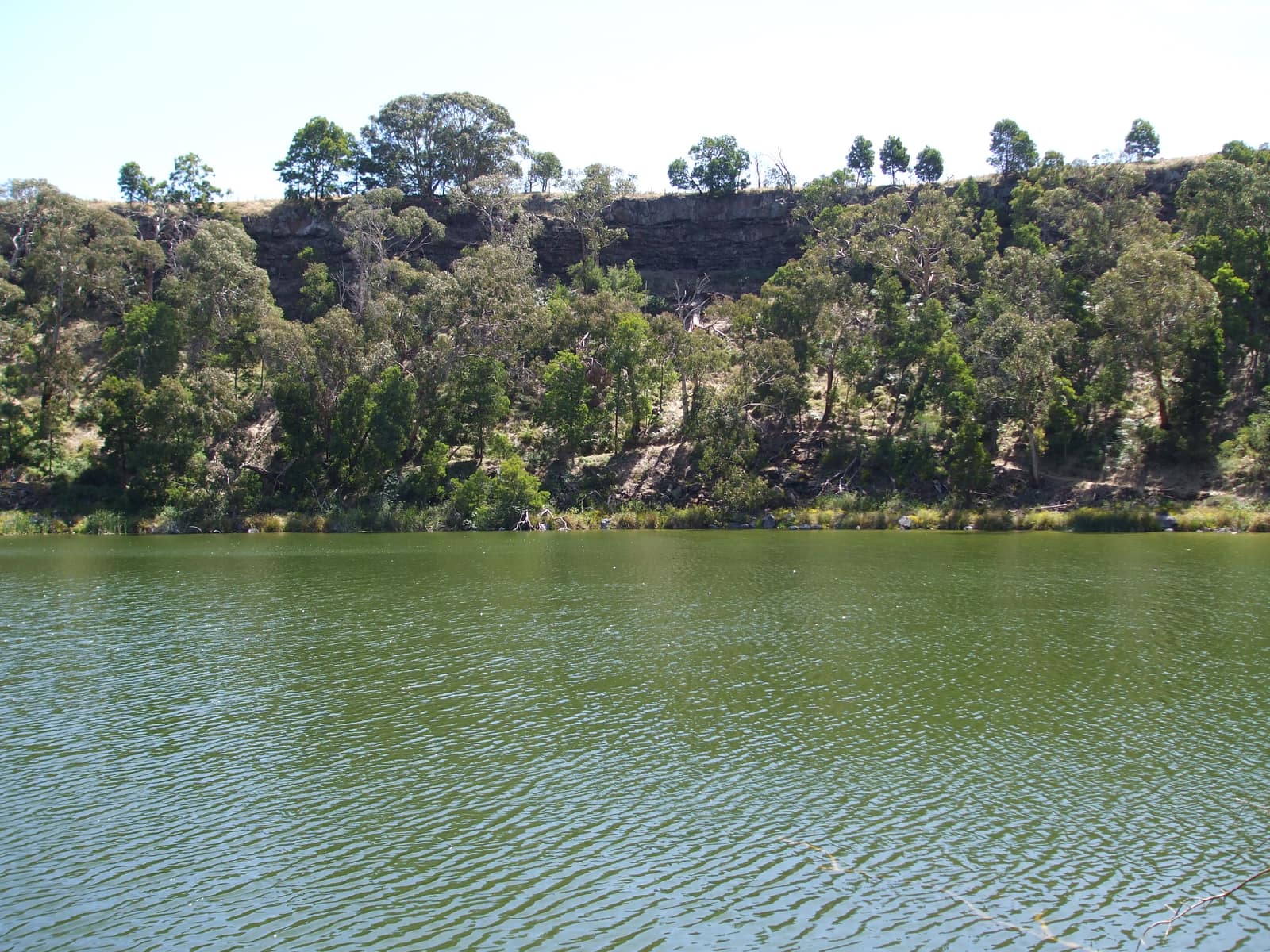

Image veiled by default
Dhx1, CC0, via Wikimedia CommonsCC0-1.0Original record
Data saver is on. Images load only when you ask. You can change this in Settings at any time.
From the archivist
The land here was made by fire. When the volcano the Gunditjmara call Budj Bim erupted, lava ran for tens of kilometres towards the sea and cooled into a broken plain of basalt, full of hollows where water gathered.
Every year, eels moved through these waters. The Gunditjmara learned their seasons and built for them. They cut channels into the hard rock, moved stones into walls and weirs, and shaped ponds where the kooyang could be held and grown. Woven baskets, long and narrow, were set into gaps in the weirs. The oldest channel so far dated was dug at least six thousand six hundred years ago.
The harvest could be smoked, stored and traded. People lived nearby in houses with stone walls.
After the colonists came, the land was taken and the lake was drained. The Gunditjmara never stopped speaking for it. They won it back, returned the water in 2010, and in 2019 saw it listed among the heritage of the world. The eels are coming back.
Established
- The Budj Bim Cultural Landscape was inscribed on the UNESCO World Heritage List in July 2019, the first place in Australia listed solely for its Aboriginal cultural values (Parks Victoria).
- Along the Budj Bim lava flow, Gunditjmara built weirs, holding and growing ponds and stone channels, some hundreds of metres long, to trap, store and harvest kooyang, the short-finned eel (Parks Victoria).
- Sediments filling a channel cut into basalt at Lake Condah date its construction to at least about 6,600 years ago (McNiven et al. 2012).
- The volcano Budj Bim erupted about 36,900 years ago, give or take about 3,100 years, producing the lava flow on which the system was built (Matchan et al. 2020).
- Lake Condah, Tae Rak, was drained by works completed in 1954; in 2010 Gunditjmara built a cultural weir that restored water flows to it (Gunditj Mirring).
Interpretation
Gunditjmara tradition tells of an ancestral being revealed in the volcano; some geologists suggest this may preserve a memory of the eruption, which would make it one of the oldest stories known, but that link cannot be proven. The size of the settled communities that the eel harvest supported is also debated.
In 10,000 years
In 10,000 years, will the eels still find their way into channels cut for their ancestors?
Sources (5)
- UNESCO World Heritage Centre. Budj Bim Cultural Landscape (property 1577), inscribed 2019. · whc.unesco.org
- Parks Victoria. UNESCO World Heritage listing for Budj Bim Cultural Landscape. · www.parks.vic.gov.au
- McNiven, I. J., Crouch, J., Richards, T., Gunditj Mirring Traditional Owners Aboriginal Corporation, Dolby, N., Jacobsen, G. Dating Aboriginal stone-walled fishtraps at Lake Condah, southeast Australia. Journal of Archaeological Science 39 (2), 2012, p. 268-286. · doi.org
- Matchan, E. L., Phillips, D., Jourdan, F., Oostingh, K. Early human occupation of southeastern Australia: new insights from 40Ar/39Ar dating of young volcanoes. Geology 48 (4), 2020, p. 390-394. · doi.org
- Gunditj Mirring Traditional Owners Aboriginal Corporation. Lake Condah restoration project. · www.gunditjmirring.com
Related fragments
8200 to 2000 BCE
Kuk Swamp
Near Mount Hagen, Western Highlands Province, Papua New Guinea · Oceania
c. 50,000 years ago
The engravings of Murujuga
Burrup Peninsula and Dampier Archipelago, Pilbara, Western Australia · Oceania