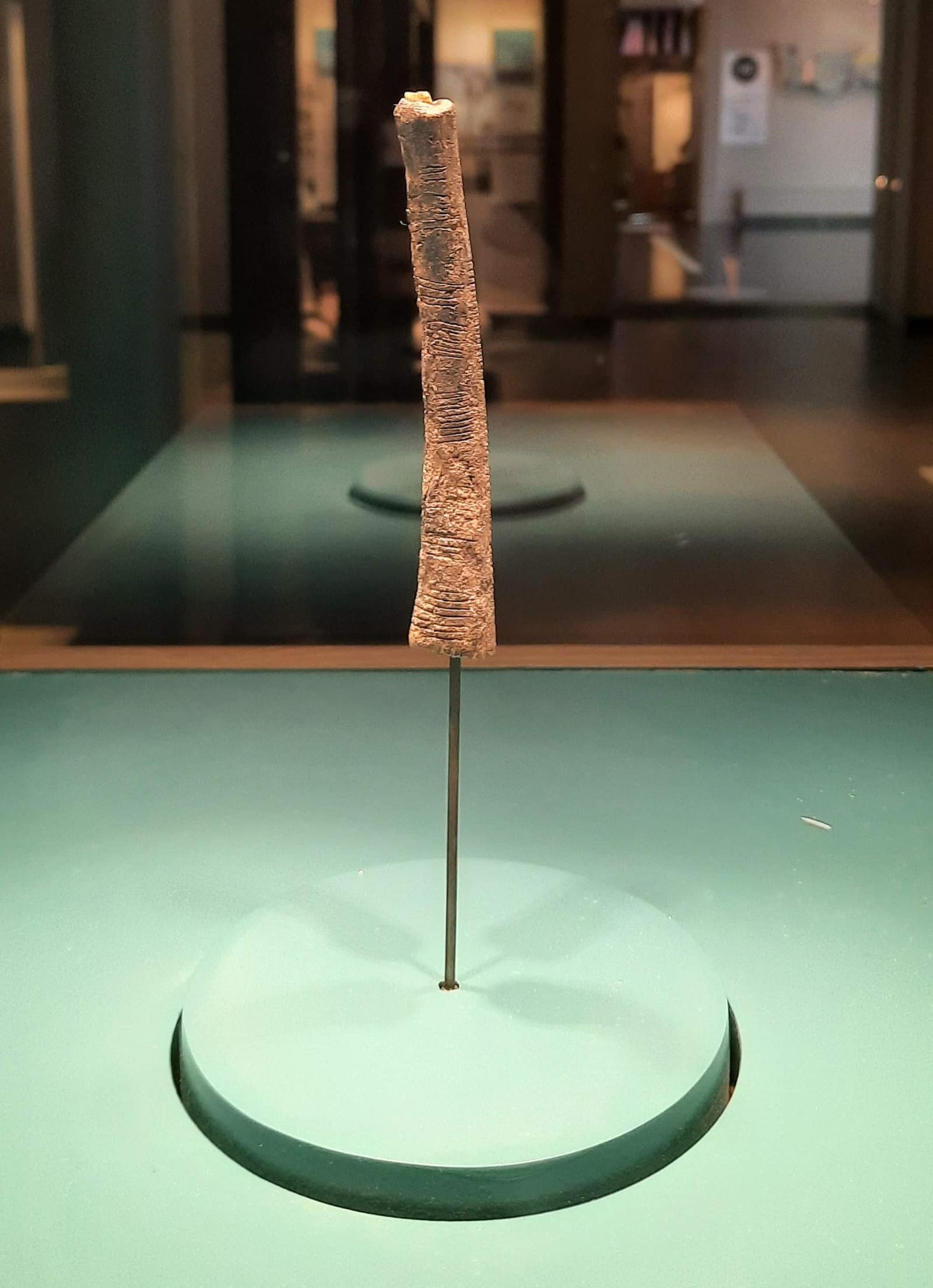
A handaxe from Olduvai Gorge
- Dated
- Place
- Olduvai Gorge, Ngorongoro Conservation Area, Tanzania · Early humans of the Acheulean tradition
- Coordinates
- 2° 59′ S · 35° 21′ E (approximate)
- Remains
- Intact
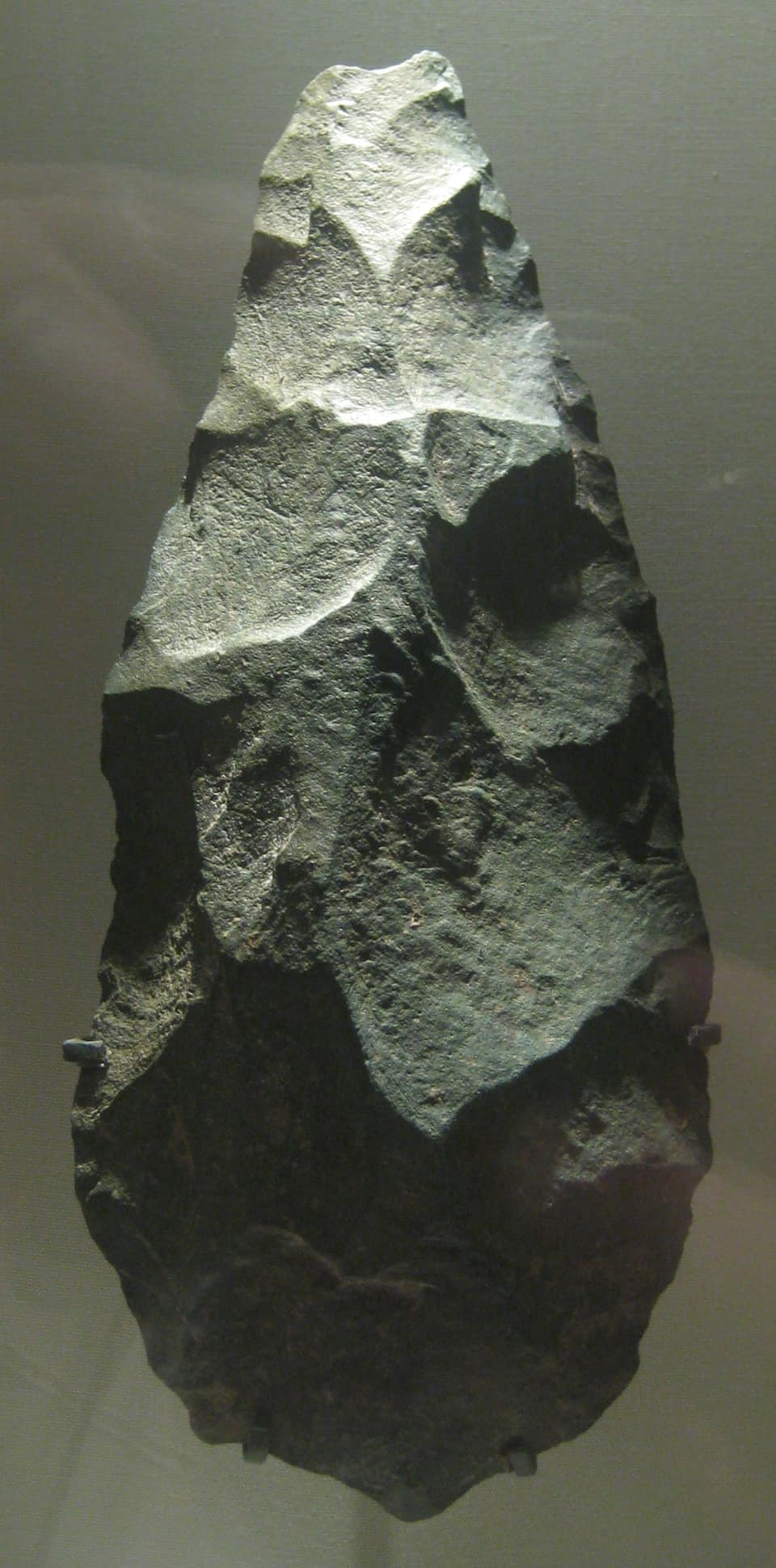
BabelStone, CC0, via Wikimedia CommonsCC0-1.0Original record
Data saver is on. Images load only when you ask. You can change this in Settings at any time.
From the archivist
This civilization began with a stone held in one hand and another stone struck against it. At Olduvai, in the dry country east of Lake Victoria, the gorge cuts down through layer after layer of ash and lake mud, and in those layers lie the flakes and cores of more than a million years of work.
This piece is heavy, about a kilogram of green lava. Someone chose the block, turned it, and struck it again and again from both faces until it narrowed into a long teardrop with a sharp edge all round. Every scar on its surface is a single blow, placed after judging the one before. The maker had a shape in mind before the stone had it.
It could butcher an animal, cut branches, dig. Tools of this kind were made across Africa, then Asia and Europe, for well over a million years, longer than any other object this civilization ever produced.
It was taken from the gorge in the early 1930s by a British expedition, in a Tanganyika under British administration, and has been in London since 1934. Its age has been revised as the dating of the gorge improved. The hand that shaped it was not yet quite ours.
Established
- The handaxe was shaped from a single block of phonolite, a green volcanic lava, and measures 238 by 100 by 50 mm for a weight of about 1 kg (British Museum, 1934,1214.49).
- It was collected at Olduvai Gorge, Tanzania, by the East African Archaeological Expedition led by Louis Leakey, and entered the British Museum in 1934 (British Museum).
- Its published age has changed: the British Museum presented it as 1.2 to 1.4 million years old in A History of the World in 100 Objects (2010), while its 2025 loan documentation gives 850,000 to 400,000 years.
- The Acheulean, the tradition of large flaked tools with a planned, symmetrical shape to which this handaxe belongs, is documented at Olduvai from about 1.7 million years ago (Diez-Martín et al. 2015).
Interpretation
Which human species made this handaxe is not recorded; Acheulean tools in East Africa are usually associated with Homo erectus and its relatives, but no bones were found with this piece. Why its makers pursued a symmetry that the cutting edge did not strictly require is still discussed: a sense of form, a sign of skill, or simply the most efficient way to keep an edge all round.
In 10,000 years
In 10,000 years, which of our tools will still hold an edge?
Sources (4)
- British Museum. Handaxe, Olduvai Gorge, Tanzania, museum number 1934,1214.49, collection online record. · www.britishmuseum.org
- Western Australian Museum and British Museum. A History of the World in 100 Objects, touring exhibition provenance list, 2025 (entry EXH002, Olduvai handaxe, 1934,1214.49). · visit.museum.wa.gov.au
- MacGregor, N. A History of the World in 100 Objects. London, Allen Lane and British Museum, 2010, chapter 3, Olduvai handaxe.
- Diez-Martín, F. et al. The origin of the Acheulean: the 1.7 million-year-old site of FLK West, Olduvai Gorge (Tanzania). Scientific Reports 5, 17839, 2015. · www.nature.com