The Ishango bone
- Dated
- Place
- Ishango, Virunga National Park, North Kivu, Democratic Republic of the Congo · Late Stone Age fishers and gatherers of Ishango, Lake Edward
- Coordinates
- 0° 08′ S · 29° 36′ E (approximate)
- Remains
- Fragmentary
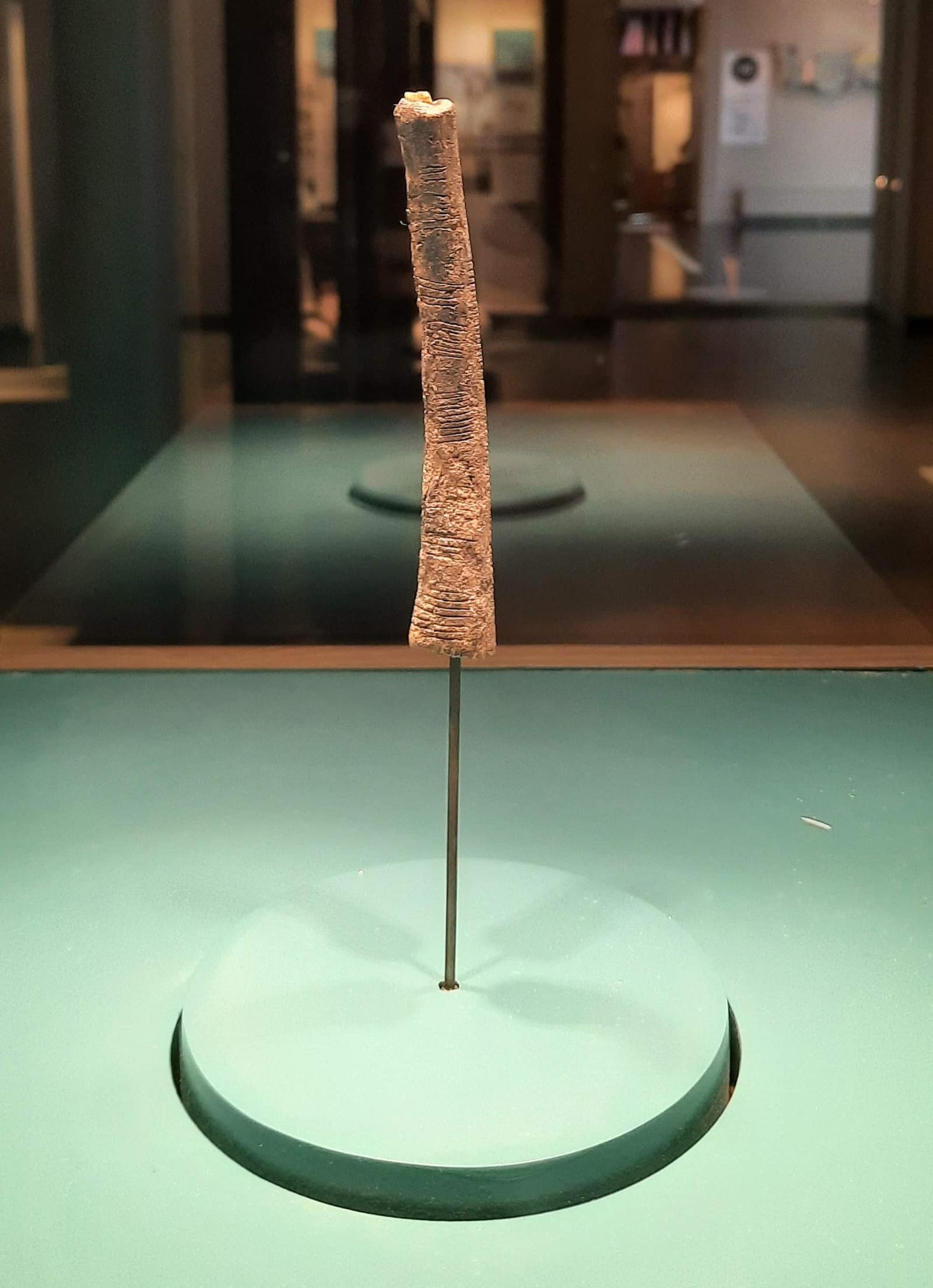

JhowieNitnek, CC BY-SA 4.0, via Wikimedia CommonsCC-BY-SA-4.0Original record
Data saver is on. Images load only when you ask. You can change this in Settings at any time.
From the archivist
This civilization lived by the water. On the shore of Lake Edward, some twenty thousand years ago, people fished, gathered, and made harpoons of bone. One of them took a thin piece of bone, set a chip of quartz at its end, and began to cut.
The cuts are small and deliberate. They run in three columns along the shaft, gathered in groups, as if the hand had paused between each set and started again. Someone was keeping something: a count, a sequence, a record of days. We do not know which. The order of the groups looks intended, and that is almost all that can be said with certainty.
The bone was lifted from the ground in 1950 by a Belgian geologist, in a Congo that Belgium then ruled, and carried to Brussels, where it is still kept. It is barely the length of a finger. It has been called the first mathematical object, and also a tool whose meaning has been overloaded. Both may be true.
What it proves is simpler. Long before writing, a person in the heart of Africa wanted a quantity to last longer than memory, and trusted it to bone.
Established
- Found in 1950 during excavations led by the geologist Jean de Heinzelin on the Congolese shore of Lake Edward, near Ishango (Royal Belgian Institute of Natural Sciences).
- The bone is about 10 cm long and is topped with a fragment of quartz (Royal Belgian Institute of Natural Sciences).
- Its notches are cut in groups along the shaft, arranged in three columns (Royal Belgian Institute of Natural Sciences; Pletser 2012).
- First assigned to the early Holocene, the Ishango levels were redated to the late Pleistocene (Brooks and Smith 1987); the institute now gives an age of nearly 20,000 years.
- Volcanic activity in the region has made radiocarbon dating of the site difficult, so the age remains an estimate (Brooks and Smith 1987).
Interpretation
What the notches meant is not known. One column groups 11, 13, 17 and 19 marks, which some have read as the prime numbers between 10 and 20; others have proposed a lunar calendar, a tally, or a counting aid in base 12 (Pletser 2012). Critics such as Olivier Keller warn against projecting modern arithmetic onto a single engraved bone. The animal the bone came from can no longer be identified with certainty.
In 10,000 years
In 10,000 years, will anyone still know which of our marks were counting?
Sources (4)
- Institute of Natural Sciences (Royal Belgian Institute of Natural Sciences), Brussels. The Ishango bone, exhibition 250 years of natural sciences, online notice. · www.naturalsciences.be
- Brooks, A. S., Smith, C. C. Ishango revisited: new age determinations and cultural interpretations. African Archaeological Review 5, 1987, p. 65-78. · link.springer.com
- Pletser, V. Does the Ishango bone indicate knowledge of the base 12? An interpretation of a prehistoric discovery, the first mathematical tool of humankind. arXiv:1204.1019, 2012. · arxiv.org
- Keller, O. The fables of Ishango, or the irresistible temptation of mathematical fiction. Bibnum, 2010.
Related fragments
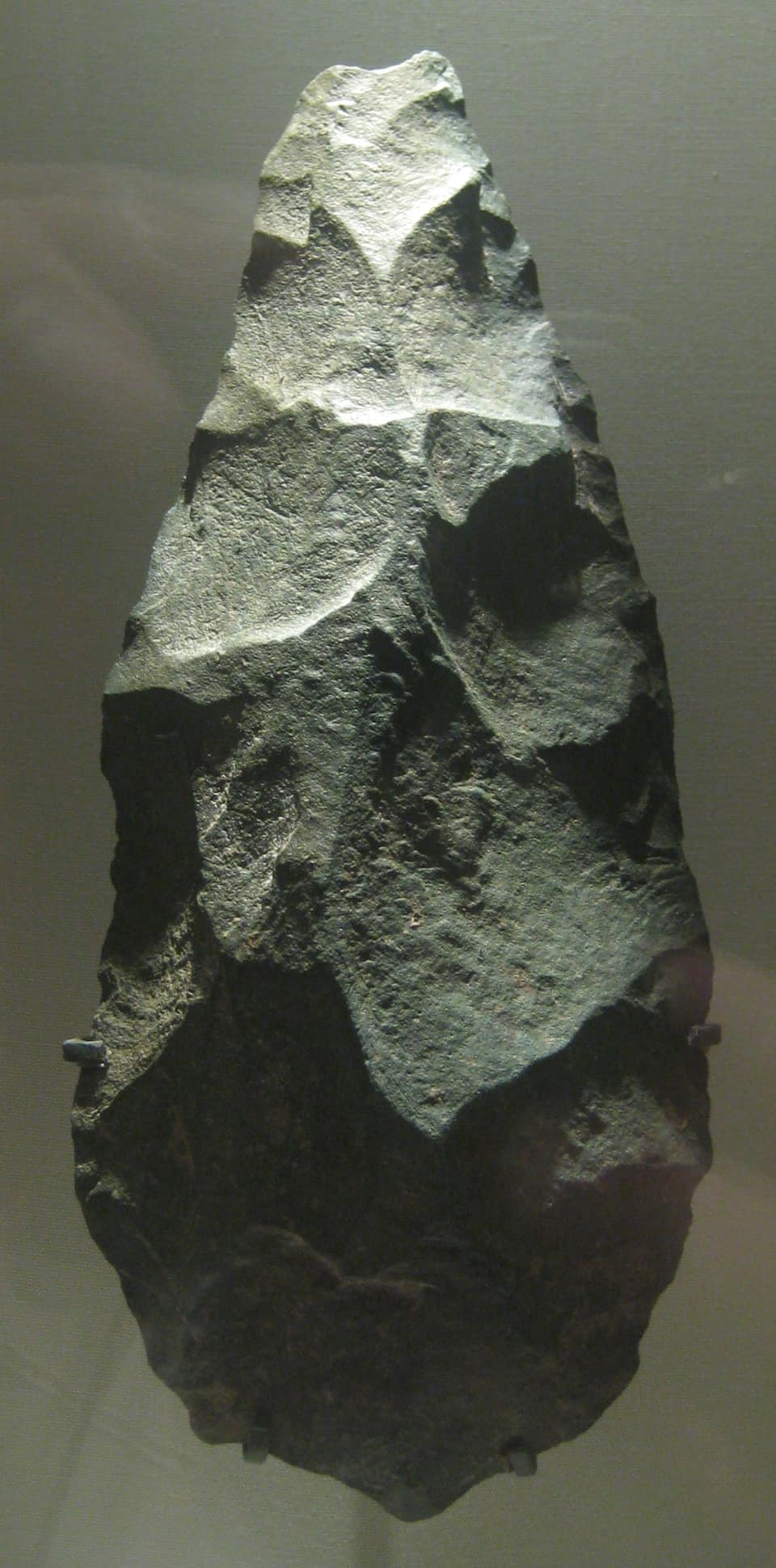
c. 1.4 million years ago
A handaxe from Olduvai Gorge
Olduvai Gorge, Ngorongoro Conservation Area, Tanzania · Africa
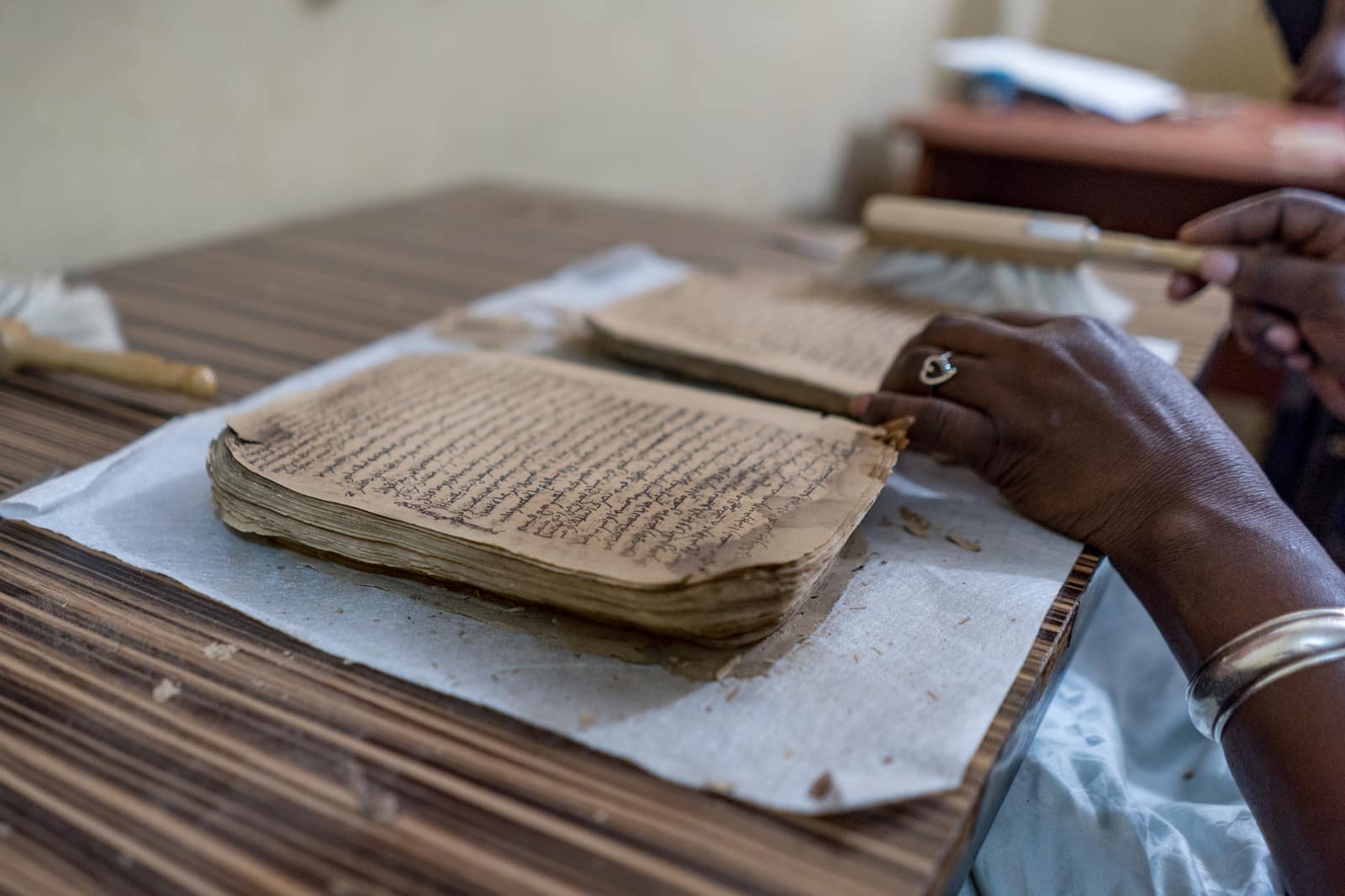
after 1200 CE
The Timbuktu manuscripts
Timbuktu, Mali · Africa