The Edwin Smith Papyrus
- Dated
- Place
- Luxor, Egypt (place of purchase); now in New York, United States · Ancient Egypt, Second Intermediate Period (copy of an older medical text)
- Coordinates
- 25° 41′ N · 32° 38′ E (approximate)
- Remains
- Intact
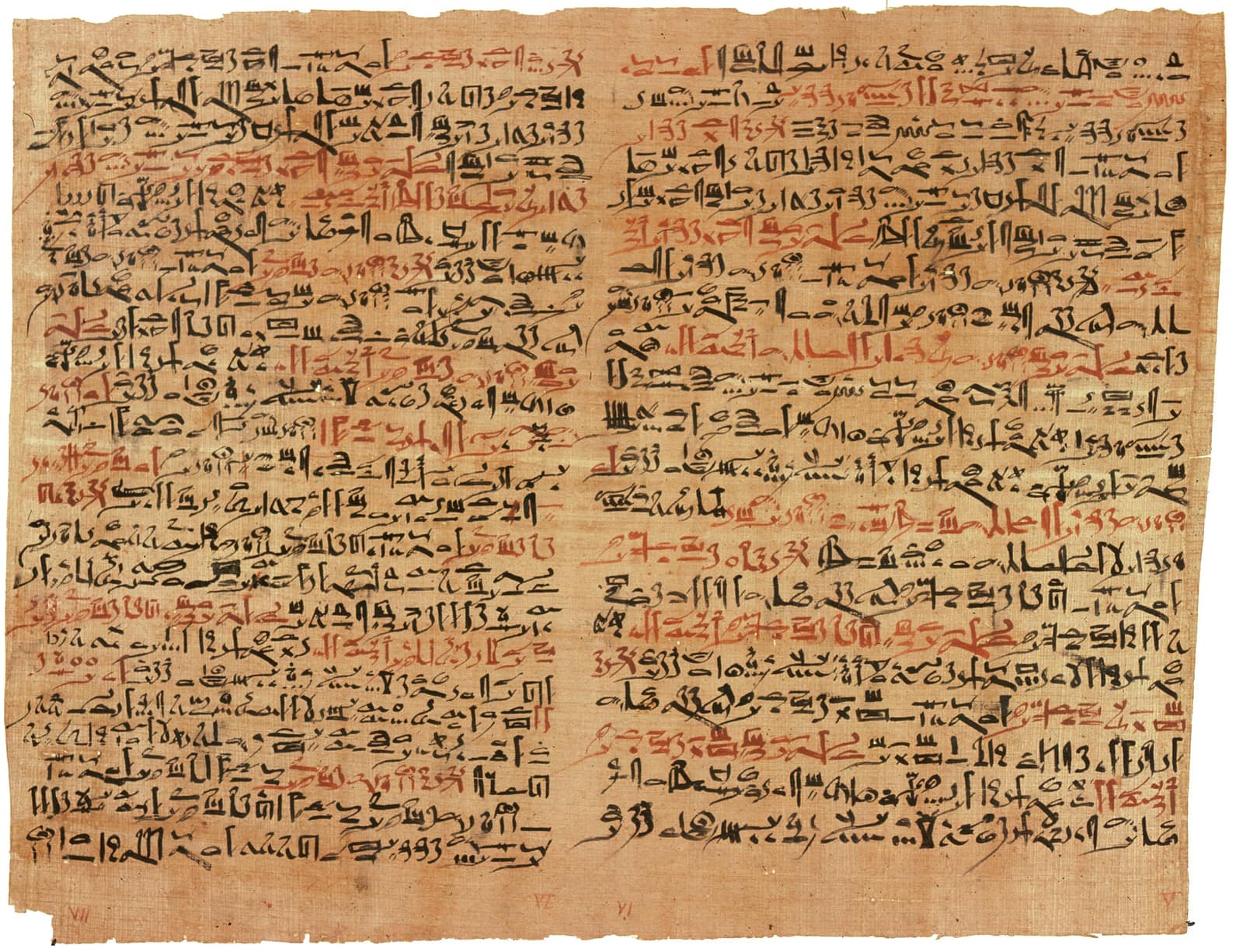
Edwin Smith Papyrus, recto columns 6 and 7, public domain, via Wikimedia CommonsPDMOriginal record
Data saver is on. Images load only when you ask. You can change this in Settings at any time.
From the archivist
Someone in Egypt, about three thousand six hundred years ago, sat with a reed pen and two inks, black and red, and copied a manual for treating wounds. It begins at the top of the head and works downward: the skull, the face, the nose, the jaw, the throat, the collarbone, the shoulder, the spine.
Each case follows the same steps. If you examine a man with a gaping wound in his head, feel it with your fingers; look at what you find; say what it is. Then comes a judgement in three forms: an ailment I will treat, an ailment I will contend with, or an ailment not to be treated. The writer was not afraid to admit what could not be healed.
Here, for the first time in any surviving text, is a word for the brain, described as it appears through a broken skull, and a note that an injury to the head can affect the body far below.
The copyist stopped in the middle of a sentence and never came back. The rest of the roll he left blank.
Established
- The papyrus was written in about 1600 BCE in hieratic, the cursive form of Egyptian hieroglyphic script; it was about 15 feet (4.6 metres) long and held 17 columns of text (New York Academy of Medicine).
- It sets out 48 cases of wounds and trauma, each in the same order: the injury, its examination, a diagnosis, a verdict on whether to treat it, and the treatment (New York Academy of Medicine; Breasted 1930).
- Edwin Smith bought it at Luxor in 1862; it passed to the New-York Historical Society after his death, was lent to the Brooklyn Museum in 1938 and was given to the New York Academy of Medicine in 1948 (New York Academy of Medicine).
- James Henry Breasted of the University of Chicago published the first full facsimile, transliteration and translation in 1930 (Breasted 1930).
Interpretation
Its language suggests that the scribe copied a much older treatise, perhaps from the Old Kingdom, but how old is disputed. It is often called the first work of scientific medicine because it reasons from observation and names cases it cannot cure; others caution that magic and practical care were not separated in Egyptian medicine, and a spell appears on the back of the same roll.
In 10,000 years
In 10,000 years, will our own medicine read as careful observation, or as another set of charms?
Sources (3)
- New York Academy of Medicine Library. Edwin Smith Surgical Papyrus. · nyam.org
- Breasted, J. H. The Edwin Smith Surgical Papyrus, published in facsimile and hieroglyphic transliteration with translation and commentary. 2 vols. Chicago, University of Chicago Press (Oriental Institute Publications 3 and 4), 1930. · catalog.hathitrust.org
- Allen, J. P. The Art of Medicine in Ancient Egypt. New York, The Metropolitan Museum of Art, 2005.