The bells of Marquis Yi: an orchestra buried with a man
- Dated
- Place
- Leigudun, Suizhou, Hubei Province, China · The state of Zeng, Warring States China
- Coordinates
- 31° 43′ N · 113° 20′ E (approximate)
- Remains
- Intact
This fragment shows human remains.
It is shown here as the institution that holds it presents it. Some communities connected to it ask that it be viewed with care. You may choose to see the image, or read the record without it.
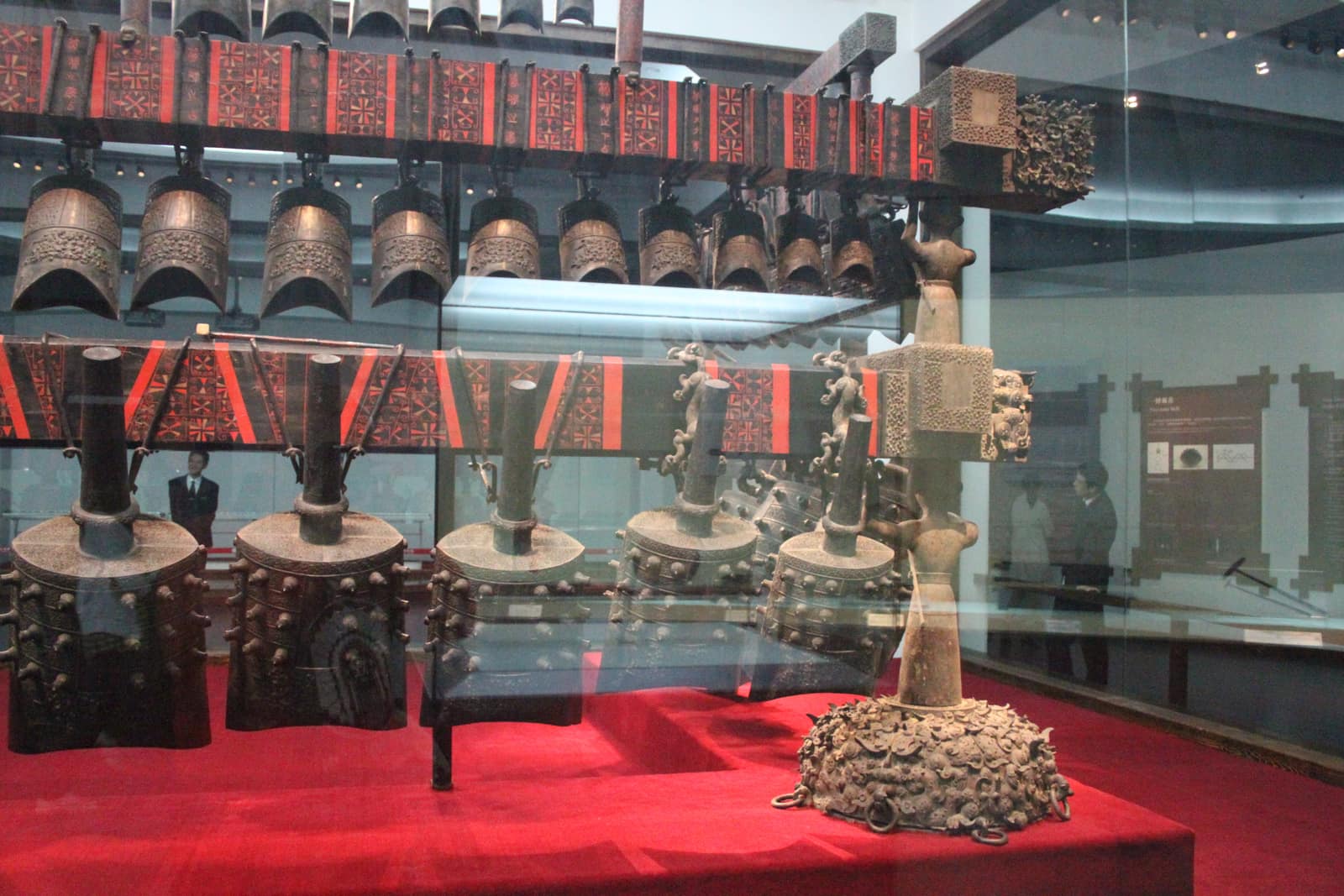
Image veiled by default
Gary Todd, CC0, via Wikimedia CommonsCC0-1.0Original record
Data saver is on. Images load only when you ask. You can change this in Settings at any time.
From the archivist
He wanted music after death. So when Yi, marquis of the small state of Zeng, was buried, around 433 BCE, the bells went down with him: sixty-five of them, hung in tiers on a frame of lacquered wood held up by figures cast in bronze, together with the mallets that struck them and the other instruments of a court orchestra.
Each bell had been cast so that it could sing twice. Struck at the centre it gave one note; struck nearer the side it gave another, a third higher. The founders had found this in the bronze, and they wrote it down, in gold, on the bells themselves: the names of the notes, the way a musician labels the keys.
They buried people too. Twenty-one young women, the youngest thirteen, the oldest twenty-five, lay in their own coffins around him. Some, it is thought, had played these instruments for him while he lived.
Water filled the tomb and kept everything. In 1978 the bells were lifted into the light, and that summer, in a hall in Hubei, someone took up a mallet and struck the first of them. After nearly two thousand four hundred years of silence, it gave both its notes.
Established
- The tomb of Marquis Yi of Zeng, at Leigudun near Suizhou in Hubei, was found in 1977 and excavated from May 1978 (Hubei Provincial Museum; Rossing 1999).
- The set has 65 bells: 19 niu bells, 45 yong bells and one bo bell, the gift of Xiong Zhang, king of Chu; on the evidence of that gift the marquis was buried no earlier than 433 BCE (Hubei Provincial Museum).
- Inscriptions of 3,755 characters in all, inlaid in gold, concern the musical sound of the bells (Hubei Provincial Museum).
- Each bell gives two distinct notes depending on where it is struck; the inscriptions name an interval of a major or a minor third between them (Rossing 1999; Okamoto 2007).
- The tomb filled with water, which preserved its contents (Rossing 1999).
- The set weighs nearly five tonnes; on 1 August 1978 it was played again in a local auditorium, and today a replica is played daily at the Hubei Provincial Museum (Xinhua 2025).
- Eight young women were buried in the eastern chamber with the marquis's coffin and thirteen more in the western chamber; all were between 13 and 25 years old (University of Washington, Visual Sourcebook of Chinese Civilization).
- In 2025 the set was inscribed in UNESCO's Memory of the World Register (Xinhua 2025).
Interpretation
Who the twenty-one women were is debated: some accounts take the eight buried beside the marquis to be his consorts and the thirteen in the western chamber to be musicians, others read the eight as the musicians who had played for him at court and the thirteen as concubines or servants; nothing written in the tomb settles it. Counts of the set vary between 64 and 65 bells, depending on whether the bo bell given by the king of Chu is included.
Looking ahead
Imagine someone, a thousand years from now, finding the music we loved, unharmed, and playing it again. Would they hear our joy in it, or the price that was paid for it?
Sources (5)
- Hubei Provincial Museum. The Marquis Yi of Zeng: bronze objects, online exhibition on Google Arts and Culture. · artsandculture.google.com
- Okamoto, H. Consonances and arrangement of the Marquis Yi set-bells. Acoustical Science and Technology 28 (5), 2007, p. 343-345. · www.jstage.jst.go.jp
- Rossing, T. D. Acoustics of ancient Chinese bells, lay-language paper 4pAA1, 138th meeting of the Acoustical Society of America, Columbus, Ohio, 4 November 1999. · acoustics.org
- Ebrey, P. B. (ed.). Warring States tomb of Marquis Yi, A Visual Sourcebook of Chinese Civilization, University of Washington (after Suixian Zenghouyi mu, Beijing, Wenwu chubanshe, 1980). · depts.washington.edu
- Xinhua. Across China: China's UNESCO-designated chime bells enrich music history, 25 April 2025 (republished by the Jiangsu Artists portal). · jsmsj.org.cn
Related fragments
c. 43,000 years ago
The bone flute of Geißenklösterle
Near Blaubeuren, Baden-Württemberg, Germany · Europe
c. 1400 BCE
The Hurrian Hymn no. 6
Ras Shamra, near Latakia, Syria · Asia
246 to 210 BCE
The Terracotta Army
Lintong district, Xi'an, Shaanxi, China · Asia
1977
The Golden Record
Voyager 1 · Voyager 2 · Americas