The Hurrian Hymn no. 6
- Dated
- Place
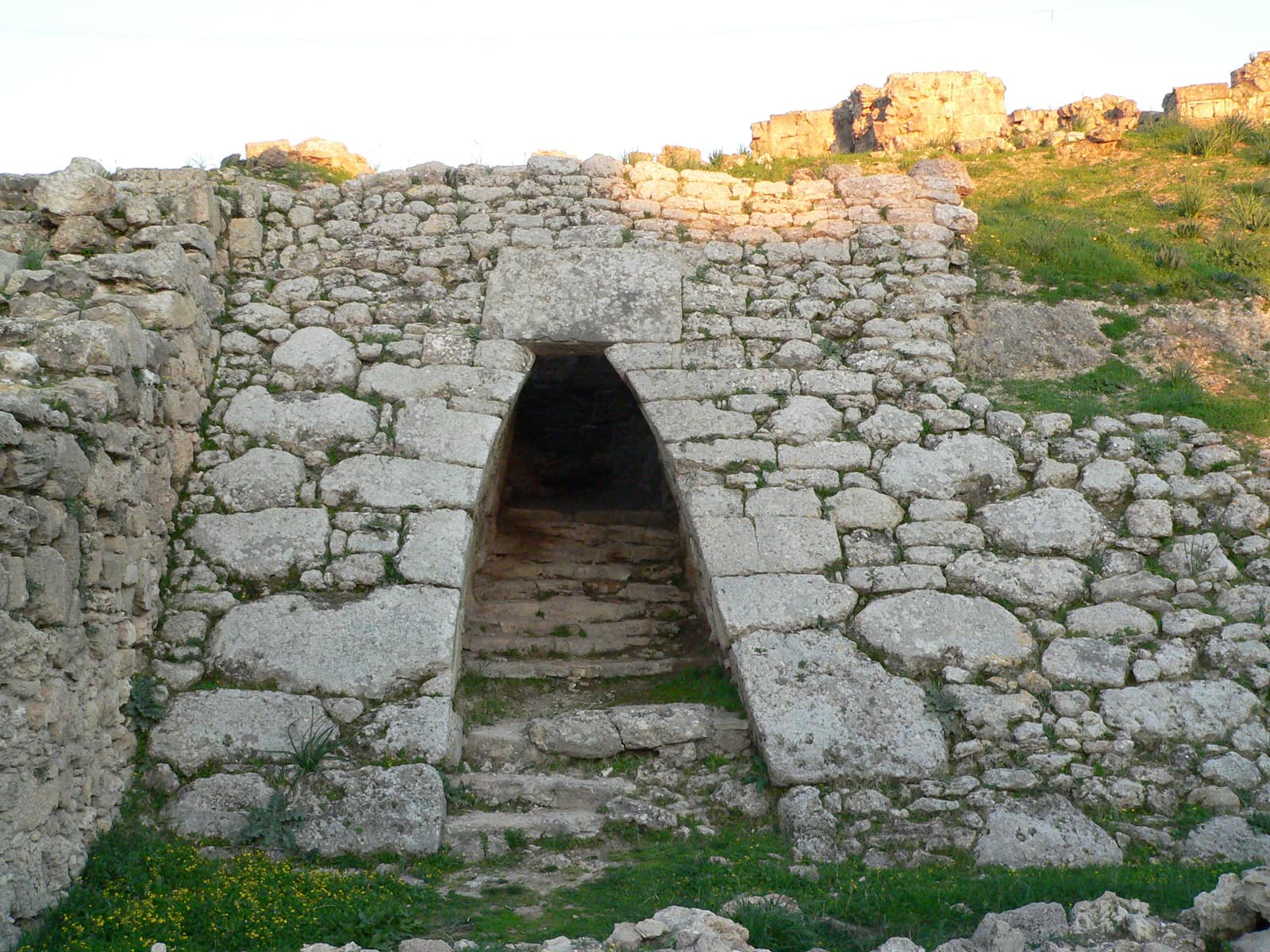
- Ras Shamra, near Latakia, Syria · Hurrian-speaking musicians and scribes of Ugarit, a Late Bronze Age kingdom on the Syrian coast
- Coordinates
- 35° 36′ N · 35° 47′ E (approximate)
- Remains
- Fragmentary
Disdero, CC BY 3.0, via Wikimedia CommonsCC-BY-3.0Original record
Data saver is on. Images load only when you ask. You can change this in Settings at any time.
From the archivist
Someone in this city wanted a song to last longer than a voice. On a small tablet of clay, a scribe wrote the words of a hymn in Hurrian to a goddess called Nikkal. Then, beneath a double line, the scribe added something rarer: the names of intervals for a stringed instrument, each followed by a number, one after another. It is a way of saying how to play.
That was about 1400 BCE, in Ugarit, a trading city on the coast of what is now Syria. The city was destroyed some two centuries later. The tablet broke. Archaeologists found its pieces in the 1950s among thousands of other texts, and a scholar fitted three of them together.
Since then, people have tried to play it. Each reading of the numbers yields a different melody: slow or quick, in one line or two. None can be proved.
It is the oldest song we can nearly read. We hear it, and do not know whether we hear it.
Established
- Clay tablets bearing Hurrian songs with musical notation were excavated in the 1950s at Ras Shamra, ancient Ugarit, in Syria; the only one preserved nearly whole, known as h.6, was reassembled from three fragments, RS 15.30, 15.49 and 17.387 (Laroche 1968).
- The tablet dates to about 1400 BCE and is the oldest substantially complete piece of notated music known (West 1994).
- Above a double ruled line is the text of a hymn in Hurrian addressed to the goddess Nikkal; below it, Akkadian terms for intervals on a stringed instrument, each followed by a number (Laroche 1968; West 1994).
- The interval names follow the Babylonian system for tuning a lyre of nine strings, known from other cuneiform texts (West 1994).
- In 1976 Anne Draffkorn Kilmer, with Richard Crocker and Robert Brown, published a recorded performance of her interpretation on a reconstructed lyre (Kilmer, Crocker and Brown 1976).
Interpretation
Scholars disagree on what the numbers mean: repetitions of each interval, numbers of notes, or durations. Depending on the reading, the melody is sung in two voices or one, in long or short phrases, and several rival transcriptions exist that sound nothing alike. No performance heard today can claim to be the hymn as it sounded.
In 10,000 years
In 10,000 years, if our recordings are lost and only our scores remain, will anyone agree on how we sounded?
Sources (3)
- Laroche, E. Documents en langue hourrite provenant de Ras Shamra. In Nougayrol, J. et al., Ugaritica V, Paris, Imprimerie nationale and Paul Geuthner, 1968, p. 447-544.
- West, M. L. The Babylonian musical notation and the Hurrian melodic texts. Music and Letters 75 (2), 1994, p. 161-179. · doi.org
- Kilmer, A. D., Crocker, R. L., Brown, R. R. Sounds from Silence: Recent Discoveries in Ancient Near Eastern Music. Berkeley, Bit Enki Publications, 1976 (sound recording and booklet).