The Golden Record
- Dated
- Place
- Voyager 1 · Voyager 2 · Humanity, as selected by a NASA committee chaired by Carl Sagan
- Remains
- Intact
NASA/JPLPDMOriginal record
Data saver is on. Images load only when you ask. You can change this in Settings at any time.
From the archivist
If you are holding this, you found it very far from us. It left in 1977, fixed to the side of two spacecraft, Voyager 2 in August and Voyager 1 in September, and it was addressed to no one this civilization knew.
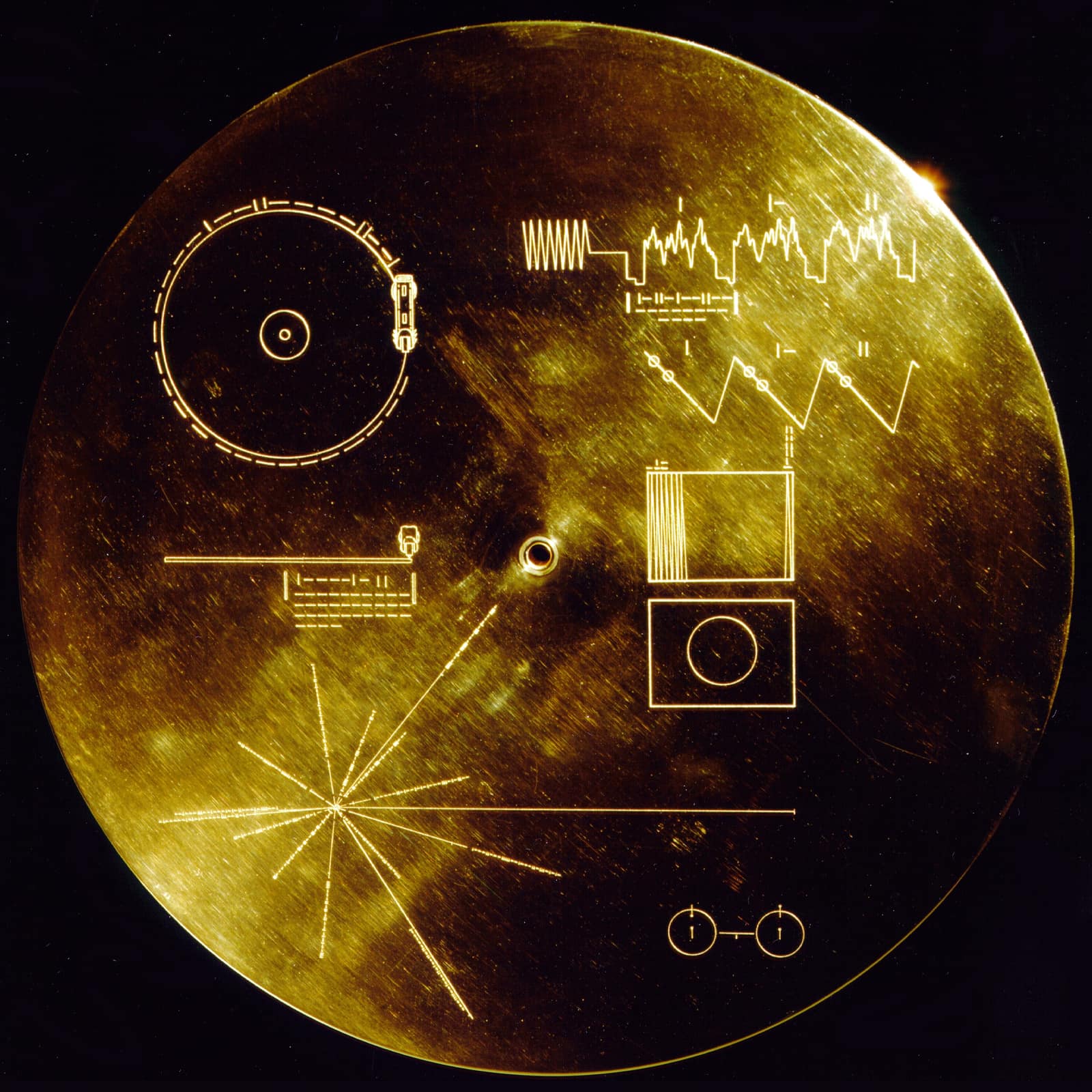
It is a record: a disc of copper plated with gold, a foot across, packed with a cartridge and a needle. The cover is our instruction for use, cut in lines rather than words: how to lower the stylus, how fast to turn the disc, how to rebuild the pictures stored in the grooves, and where our Sun lay, measured against distant pulsars. A trace of uranium was plated onto it so that you could tell how long it had travelled.
Inside are 115 images and one more to calibrate them, greetings in 55 languages, the sound of surf, wind, thunder, birds and whales, and about ninety minutes of music from many peoples and centuries. A small committee led by Carl Sagan chose them.
In 2012 Voyager 1 passed into the space between the stars, and Voyager 2 followed in 2018. We knew how small the chance was that anyone would ever find it. We sent it anyway. That, too, is part of what we were.
Established
- Each Voyager spacecraft carries a 12 inch (30 cm) gold plated copper record in a protective aluminium cover, with a cartridge and a needle (NASA).
- The record holds 115 images plus one for calibration, spoken greetings in 55 languages, natural sounds such as surf, wind, thunder, birds and whales, and about 90 minutes of music from many cultures and eras (NASA).
- The contents were chosen for NASA by a committee chaired by Carl Sagan of Cornell University (NASA).
- The cover shows how to play the record, a pulsar map locating the Sun, and the hydrogen atom as a unit of time; an ultra pure sample of uranium 238, with a half life of 4.51 billion years, is electroplated on it as a clock (NASA).
- Voyager 1 was launched on 5 September 1977 and entered interstellar space on 25 August 2012; Voyager 2 crossed the heliopause on 5 November 2018 (NASA).
Interpretation
The choice of contents has been criticised as reflecting the outlook of a small group of mostly American scientists in 1977, and the chance that any intelligence will ever find and play the record is unknown and generally judged very small; many see it as a message addressed as much to humanity itself.
In 10,000 years
In 10,000 years it will still be falling between the stars; who, if anyone, will know how to play it?
Sources (5)
- NASA Science. Voyager: Golden Record contents. · science.nasa.gov
- NASA Science. Voyager: the Golden Record cover. · science.nasa.gov
- NASA Science. Voyager 1. · science.nasa.gov
- NASA Jet Propulsion Laboratory. NASA's Voyager 2 probe enters interstellar space, 10 December 2018. · www.jpl.nasa.gov
- Sagan, C., Drake, F. D., Druyan, A., Ferris, T., Lomberg, J., Salzman Sagan, L. Murmurs of Earth: The Voyager Interstellar Record. New York, Random House, 1978.