The Pioneer plaque
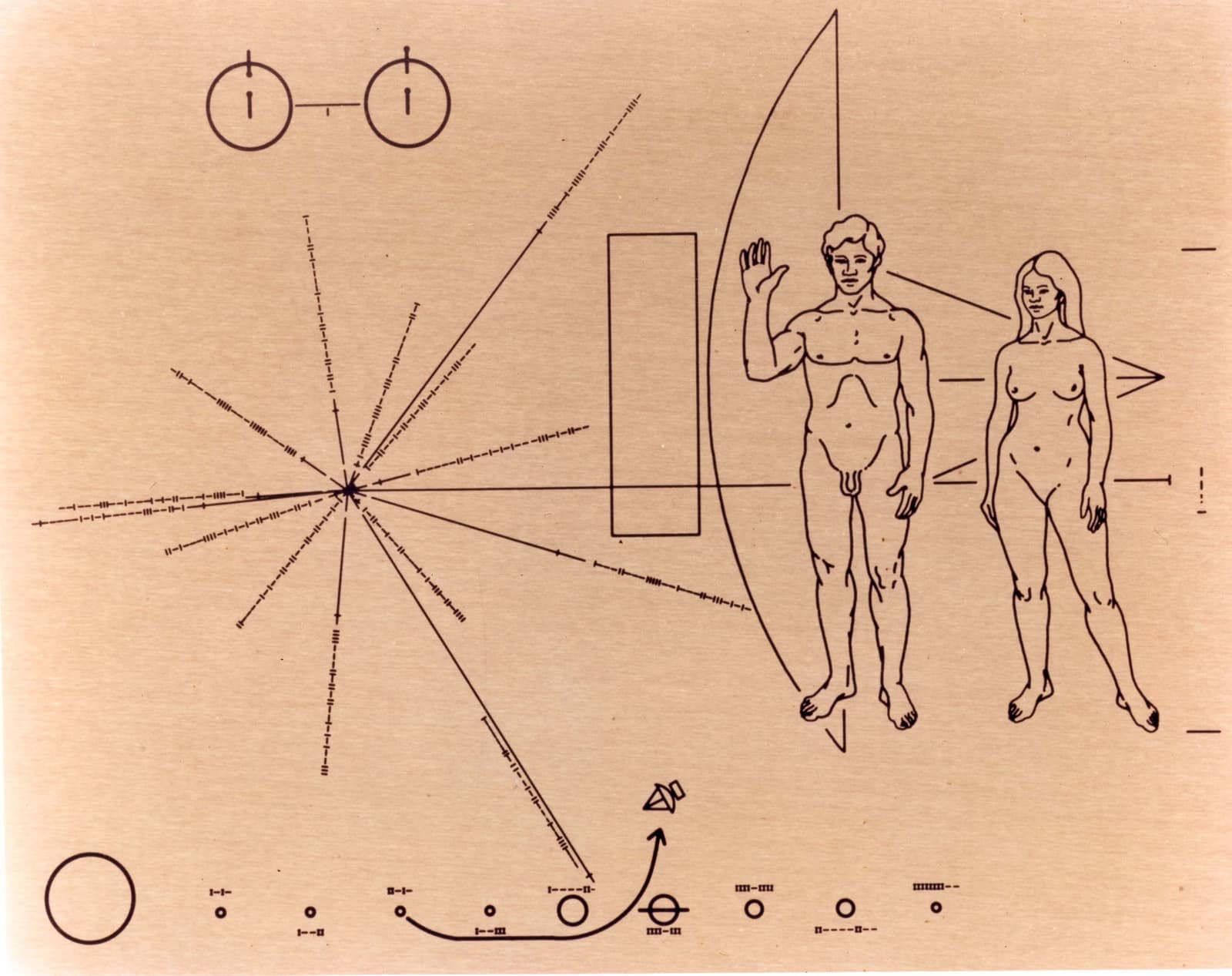
It was the first physical message addressed to possible beings beyond Earth, carried by spacecraft launched on paths out of the solar system.
- Dated
- Place
- Pioneer 10 · Pioneer 11 · Humanity, as drawn for NASA by Carl Sagan, Frank Drake and Linda Salzman Sagan
- Remains
- Intact

NASA Ames Research CenterPDMOriginal record
Data saver is on. Images load only when you ask. You can change this in Settings at any time.
From the archivist
The first letter this civilization sent beyond its own Sun was a drawing, not a word.
It was cut into a small plate of gold coloured aluminium, hardly larger than the page of a book, and fixed to two spacecraft: Pioneer 10, which left for Jupiter in March 1972, and Pioneer 11, which followed in April 1973. Both would leave the solar system for good.
Three people designed it: two astronomers, Carl Sagan and Frank Drake, and an artist, Linda Salzman Sagan. They shared no language with the reader they imagined, so they relied on what they believed any traveller between the stars would know: the hydrogen atom as a ruler and a clock, fourteen pulsars to fix the place of our Sun, a row of planets with a small craft leaving the third.
And, standing before the outline of the craft, a man and a woman, drawn naked, the man with one hand raised. People argued about them for years.
Pioneer 10 last spoke to us in January 2003. The plaques travel on in silence, carrying, for strangers, the first portrait we ever sent of ourselves.
Established
- Pioneer 10 and Pioneer 11 each carry a gold anodised aluminium plaque of 6 by 9 inches (15.2 by 22.9 cm), fixed to the antenna support struts to shield it from erosion by interstellar dust (University of Iowa).
- The plaque was designed by Carl Sagan and Frank Drake, and its artwork was prepared by Linda Salzman Sagan; the three described it in Science in February 1972 (Science; University of Iowa).
- It shows a man and a woman in front of the outline of the spacecraft, the position of the Sun relative to 14 pulsars, the solar system with the craft leaving the third planet, and the hydrogen atom as a unit of length and time (NASA; Science).
- Pioneer 10 was launched on 2 March 1972 and sent its last, very weak signal on 23 January 2003, from some 7.6 billion miles (12.2 billion km) away; it is heading towards the star Aldebaran, which it would take more than two million years to reach (NASA).
- Pioneer 11 was launched in April 1973; NASA ended routine contact with it on 30 September 1995 (NASA).
Interpretation
The drawing was criticised as soon as it was published: some objected to the nudity, others to the fact that only the man raises his hand, and many pointed out that the bodies, the gesture and the arrow showing the craft's path rest on conventions a non human reader might not share. Whether anyone will ever find either plaque is unknown and generally judged very unlikely; like the later Voyager records, many see it as a message addressed as much to humanity itself.
In 10,000 years
In two million years Pioneer 10 will still be drifting towards Aldebaran; will anyone know what a raised hand meant?
Sources (4)
- NASA Science. Pioneer 10. · science.nasa.gov
- NASA Science. Pioneer 11. · science.nasa.gov
- Sagan, C., Salzman Sagan, L., Drake, F. A Message from Earth. Science, vol. 175, no. 4024, 25 February 1972, pp. 881-884. · www.science.org
- University of Iowa, Department of Physics and Astronomy. Pioneers 10 and 11: the plaque. · space.physics.uiowa.edu
Related fragments
1977
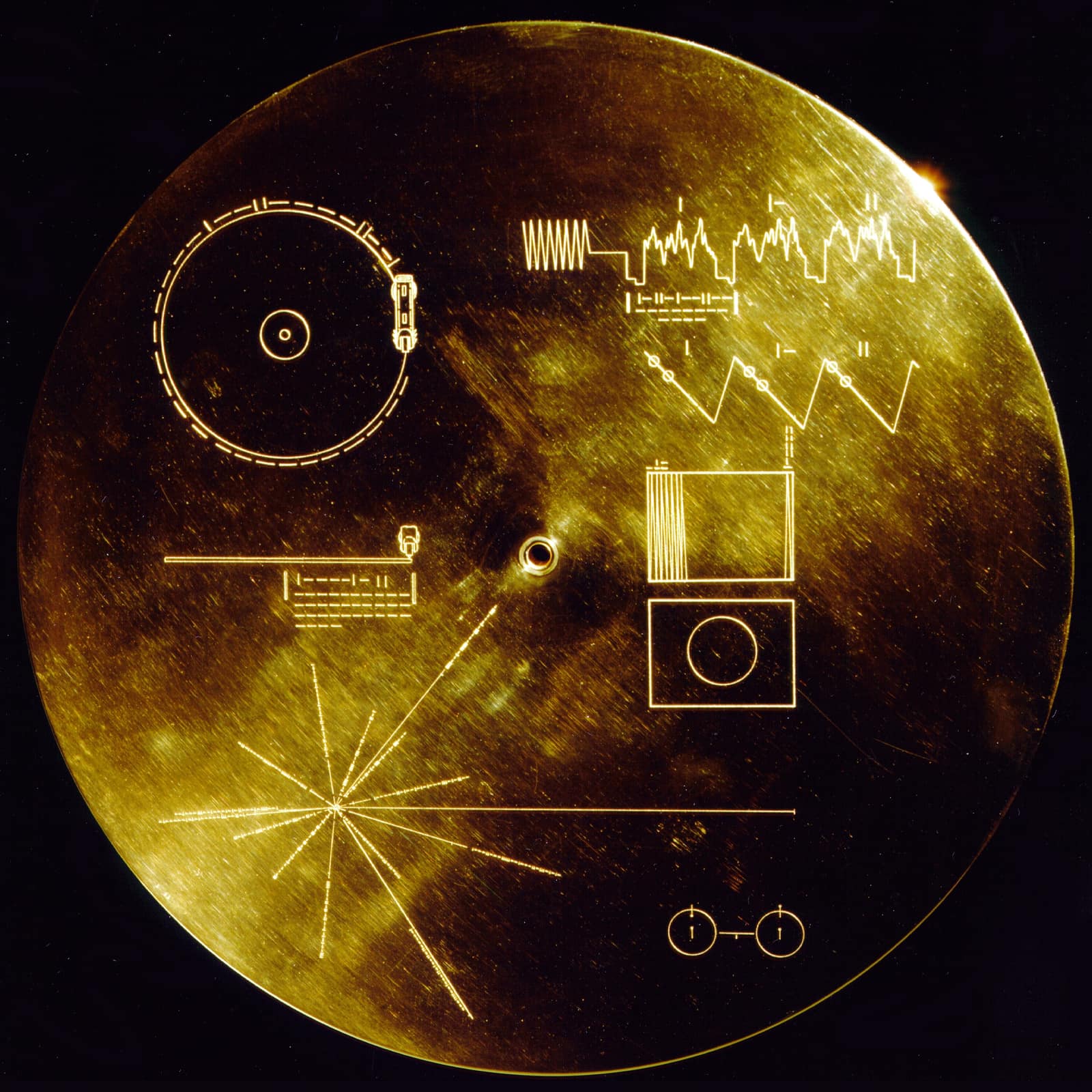
The Golden Record
Voyager 1 · Voyager 2 · Americas
1993
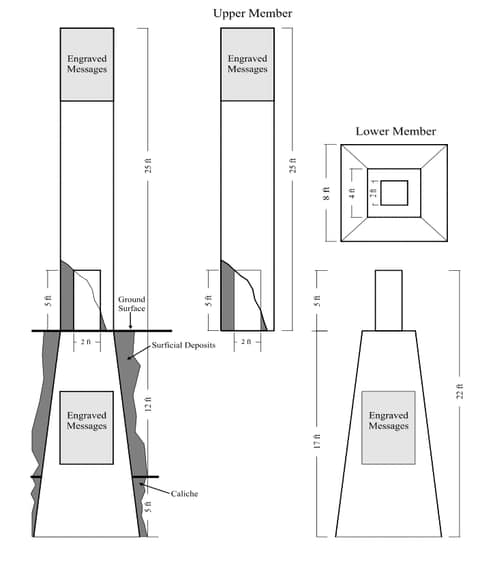
“This place is not a place of honor”
Waste Isolation Pilot Plant, near Carlsbad, New Mexico, United States · Americas
2002 to 2008
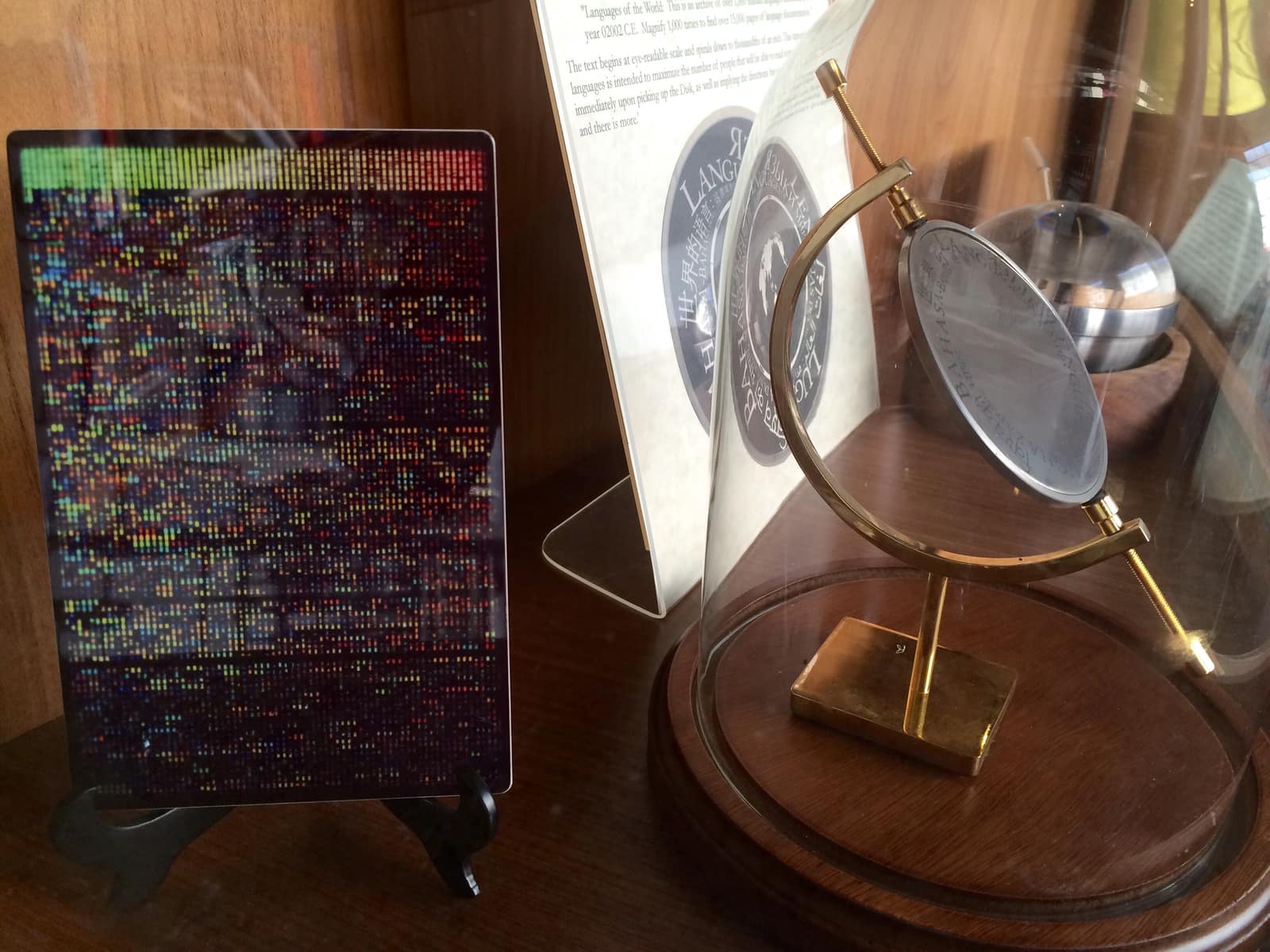
The Rosetta Disk
San Francisco, California, United States · Americas