The Expo '70 time capsules
It turned a time capsule into an experiment across centuries: one twin is to be opened every hundred years to see how its contents age, so that the other can wait five thousand years.
- Dated
- Place
- Osaka Castle Park, Osaka, Japan · Matsushita Electric (today Panasonic) and The Mainichi Newspapers, with the Japanese public and scholars from many countries
- Coordinates
- 34° 41′ N · 135° 32′ E (approximate)
- Remains
- Intact
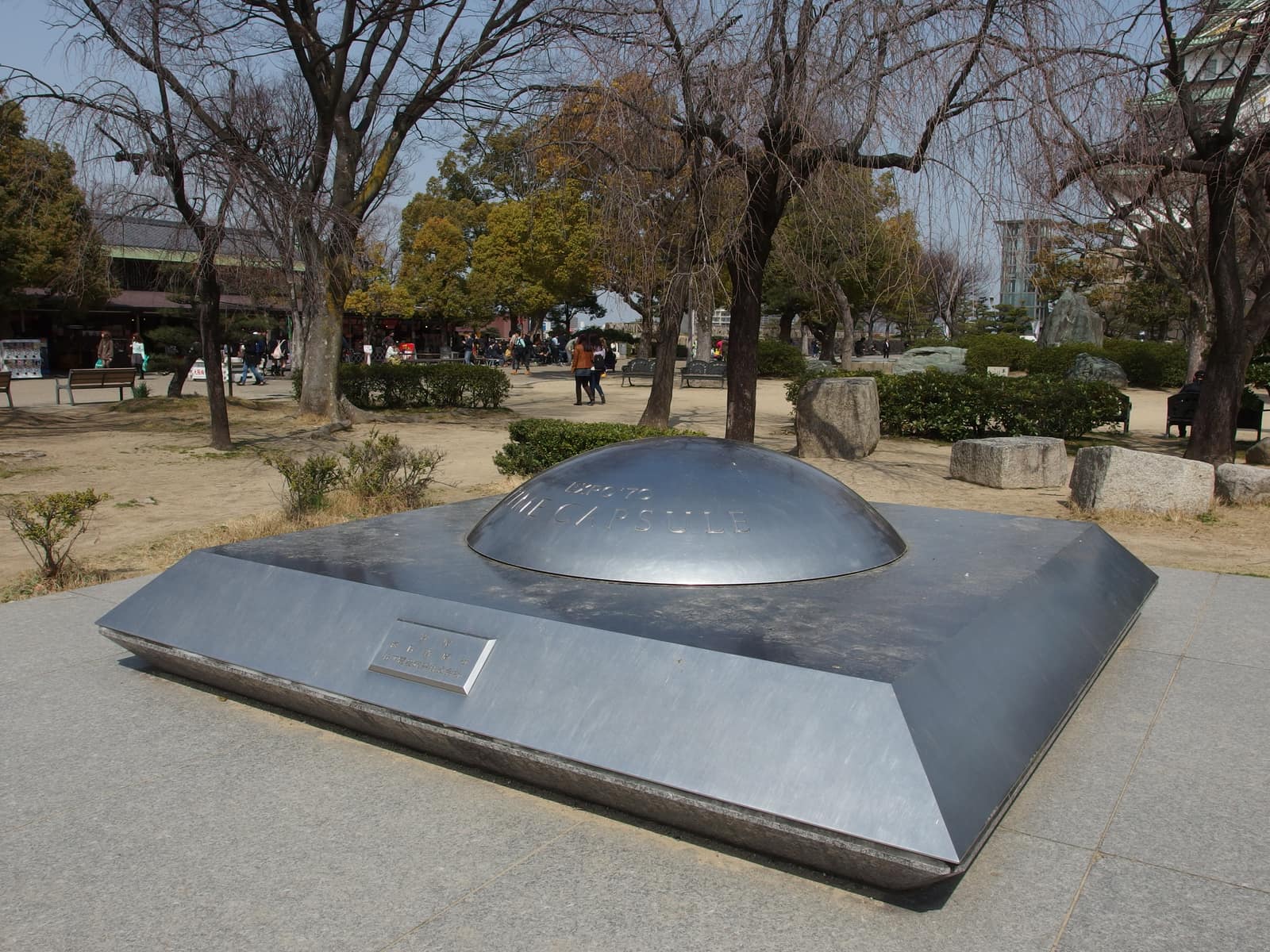
.jpg)
Guilhem Vellut, CC BY 2.0, via Wikimedia CommonsCC-BY-2.0Original record
Data saver is on. Images load only when you ask. You can change this in Settings at any time.
From the archivist
Within eight days in January 1971, two steel capsules went into the ground beside Osaka Castle. They were identical, down to the last object.
Each held 2,098 things chosen to show how people in Japan lived in 1970: works of science, of daily life and of the arts, books, films and recordings, and messages addressed to the people of the year 6970. The year before, some 7.6 million visitors to a company pavilion at the World Exposition in Osaka had filed past them.
The makers did not trust a single sealing. They laid one capsule above the other and left precise instructions, in a steel cylinder under the monument, for whoever came next: open the upper capsule in the year 2000, examine it, reseal it, bury it again, and do the same every hundred years. Leave the lower one closed until 6970. When the languages of the documents grow old, translate them.
In March 2000 the upper capsule was opened for the first time, and closed again. It is waiting for 2100, and for someone who will still remember to come.
Established
- In January 1968 Matsushita Electric (today Panasonic) and The Mainichi Newspapers agreed to prepare a joint time capsule project for the Japan World Exposition, held in Osaka from 15 March to 13 September 1970 (Panasonic).
- Two identical stainless steel capsules each hold 2,098 objects and recorded items in 29 compartments, chosen with the help of the Japanese public and of scientists and scholars from many countries (Panasonic).
- Capsule No. 1 was buried on 20 January 1971 and Capsule No. 2, above it, on 28 January 1971, beside Osaka Castle; the monument was unveiled on 15 March 1971 (Panasonic).
- Instructions sealed in a steel cylinder under the monument set the final opening of both capsules for 6970 CE; Capsule No. 2 is to be opened in 2000 and every hundred years thereafter, examined, resealed and reburied (Panasonic).
- The same instructions ask that the documents be transcribed into contemporary languages when their own become archaic (Panasonic).
- Capsule No. 2 was opened for the first time in March 2000 (Panasonic).
Interpretation
The contents were chosen to show life in Japan in 1970 under the Exposition's theme, Progress and Harmony for Mankind, and so reflect the choices of two large companies and their advisers. Whether a custodial agreement signed in 1971 can be honoured across fifty centuries is unknowable; the project relies on a chain of openings, one per century, to keep its memory alive.
In 10,000 years
In 6970, will anyone be able to switch on the machines of 1970, or will they read them as we read clay?
Sources (4)
- Panasonic Holdings. Time Capsule EXPO '70 (excerpts from The Official Record of Time Capsule EXPO '70, March 1975). · panasonic.net
- Panasonic Holdings. Time Capsule EXPO '70: procedure for unearthing, and chronology of the project. · panasonic.net
- Panasonic Newsroom. Episode 04: Time Capsule Expo '70. · news.panasonic.com
- Panasonic Holdings. Panasonic Group history: 2000. · holdings.panasonic
Related fragments
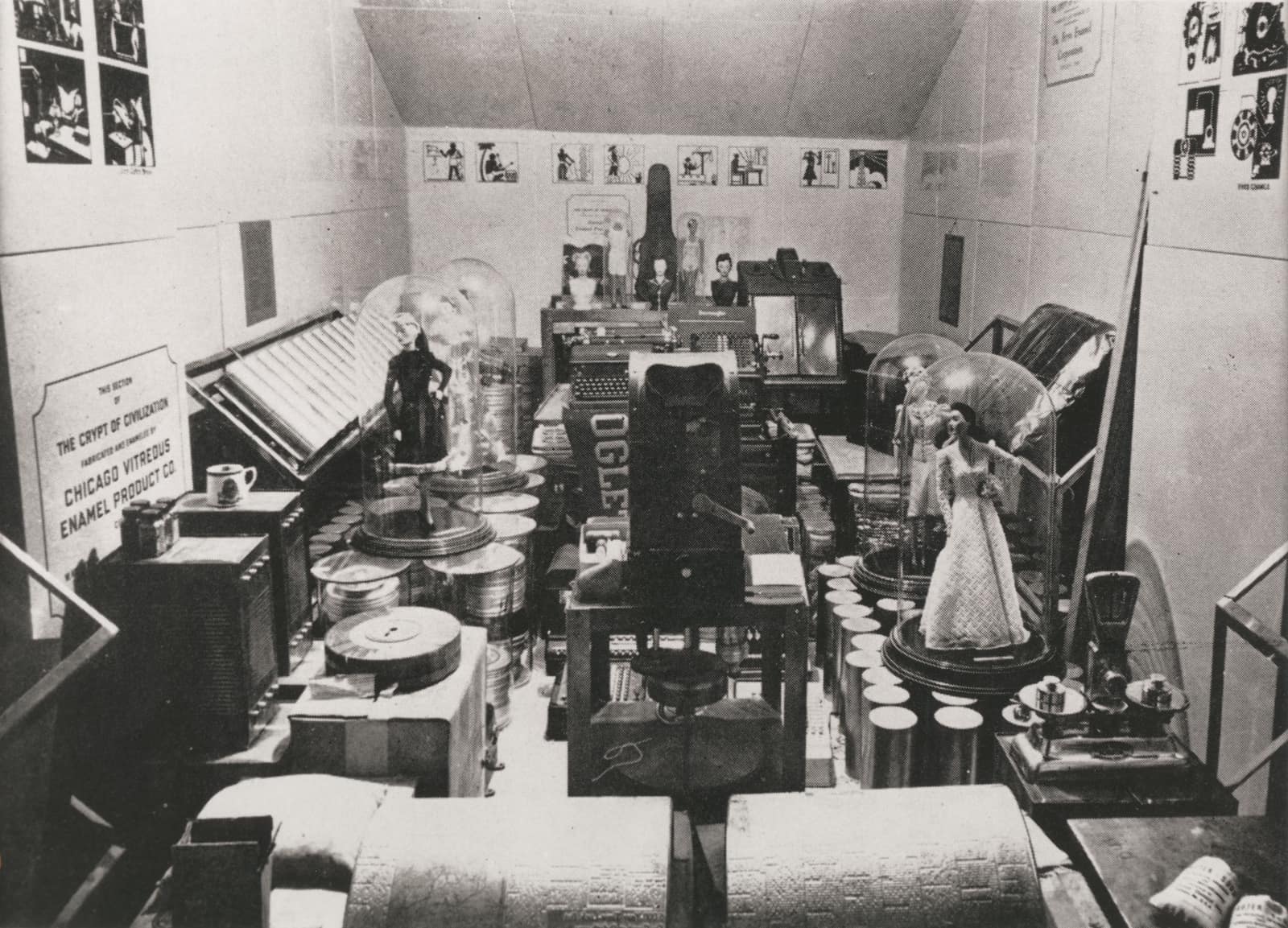
1940
The Crypt of Civilization
Oglethorpe University, Brookhaven, Georgia, United States · Americas
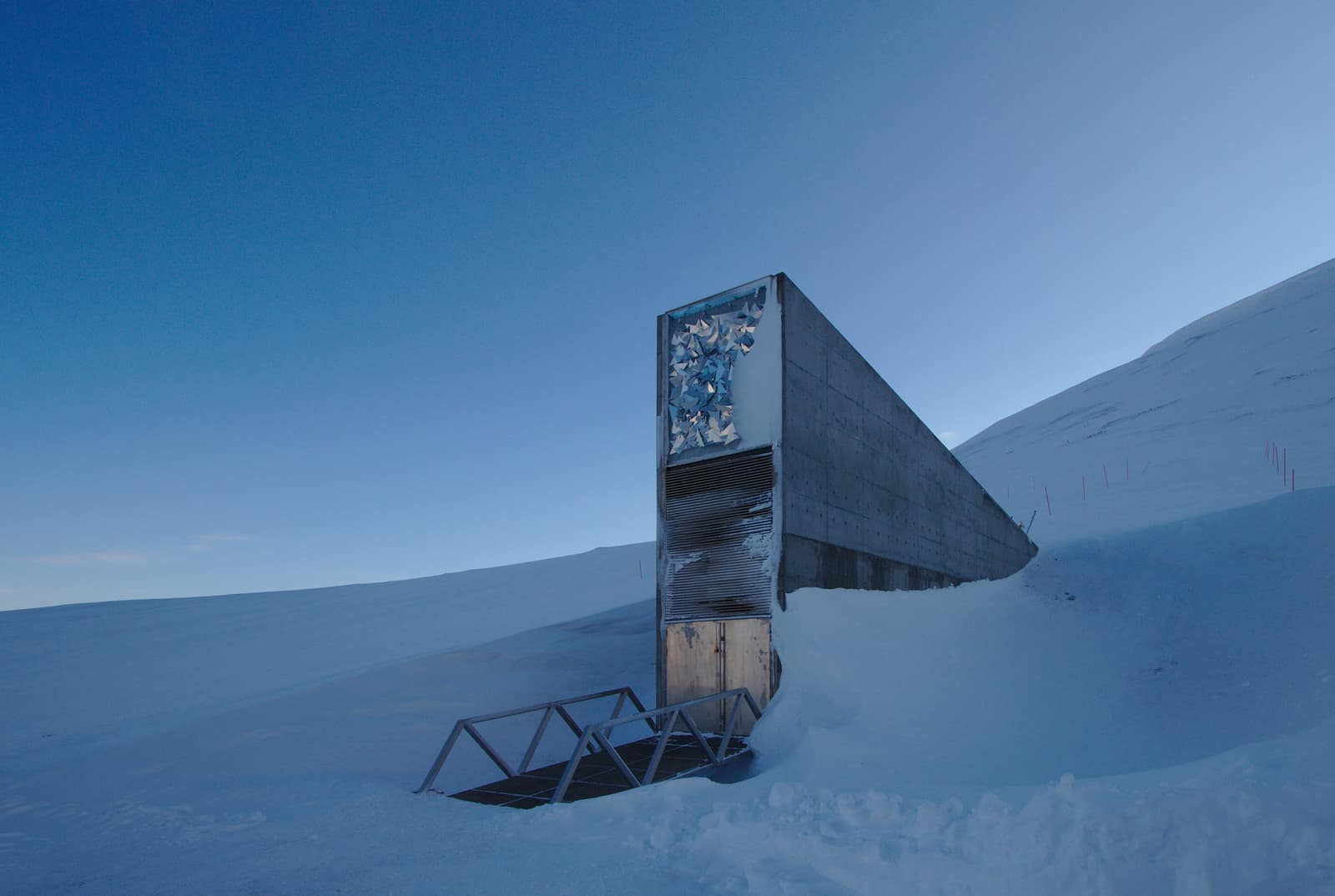
2008
The Svalbard Global Seed Vault
Longyearbyen, Svalbard, Norway · Europe
1994 to 2025
KEO, the satellite that never left
France · Europe