The Svalbard Global Seed Vault
For the first time the world's genebanks shared one common backup, and in 2015 it gave back a collection that war had cut off in Syria.
- Dated
- Place
- Longyearbyen, Svalbard, Norway · The Government of Norway, with the Nordic genebank NordGen, the Crop Trust and genebanks from almost every country
- Coordinates
- 78° 14′ N · 15° 29′ E (approximate)
- Remains
- Intact
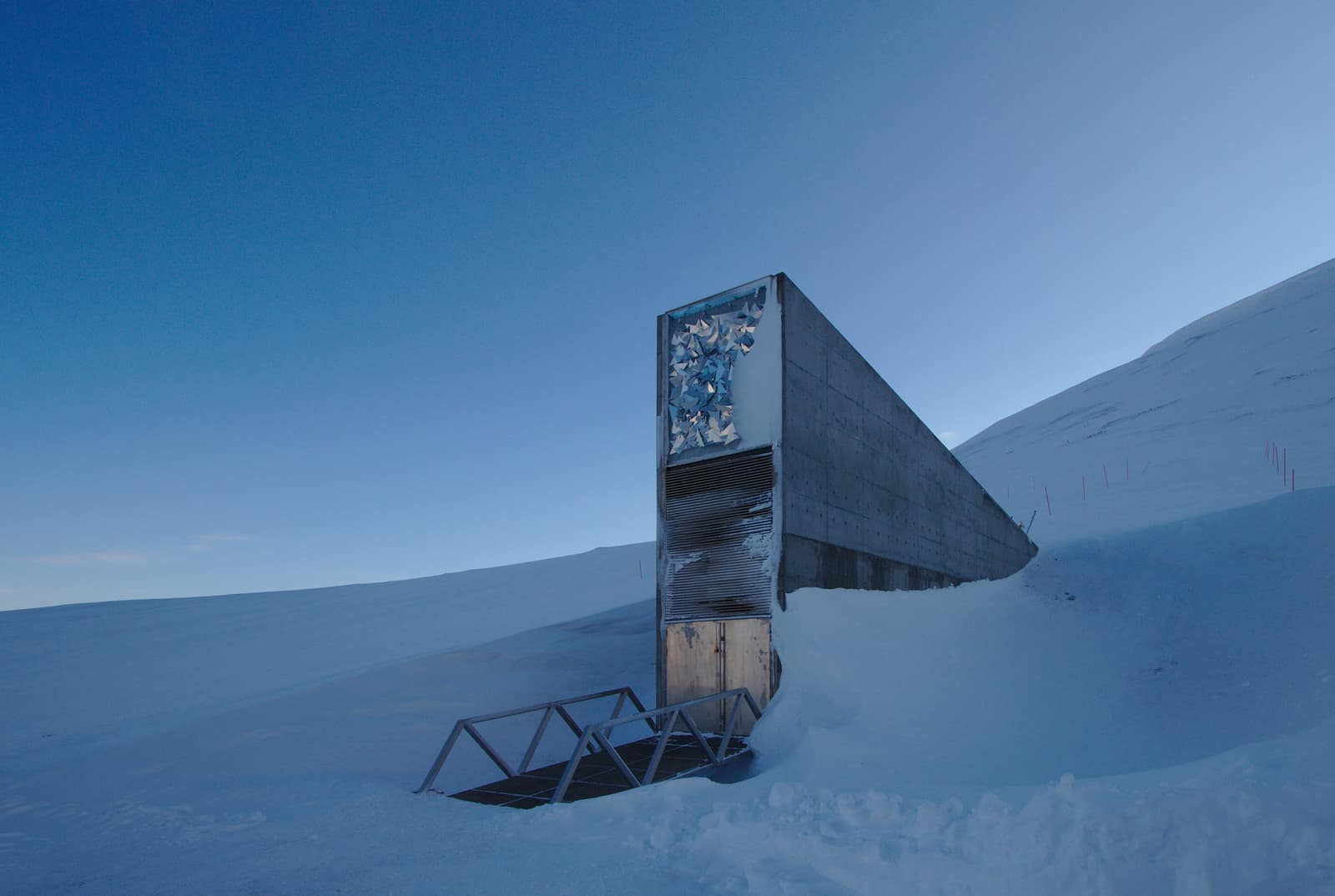

Einar Jørgen Haraldseid, CC BY-SA 2.0, via Wikimedia CommonsCC-BY-SA-2.0Original record
Data saver is on. Images load only when you ask. You can change this in Settings at any time.
From the archivist
Do not look for treasure here. Behind the door in the mountain there are only seeds, in plain boxes on metal shelves.
This civilization lived on plants its farmers had shaped over some ten thousand years, and it kept their varieties in genebanks scattered across the world. Genebanks burn, flood, run out of money, fall into wars. So in 2008 Norway opened a vault in the frozen mountain above Longyearbyen, far north on Svalbard, where any genebank could send a copy of its seeds for free and take it back whenever it needed.
The rooms lie deep in the rock, at eighteen degrees below zero. The seeds belong to those who deposited them; no one else may open their boxes.
In 2015 a research centre that had fled the war in Syria came to Svalbard and withdrew its own seeds, the first ever taken out. It sowed them in Lebanon and Morocco, harvested new seed, and sent copies back to the mountain.
By 2026 more than 1.4 million samples lay there, from almost every country. It was the humblest of our messages: not what we thought, but what we ate.
Established
- The Seed Vault, carved into the rock of a mountain near Longyearbyen, opened on 26 February 2008; its storage area lies more than 100 metres inside the mountain (Svalbard Global Seed Vault).
- The seeds are kept at minus 18 degrees Celsius, in the permafrost; the vault can hold 4.5 million seed samples (NordGen).
- Genebanks deposit duplicates free of charge in sealed boxes that only they may withdraw, and they keep ownership of their seeds (NordGen).
- The vault is run by the Norwegian Ministry of Agriculture and Food with the Nordic genebank NordGen and the Crop Trust (NordGen; Crop Trust).
- In June 2026, after the seventieth deposit since its opening, it held 1,401,285 seed samples (Crop Trust).
- In 2015 the International Center for Agricultural Research in the Dry Areas (ICARDA), forced by the war in Syria to leave its genebank in Aleppo, made the first withdrawal from the vault, to rebuild its collections in Lebanon and Morocco; its third and last withdrawal, in 2019, completed the return of all its Aleppo deposits (Crop Trust; Svalbard Global Seed Vault).
Interpretation
The vault is often called a doomsday vault, but its operators describe it as a backup for the world's genebanks rather than a reserve for the end of the world. How long seeds stay alive at minus 18 degrees varies greatly between species and is still being measured. The vault keeps only the diversity that genebanks have already collected; the knowledge of the farmers who selected these plants is not stored with them.
In 10,000 years
In 10,000 years, will anyone still know how to sow what we kept?
Sources (5)
- Svalbard Global Seed Vault (Norwegian Ministry of Agriculture and Food). About the Seed Vault. · www.seedvault.no
- NordGen. Svalbard Global Seed Vault: frequently asked questions. · www.nordgen.org
- Crop Trust. Svalbard Global Seed Vault crosses major milestone: 1.4 million seed samples secured, 17 June 2026. · www.croptrust.org
- Crop Trust. An international rescue mission from Syria to Svalbard. · www.croptrust.org
- Svalbard Global Seed Vault. Withdrawal of ICARDA Aleppo seeds accomplished, 11 September 2019. · www.seedvault.no
Related fragments
2020
The Arctic Code Vault
Longyearbyen, Svalbard, Norway · Europe
1970 to 1971
The Expo '70 time capsules
Osaka Castle Park, Osaka, Japan · Asia
after 2012
Memory of Mankind
Hallstatt, Upper Austria, Austria · Europe