Memory of Mankind
It answered the fragility of digital memory by returning to the oldest durable medium of writing, fired clay, and opened the archive to anyone willing to write to the future.
- Dated
- Place
- Hallstatt, Upper Austria, Austria · Martin Kunze and the contributors to Memory of Mankind, Hallstatt
- Coordinates
- 47° 34′ N · 13° 38′ E (approximate)
- Remains
- Intact
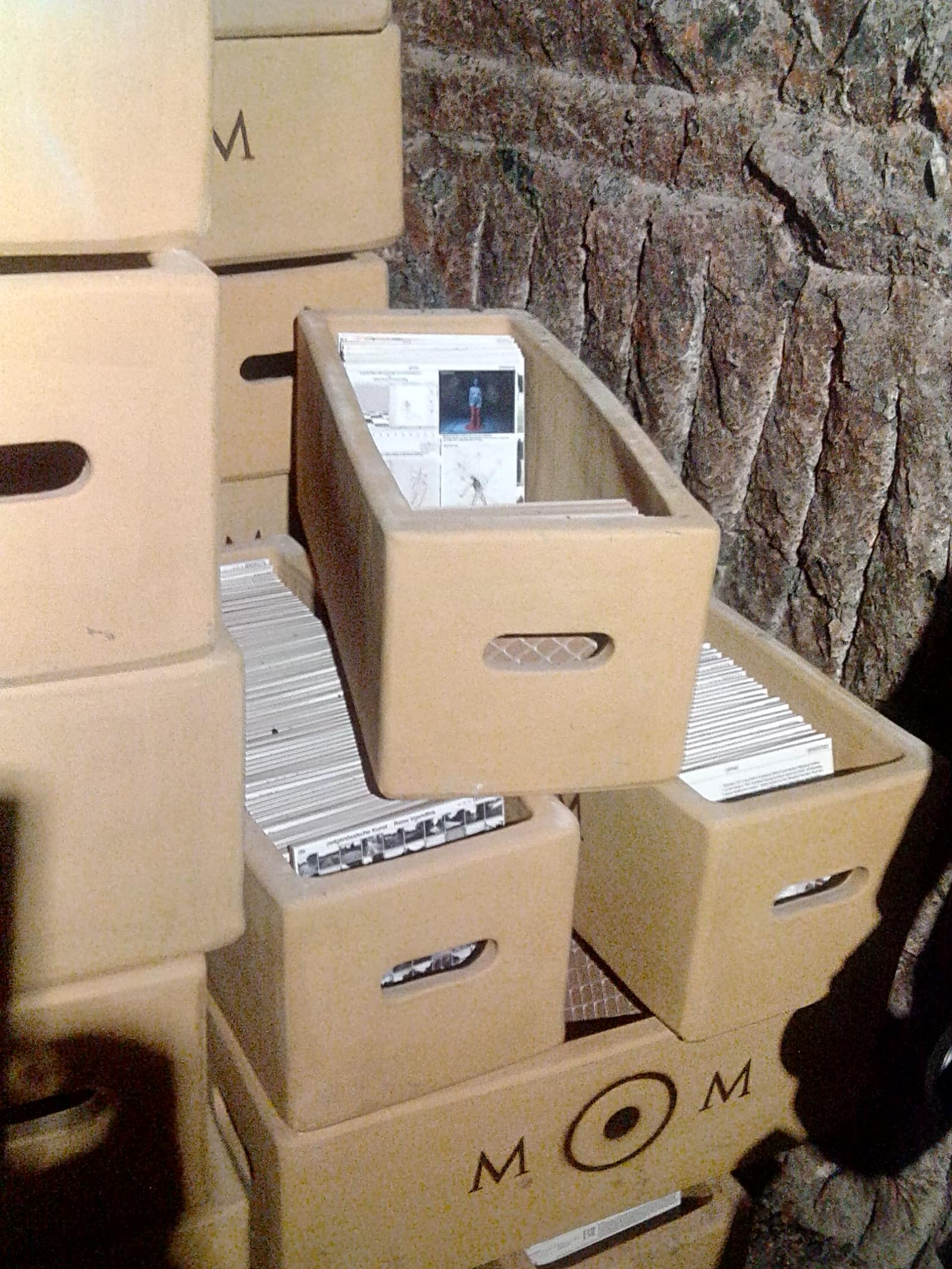

Martin Kunze, CC BY-SA 4.0, via Wikimedia CommonsCC-BY-SA-4.0Original record
Data saver is on. Images load only when you ask. You can change this in Settings at any time.
From the archivist
Some of the first writing this civilization ever made was pressed into clay, and much of it survived because the clay was fired, sometimes by the very blaze that destroyed the city around it.
Five thousand years later, a ceramicist in the Austrian Alps took the lesson literally. From 2012 Martin Kunze began to fire texts and pictures onto square ceramic tablets, twenty centimetres a side: some printed in colour, others covered with lines of writing so small that a lens is needed to read them. Once glazed and fired, they fear neither water nor fire nor acid.
He chose to keep them in the salt mine above Hallstatt, a mountain people have worked for salt since prehistory. Salt dries the air and slowly closes its own cracks.
Anyone may send a text: a family story, a trade, a regret. Institutions have taken an interest too, among them those charged with nuclear waste, which must warn a very distant future.
So that the way to the archive is not forgotten, small clay tokens bearing a map are meant to pass from grandparents to grandchildren, and their keepers to meet every fifty years.
Established
- Memory of Mankind was launched in 2012 by the Austrian ceramicist Martin Kunze, in Hallstatt (American Ceramic Society).
- Texts and images are fired onto ceramic tablets 20 cm square; a ceramic microfilm version carries text small enough to need a tenfold magnifier, and the glaze resists water, acids and very high temperatures (American Ceramic Society; Memory of Mankind).
- The tablets, packed in ceramic boxes, are stored in the salt mine of Hallstatt, within the Hallstatt Dachstein Salzkammergut UNESCO World Heritage property (Memory of Mankind).
- In September 2013 Martin Kunze presented the project to the OECD Nuclear Energy Agency's group on preserving the records, knowledge and memory of radioactive waste repositories across generations (OECD NEA).
- Small ceramic tokens bearing a map to the archive are meant to be handed down within families, and their holders are invited to gather every fifty years, starting in 2070 (Memory of Mankind; American Ceramic Society).
Interpretation
The project's hope that its tablets will stay legible for hundreds of thousands of years, or even a million, rests on the known durability of fired clay and on laboratory tests, not on experience. Its contents are gathered from the bottom up, from whoever takes part, and so reflect those who hear of it and can contribute. Figures given for the capacity of a tablet and for the position of the archive inside the mountain vary between sources.
In 10,000 years
In a million years, will salt and clay have kept our words better than our machines?
Sources (3)
- OECD Nuclear Energy Agency, Radioactive Waste Management Committee. Progress report of the initiative on the Preservation of Records, Knowledge and Memory (RK&M) across Generations, March 2013 to March 2014. NEA/RWM/RKM(2014)8, 2015. · www.oecd-nea.org
- Memory of Mankind. About MOM. · www.memory-of-mankind.com
- The American Ceramic Society, Ceramic Tech Today. Ceramic tablets may help preserve the world's knowledge for future generations, 16 June 2023. · ceramics.org
Related fragments
2020
The Arctic Code Vault
Longyearbyen, Svalbard, Norway · Europe
1940
The Crypt of Civilization
Oglethorpe University, Brookhaven, Georgia, United States · Americas
1993
“This place is not a place of honor”
Waste Isolation Pilot Plant, near Carlsbad, New Mexico, United States · Americas