Plastiglomerate from Kamilo Beach: a stone of our own making
Before the middle of the twentieth century there was no plastic to be caught in stone; by 2014 geologists had described a rock partly made of it and proposed it as a marker of this civilization's layer in the rock record.
- Dated
- Place
- Kamilo Beach, Hawai'i Island, Hawaii, United States · The plastic age: debris from all around the North Pacific, fused by beach fires on the island of Hawai'i; described by the geologist Patricia Corcoran, the oceanographer Charles Moore and the artist Kelly Jazvac
- Coordinates
- 18° 58′ N · 155° 36′ W (approximate)
- Remains
- Intact

Aaikevanoord, CC BY-SA 4.0, via Wikimedia CommonsCC-BY-SA-4.0Original record
Data saver is on. Images load only when you ask. You can change this in Settings at any time.
From the archivist
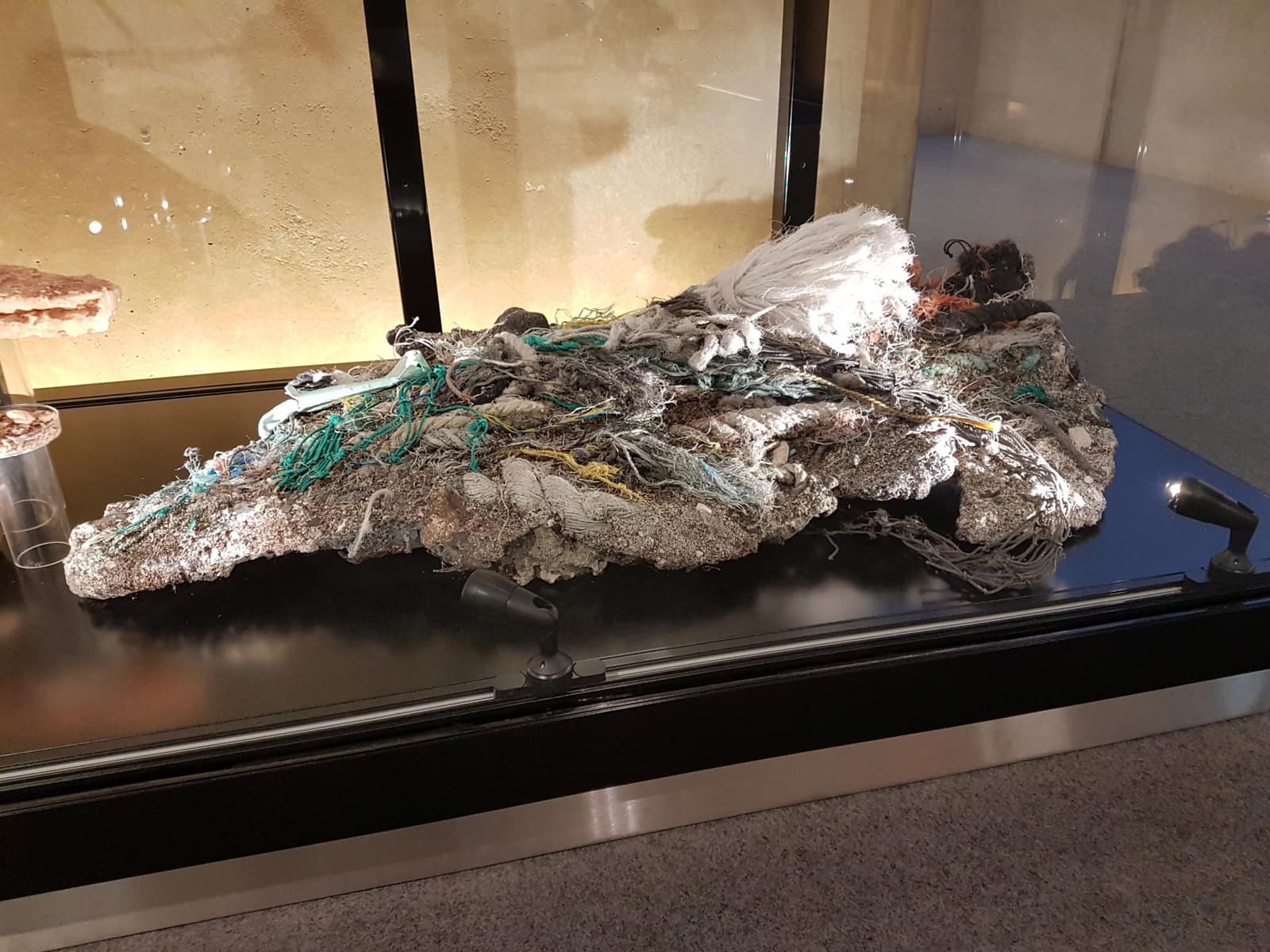
It looks, at first, like a stone that has been badly cleaned. Then the eye finds the threads: green, blue, yellow, the fibres of rope and fishing net, sealed into a crust of sand and black volcanic grit.
Nobody made it. The plastic crossed the Pacific on its own, carried by the great slow turn of the currents, and came ashore on a remote beach at the southern end of Hawai'i with everything else the ocean had gathered. People camped there and lit fires. The plastic softened, flowed around the sand, the basalt, the shells and the coral, and set hard.
In 2014 a geologist, an oceanographer and an artist gave the new material a name, plastiglomerate, and asked whether it would still be there when this age became a layer of rock.
It is the first stone in this archive that the civilization did not choose to leave behind.
Established
- In June 2014 Patricia Corcoran, Charles Moore and Kelly Jazvac described in GSA Today a new kind of stone found on Kamilo Beach, on the southeastern tip of the island of Hawai'i, and named it plastiglomerate (Corcoran et al. 2014).
- They defined it as a hardened, multi-composite material made of melted plastic agglutinated with beach sand, fragments of basalt, coral, shells and woody debris; some was stuck in place to rock outcrops, and loose fragments were collected at 21 locations along the beach (Corcoran et al. 2014).
- Because recorded lava flows of the past century did not reach Kamilo Beach, the authors concluded that the plastic had been melted by campfires, not by lava (Corcoran et al. 2014).
- Kamilo Beach lies in the path of the North Pacific subtropical gyre, whose currents bring large amounts of floating debris, from fishing nets to bottle caps, to the southeastern shores of the Hawaiian Islands (Corcoran et al. 2014).
- The United Nations Environment Programme estimated in 2021 that 9 to 14 million tonnes of plastic waste entered aquatic ecosystems in 2016, and that between 75 and 199 million tonnes of plastic were already in the oceans (UNEP 2021).
- In March 2024 the Subcommission on Quaternary Stratigraphy voted to reject the proposal to make the Anthropocene a formal epoch of the geological time scale; the International Union of Geological Sciences and the International Commission on Stratigraphy approved the vote on 26 March 2024, while noting that the informal term would remain in use (IUGS and ICS 2024).
Interpretation
The authors proposed plastiglomerate as a possible marker horizon for the Anthropocene, a layer by which future geologists could recognise this age. Whether it will survive long enough to become part of the rock record is uncertain: plastics degrade slowly, but the stone is young, its burial has not been observed, and its fate over geological time is a hypothesis. Plastiglomerate was not among the markers chosen by the working group, whose proposal, based on plutonium and other signals around 1952 in the sediments of Crawford Lake, Canada, was itself rejected in 2024. The word Anthropocene lives on as an informal name, debated among geologists and embraced by others.
In 10,000 years
In 10,000 years, will a geologist split a layer of sandstone and find, like a fossil, the green thread of a fishing net?
Sources (3)
- Corcoran, P. L., Moore, C. J., Jazvac, K. An anthropogenic marker horizon in the future rock record. GSA Today 24 (6), June 2014, p. 4-8. · doi.org
- International Union of Geological Sciences and International Commission on Stratigraphy. Joint statement on the vote of the Subcommission on Quaternary Stratigraphy rejecting the proposal for an Anthropocene Epoch, 26 March 2024. · quaternary.stratigraphy.org
- United Nations Environment Programme. From Pollution to Solution: A Global Assessment of Marine Litter and Plastic Pollution. Nairobi, 2021. · www.unep.org
Related fragments
1990 to 1999
The ice at Vostok: 420,000 years of air
Vostok Station, East Antarctica · Antarctica
1993
“This place is not a place of honor”
Waste Isolation Pilot Plant, near Carlsbad, New Mexico, United States · Americas
after 1998
The International Space Station, a wreck to come
Baikonur Cosmodrome, Kazakhstan · Asia