The Crypt of Civilization
Before it, cornerstones and foundation deposits spoke to the next few generations; with it, an institution set out deliberately to address readers more than six thousand years ahead, the model of the modern time capsule.
- Dated
- Place
- Oglethorpe University, Brookhaven, Georgia, United States · Oglethorpe University, Atlanta, under its president Thornwell Jacobs and its archivist Thomas K. Peters
- Coordinates
- 33° 53′ N · 84° 20′ W (approximate)
- Remains
- Intact
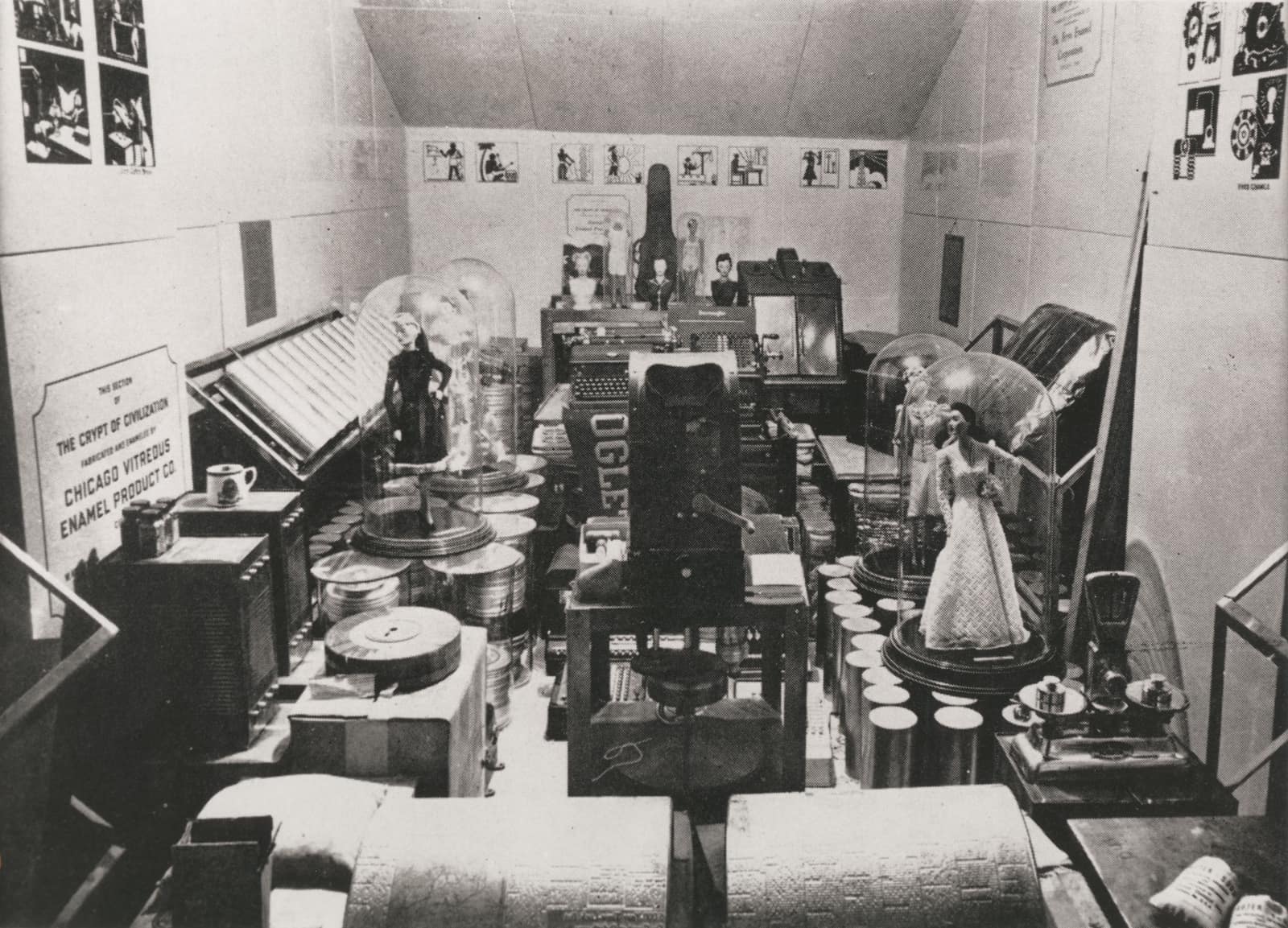

Photographe non crédité, 1940, domaine public aux États-Unis, via Wikimedia CommonsNoC-USOriginal record
Data saver is on. Images load only when you ask. You can change this in Settings at any time.
From the archivist
In the basement of a university building in Atlanta there is a steel door that no one alive was ever meant to open.
Behind it lies a room about six metres long, once a swimming pool, its walls lined with enamel. In 1936 the university's president, Thornwell Jacobs, who had been studying the ancient world, was struck by how little of its daily life had come down to him, and resolved that his own age would do better for those who came after. For three years his archivist, Thomas Peters, photographed books page by page onto film, some 640,000 pages in all. Beside the film went voices on records, newsreels, a typewriter, dolls, a bottle of beer, and a machine to teach English, in case the language had died.
In May 1940, while armies were crossing France, the door was welded shut. The instructions ask that it not be opened before the year 8113.
The date was a calculation: as much time forward as Jacobs believed had passed since the first date of the Egyptian calendar. He was writing to readers as far from him as he thought he stood from the first scribes.
Established
- The Crypt was conceived by Thornwell Jacobs, president of Oglethorpe University, who set out the idea in Scientific American in November 1936 (New Georgia Encyclopedia).
- It is a former swimming pool beneath Phoebe Hearst Hall, 20 feet long, 10 feet wide and 10 feet high, built on bedrock, lined with porcelain enamel plates set in pitch and closed by a welded stainless steel door (Oglethorpe University).
- It holds some 640,000 pages of microfilm taken from more than 800 works, voice recordings, films and newsreels, and everyday objects, together with a machine meant to teach English to those who open it (Oglethorpe University; New Georgia Encyclopedia).
- Its archivist, the inventor and photographer Thomas K. Peters, appointed in 1937, led the microfilming of the contents (Oglethorpe University).
- The Crypt was sealed in May 1940 with instructions not to open it before 28 May 8113; Jacobs chose the year by projecting forward the 6,177 years he counted between 4241 BCE, which he took as the first date of the Egyptian calendar, and 1936 (Oglethorpe University; New Georgia Encyclopedia).
Interpretation
Sources disagree on the day of the sealing: Oglethorpe University gives 28 May 1940, while the New Georgia Encyclopedia and the Atlanta Journal of 26 May 1940, which reports the ceremony as held the day before, point to 25 May. The date of 4241 BCE for the Egyptian calendar, accepted in Jacobs's time, has since been abandoned by Egyptologists. The choice of contents reflects the outlook of one university in the segregated American South in 1940. The Guinness Book of World Records later called the Crypt the first successful attempt to bury a record for any future inhabitants, a claim that depends on how a time capsule is defined.
In 10,000 years
In 8113, will anyone still read English, or will the machine left to teach it be the first thing they try to understand?
Sources (3)
- Oglethorpe University. Crypt of Civilization. · oglethorpe.edu
- New Georgia Encyclopedia (Georgia Humanities). Crypt of Civilization. · www.georgiaencyclopedia.org
- Brewer, D. E. Oglethorpe's crypt sealed amid gloomy forebodings. The Atlanta Journal, 26 May 1940. · commons.wikimedia.org

Related fragments
1970 to 1971
The Expo '70 time capsules
Osaka Castle Park, Osaka, Japan · Asia
after 2012
Memory of Mankind
Hallstatt, Upper Austria, Austria · Europe
2002 to 2008
The Rosetta Disk
San Francisco, California, United States · Americas