The Rosetta Disk
It treated the diversity of human languages as a heritage to back up for millennia, in a form that needs no machine to read, only a lens.
- Dated
- Place
- San Francisco, California, United States · The Long Now Foundation, San Francisco, and the linguists and speakers who documented some 1,500 languages
- Coordinates
- 37° 48′ N · 122° 26′ W (approximate)
- Remains
- Intact
Jeremy Keith, CC BY 2.0, via FlickrCC-BY-2.0Original record
Data saver is on. Images load only when you ask. You can change this in Settings at any time.
From the archivist
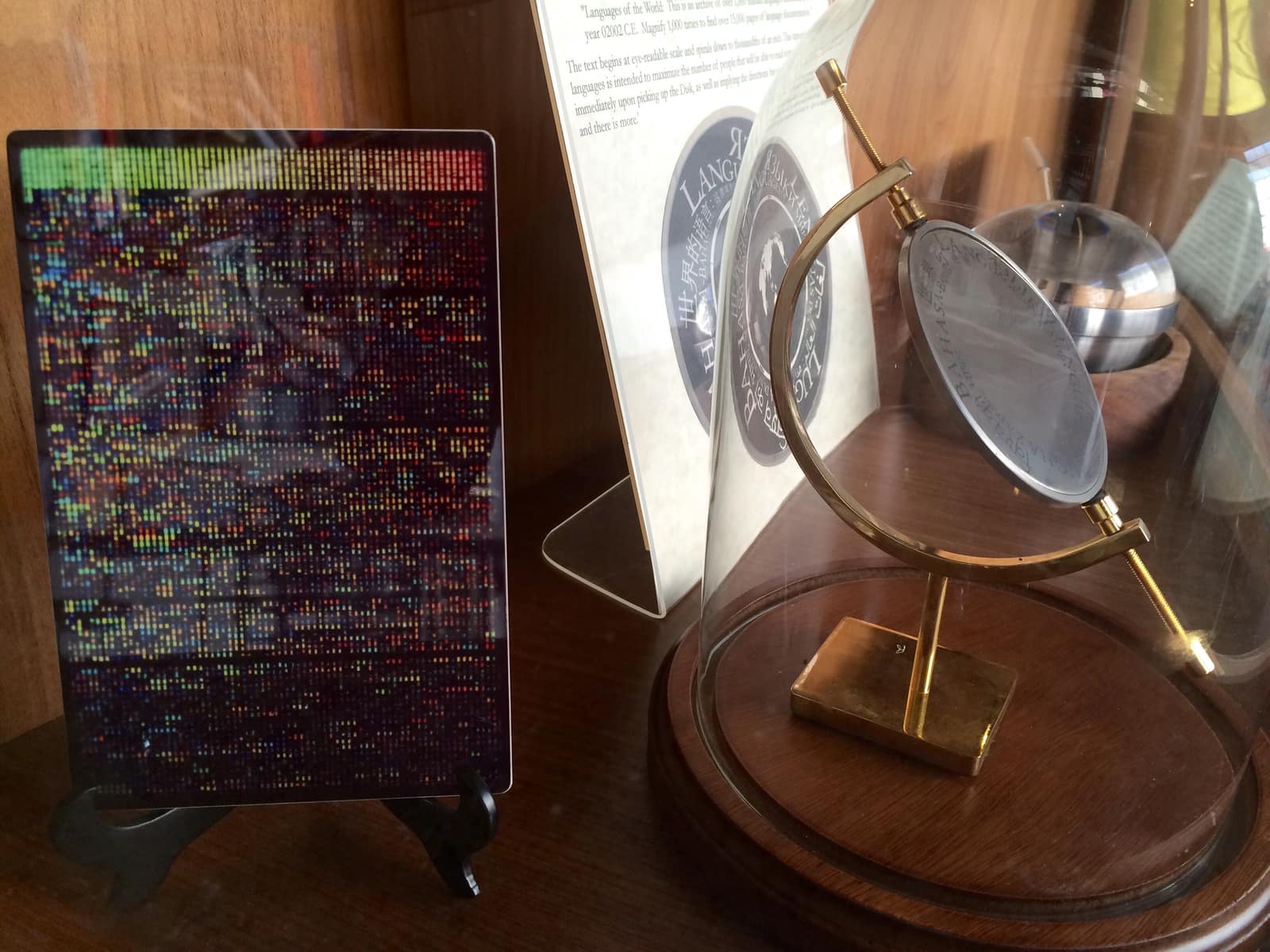
Hold it up to the light and you will see only a small metal disk, three inches across, bright as a coin. The writing begins at the edge, in eight scripts, and grows smaller as it spirals inward, until the letters vanish.
Look closer, through a microscope, and there are more than thirteen thousand pages. They describe over fifteen hundred of the languages this civilization spoke: the same opening chapters of an ancient book, the same list of everyday words, notes on how each language worked and who spoke it. No code, no machine: only pictures of pages, cast in nickel.
Its makers, a foundation in San Francisco that tried to think in spans of ten thousand years, named it after a stone found in Egypt in 1799, which carried one decree in three scripts and let later scholars read a writing long forgotten.
They knew that many of these languages had few speakers left. An earlier disk flew aboard a European spacecraft that bore the same name, and in 2016 it came to rest on a comet, where it still circles the Sun.
Established
- The Rosetta Disk, completed by The Long Now Foundation in 2008, is three inches (7.5 cm) across and carries more than 13,000 micro etched pages documenting over 1,500 human languages (Rosetta Project).
- Its pages include the opening chapters of the Book of Genesis, the Universal Declaration of Human Rights, basic word lists known as Swadesh lists, and notes on grammar and speakers, for each language where they exist (Rosetta Project).
- The text begins at eye readable size and spirals down to the microscopic; the outer ring reads, in eight major world languages, that this is an archive of over 1,500 human languages assembled in the year 02008 C.E. (Rosetta Project).
- The data face is pure nickel cast from an etched silicon mould; the pages are images, not code, and can be read with an optical microscope (Long Now Foundation; Rosetta Project).
- An earlier nickel disk, with about a thousand languages, was fixed to the European Space Agency's Rosetta orbiter in 2002; the probe, launched on 2 March 2004, ended its mission with a controlled descent onto comet 67P/Churyumov-Gerasimenko on 30 September 2016 (ESA).
Interpretation
Estimates of the disk's lifespan, from two thousand to ten thousand years, are projections from the properties of nickel, not experience. The documentation is uneven, rich for some languages and a few lines for others, and much of it was gathered by outsiders; whether a future reader could use it as a key, as the Rosetta Stone was used for Egyptian hieroglyphs, is an open question. Sources also differ on the magnification needed to read the pages.
In 10,000 years
In 10,000 years, how many of these 1,500 languages will still be spoken, and by whom?
Sources (4)
- The Rosetta Project (The Long Now Foundation). The Rosetta Disk: concept. · rosettaproject.org
- Kelly, K. Very long-term backup. The Long Now Foundation, 20 August 2008. · longnow.org
- European Space Agency. Rosetta disk goes back to the future. · sci.esa.int
- European Space Agency. Mission complete: Rosetta's journey ends in daring descent to comet, 30 September 2016. · sci.esa.int
Related fragments
1977
The Golden Record
Voyager 1 · Voyager 2 · Americas
1972 to 1973
The Pioneer plaque
Pioneer 10 · Pioneer 11 · Americas
after 2012
Memory of Mankind
Hallstatt, Upper Austria, Austria · Europe