The footprints of White Sands: a child carried across the mud
- Dated
- Place
- White Sands National Park, New Mexico, United States · Late Pleistocene people of the Tularosa Basin (prehistoric; the place is now in the United States)
- Coordinates
- 32° 52′ N · 106° 19′ W (approximate)
- Remains
- Fragmentary
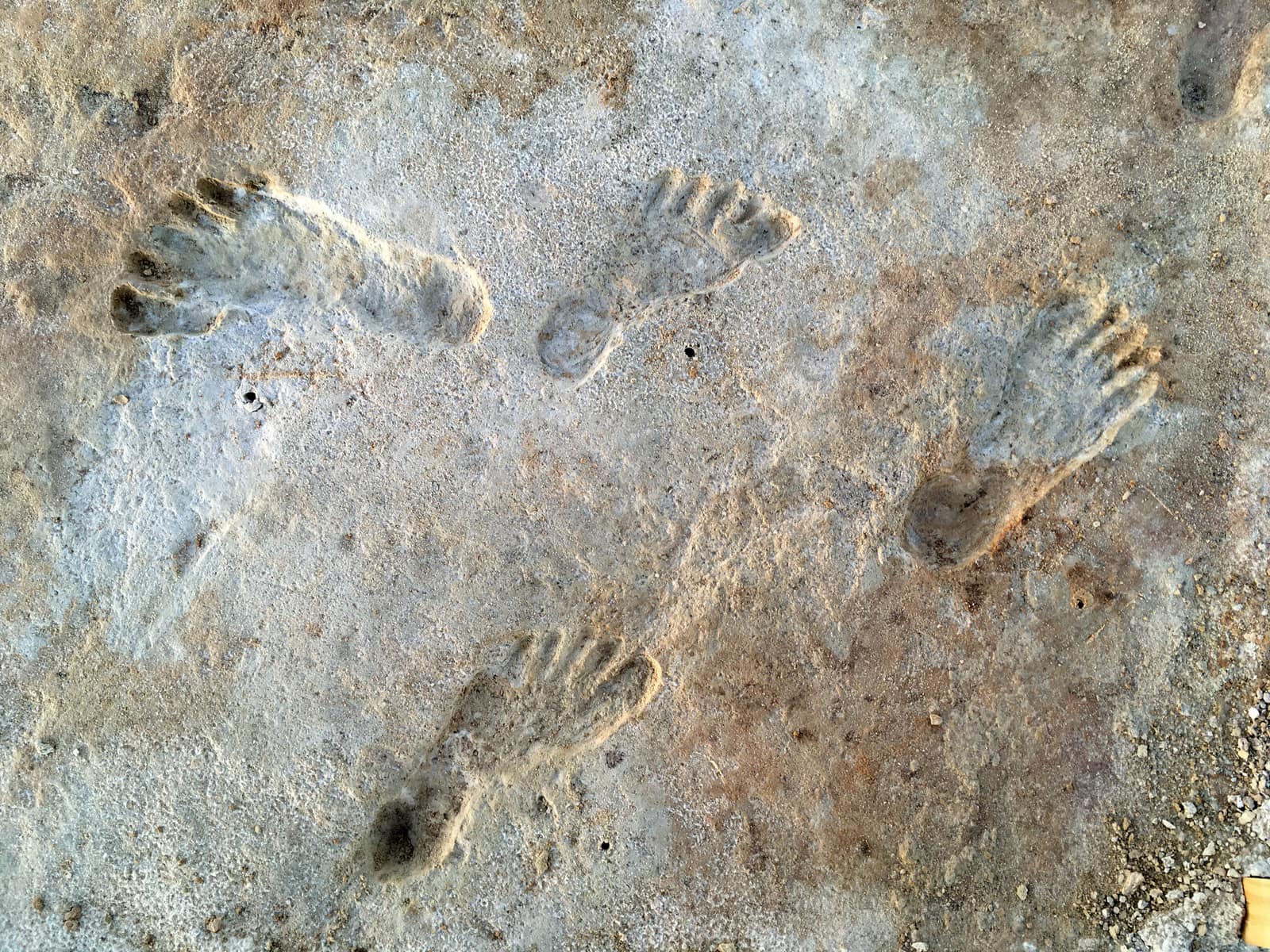
National Park Service / U.S. Geological Survey, domaine public, via Wikimedia CommonsPDMOriginal record
Data saver is on. Images load only when you ask. You can change this in Settings at any time.
From the archivist
Someone crossed the mud here with a child in their arms. The prints are those of a small woman, or perhaps an adolescent, walking fast and straight across the wet flats of a lake that no longer exists. Where the weight shifted from one arm to the other, the feet slipped and splayed. Now and then, beside the adult's steps, much smaller feet appear: a child under three, set down for a moment, then lifted again.
We do not know what this civilization called itself, or what language was spoken on that shore. The place now lies in the United States; the people who walked it lived thousands of years before any nation. What the prints keep is simpler: the weight of a child, and the ache in the arms that makes you stop, put them down, and pick them up once more.
Hours later the same walker came back along almost the same line, alone, the steps now steadier. In between, a giant sloth and mammoths had crossed the path. Nobody knows where the child stayed, or with whom.
Elsewhere in the same basin, older prints go back more than twenty thousand years. The gypsum kept them all.
Established
- A double trackway more than 1.5 km long records an outward and a return journey across the mudflats of former Lake Otero, in what is now White Sands National Park, New Mexico (Bennett et al. 2020).
- The walker was probably an adolescent or a small adult woman; in at least three places, small prints of a child probably under three years old appear beside the trackway, where the child seems to have been set down briefly (Bennett et al. 2020).
- Tracks of a giant ground sloth and of Columbian mammoths cross the outward trackway and are crossed in turn by the return one, so the two journeys were separated by at least several hours (Bennett et al. 2020).
- This trackway is dated only indirectly, by its association with extinct megafauna: most probably before about 10,000 years ago (Bennett et al. 2020).
- Other human footprints in the park were dated in 2021 to between about 23,000 and 21,000 years ago, from seeds of the aquatic plant Ruppia found in the same layers (Bennett et al. 2021).
- In 2023, radiocarbon dates on conifer pollen and luminescence dates on the sediments gave the same range (Pigati et al. 2023).
Interpretation
That the walker was a woman, and that the child was hers, cannot be known: sex is inferred from foot size, and kinship is only a likelihood. The researchers read the speed and the straight line as a known destination, perhaps as haste in a landscape of large animals, but footprints do not say why anyone walks. The 2021 ages were contested because Ruppia seeds can take up old carbon from groundwater and look too old; the 2023 pollen and luminescence ages answered that objection for most specialists, while the wider debate on when people first reached the Americas goes on. The photograph shows prints from the older layers, not the trackway of the carried child.
Looking ahead
A hundred years from now, which of our traces will show that we carried our children when they were tired?
Sources (5)
- Bennett, M. R., Bustos, D., Odess, D., Urban, T. M., Lallensack, J. N., Budka, M., Santucci, V. L., Martinez, P., Wiseman, A. L. A., Reynolds, S. C. Walking in mud: remarkable Pleistocene human trackways from White Sands National Park (New Mexico). Quaternary Science Reviews 249, 106610, 2020. · eprints.bournemouth.ac.uk
- Bennett, M. R., Bustos, D., Pigati, J. S., Springer, K. B., Urban, T. M., Holliday, V. T., et al. Evidence of humans in North America during the Last Glacial Maximum. Science 373 (6562), 2021, p. 1528-1531. · doi.org
- Pigati, J. S., Springer, K. B., Honke, J. S., Wahl, D., Champagne, M. R., Zimmerman, S. R. H., Gray, H. J., Santucci, V. L., Odess, D., Bustos, D., Bennett, M. R. Independent age estimates resolve the controversy of ancient human footprints at White Sands. Science 382 (6666), 2023, p. 73-75. · doi.org
- National Park Service, White Sands National Park. News release, 9 October 2020 (world's longest fossilized human trackway). · www.nps.gov
- U.S. Geological Survey. Footprints found in White Sands National Park (image and caption). · www.usgs.gov
Related fragments
c. 23,000 years ago
The footprints of the Willandra Lakes
Willandra Lakes Region World Heritage Area, New South Wales, Australia (exact site not disclosed) · Oceania
c. 13,000 years ago
A Clovis point
Sevier County, Utah, United States · Americas