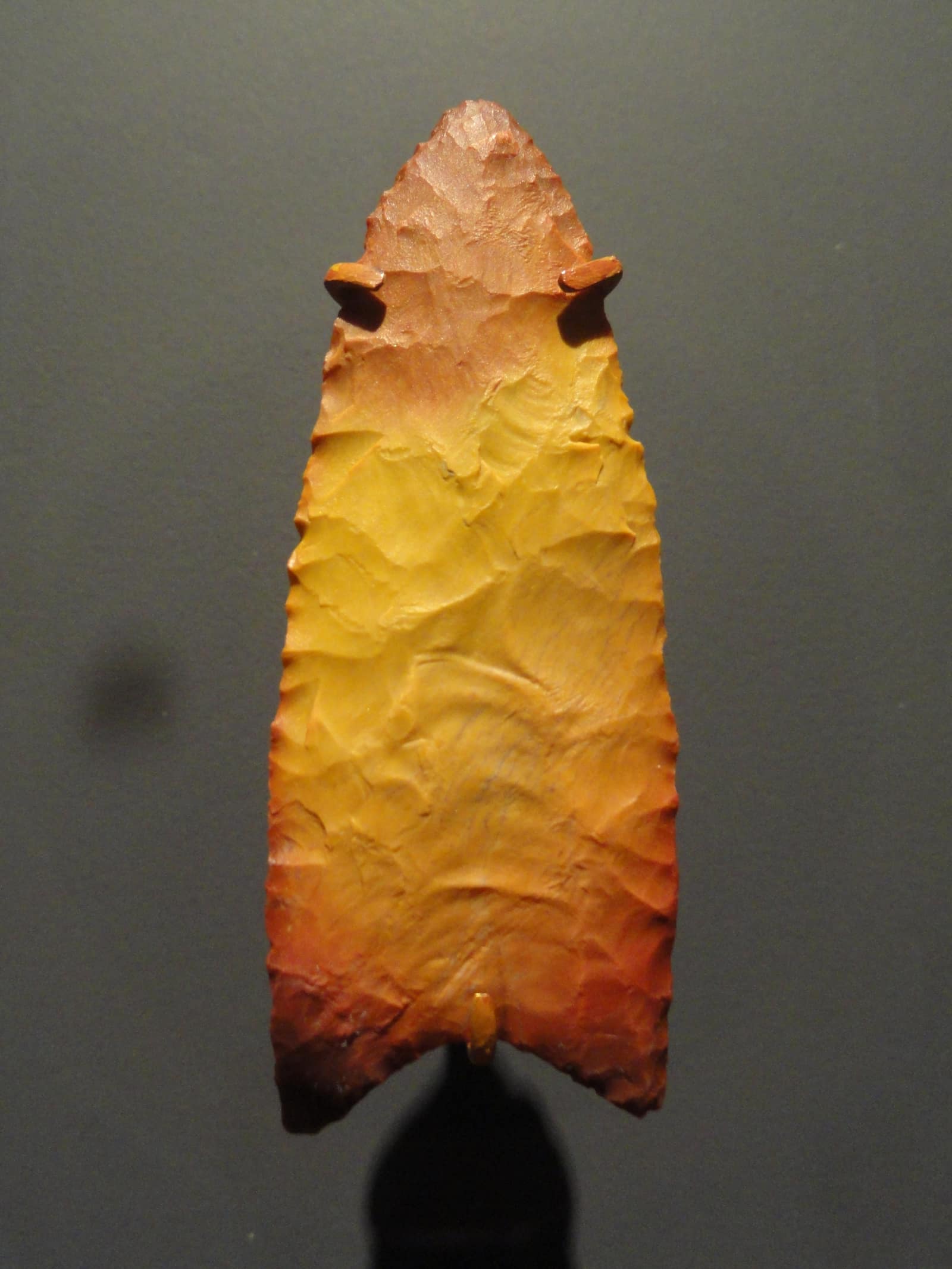
A Clovis point
- Dated
- Place
- Sevier County, Utah, United States · Clovis hunter-gatherers of North America
- Coordinates
- 38° 45′ N · 111° 48′ W (approximate)
- Remains
- Intact
Daderot, CC0, via Wikimedia CommonsCC0-1.0Original record
Data saver is on. Images load only when you ask. You can change this in Settings at any time.
From the archivist
It fits in the palm of a hand. Someone chose a piece of chert, yellow with streaks of red, and struck it again and again with stone, bone and antler until it thinned into a leaf. Then came the hardest gesture: a long flake taken from the base, up the middle of each face, leaving the shallow groove that archaeologists call a flute. One blow too hard and the point would snap. Many did.
Points like this one were made across much of North America for about three hundred years, some thirteen thousand years ago, when mammoths, horses and giant bison still grazed the plains. They were bound to wooden shafts and thrown or thrust. The first to be recognised lay among mammoth bones near Clovis, New Mexico, and the town gave its name to the people who made them, whose own name we do not know.
This one came from a valley in Utah. It was lost, or left, and the land kept it. Its edges are still sharp.
Established
- Clovis points take their name from Clovis, New Mexico: fluted points were found with mammoth bones at nearby Blackwater Draw from 1929, and the site was excavated in the 1930s (The Met).
- Thirty-two radiocarbon ages from ten Clovis sites give a calibrated age range for Clovis of about 13,050 to 12,750 years ago, a span of roughly three centuries (Waters, Stafford and Carlson 2020).
- The same study counts Clovis as one of at least three contemporary archaeological complexes in the Western Hemisphere at the end of the Pleistocene (Waters, Stafford and Carlson 2020).
- The point shown, of chert, was found in Sevier County, Utah, and is exhibited at the Natural History Museum of Utah (museum label).
Interpretation
Whether Clovis people were the first inhabitants of the Americas, as long believed, is now widely doubted: older sites such as Monte Verde in Chile point to earlier arrivals, and the short Clovis span suggests a technology that spread quickly among existing populations rather than a single migration. What the flute was for, hafting or display, is still discussed.
In 10,000 years
In 10,000 years, will a single worked stone still be enough to show that someone was here, and was skilled?
Sources (3)
- Waters, M. R., Stafford, T. W., Carlson, D. L. The age of Clovis: 13,050 to 12,750 cal yr B.P. Science Advances 6 (43), 2020, eaaz0455. · doi.org
- The Metropolitan Museum of Art. Blackwater Draw (ca. 9500 to 3000 B.C.), Heilbrunn Timeline of Art History essay. · www.metmuseum.org
- Natural History Museum of Utah, Salt Lake City. Exhibit label: Clovis point, 11500 to 9000 BC, Sevier County, Utah, chert (photographed 2013). · commons.wikimedia.org