The footprints of the Willandra Lakes
- Dated
- Place
- Willandra Lakes Region World Heritage Area, New South Wales, Australia (exact site not disclosed) · Ancestors of the Paakantyi, Mutthi Mutthi and Ngiyampaa peoples, Willandra Lakes
- Coordinates
- 33° 42′ S · 143° 06′ E (approximate)
- Remains
- Fragmentary
This fragment shows an object held as sacred.
It is shown here as the institution that holds it presents it. Some communities connected to it ask that it be viewed with care. You may choose to see the image, or read the record without it.
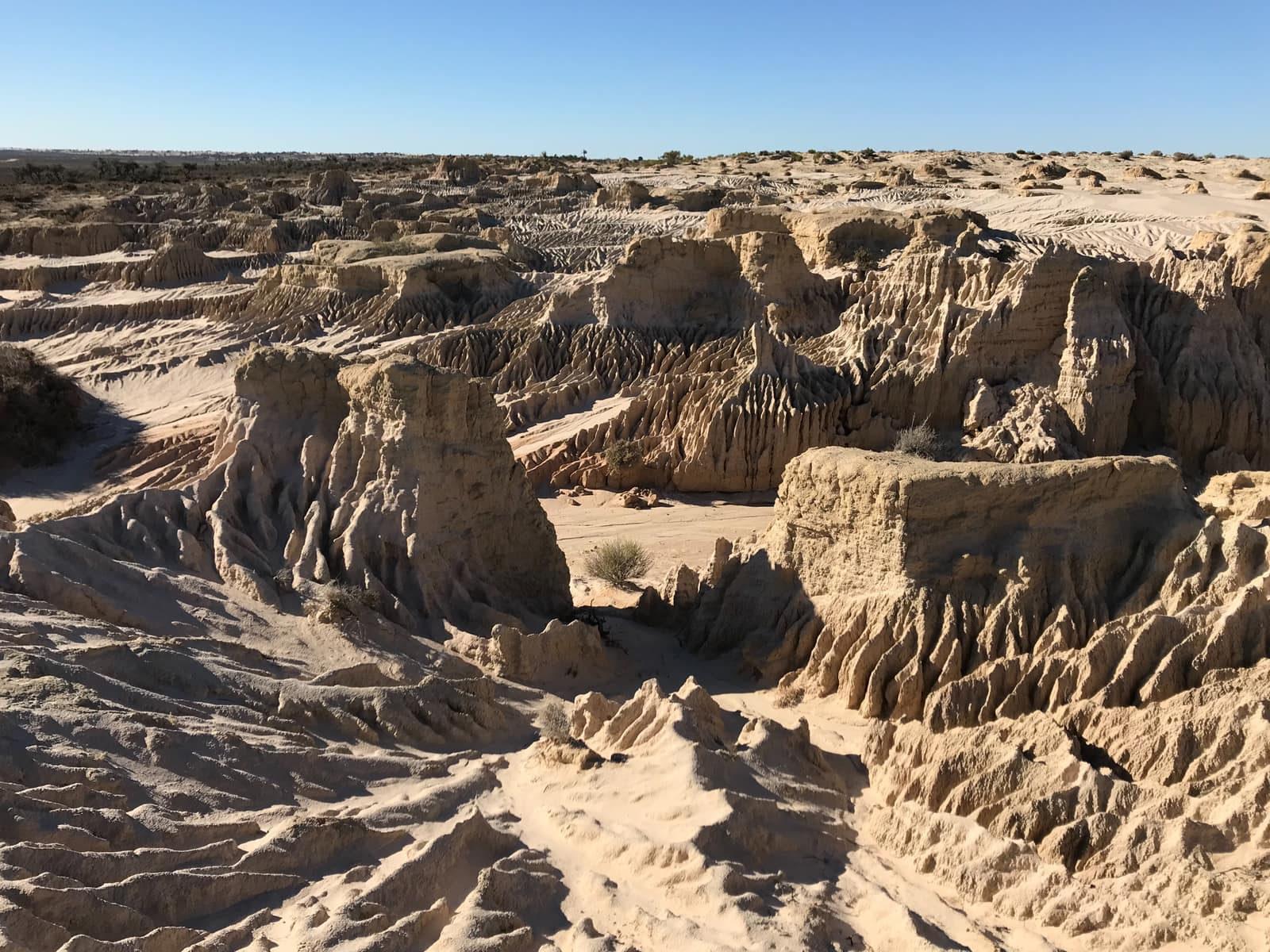
Image veiled by default
Rueparadis, CC BY-SA 4.0, via Wikimedia CommonsCC-BY-SA-4.0Original record
Data saver is on. Images load only when you ask. You can change this in Settings at any time.
From the archivist
At the edge of a shallow soak, some twenty thousand years ago, a group of people walked across wet clay. The water has long gone. What stays is the shape of their passing.
Adults crossed in both directions. Several men ran side by side, fast, perhaps after an animal. Children walked among them, one no older than four or five. In one place, two small wavy lines curl through the clay: a child's fingers, trailed through the mud for no reason at all.
One man went on a single leg. His track is a line of right footprints, hopping, level with the running men. Pintupi trackers from the Western Desert, invited to read the ground, were not surprised: they had grown up with a one-legged hunter of their own, respected for his skill.
This civilization has not vanished. The Paakantyi, Mutthi Mutthi and Ngiyampaa peoples still walk this Country. It was a young Mutthi Mutthi woman, Mary Pappin Jr, who first saw the prints, in 2003. "To leave those footprints for us to find was unique," Mary Pappin Senior, a Mutthi Mutthi elder, said years later.
The prints are covered with sand again, at a place that is not told. They are not shown here.
Established
- The prints were first noticed in August 2003 by Mary Pappin Jr, a young Mutthi Mutthi woman, during a site survey in the Willandra Lakes region of western New South Wales (Webb et al. 2006; Australian Museum 2019).
- They were pressed into the moist clay of a small, seasonal wetland and are dated by optically stimulated luminescence to between about 23,000 and 19,000 years ago, near the height of the last glacial period (Webb et al. 2006).
- By 2007, 563 prints had been recorded, with 23 trackways, left by men, women, adolescents and children, the youngest about four years old (Webb 2007).
- Trackway 4 was made by a man hopping on his right foot alone, keeping pace with the running men beside him (Webb 2007).
- Pintupi trackers from the Western Desert, asked to read the site, identified spear butts rested on the ground, a groove left by a spear skidding over the mud, and two small wavy marks drawn by a child's fingers (Webb 2007).
- To protect them from wind erosion, the prints have been covered again with sand at a location that is not made public (SBS NITV 2016).
Interpretation
Estimates of height, sex, age and speed come from the size and spacing of the prints, and the running men's speeds are especially uncertain. The reading of a hunting party, of spear marks and of a one-legged hunter rests on the knowledge of the Pintupi trackers consulted by the researchers, who had grown up with a one-legged hunter of their own; that knowledge is expert, but it is an interpretation. The traditional owners say the tracks connect them with Dreaming pathways and with the ancestors who walked this Country; the archive follows their protocols and shows no photograph of the prints.
Looking ahead
Ten thousand years is a short time for a people who have walked the same Country for longer than that. The question is whether we will still know how to read a footprint.
Sources (7)
- Webb, S., Cupper, M. L., Robins, R. Pleistocene human footprints from the Willandra Lakes, southeastern Australia. Journal of Human Evolution 50 (4), 2006, p. 405-413. · pure.bond.edu.au
- Webb, S. Further research of the Willandra Lakes fossil footprint site, southeastern Australia. Journal of Human Evolution 52, 2007, p. 711-715. · doi.org
- Willandra Lakes Region World Heritage Aboriginal Advisory Group. Research Code of Practice, May 2021 (NSW Department of Planning and Environment). · www.environment.nsw.gov.au
- NSW Environment and Heritage. Willandra Lakes Region (World Heritage-listed area). · www.environment.nsw.gov.au
- Australian Museum. No Distance Between Us, media release, 15 October 2019; Mungo footprint mould (Unsettled exhibition). · australian.museum
- SBS NITV. How Australia is protecting 20,000-year-old footprints, 3 February 2016. · www.sbs.com.au
- ABC News, Deep Time Australia. Willandra footprints (with Patsy Winch née Kelly and Tanya Charles, Mutthi Mutthi). · www.abc.net.au
Related fragments
before 8000 BCE
The footprints of White Sands: a child carried across the mud
White Sands National Park, New Mexico, United States · Americas
before 4600 BCE
The eel traps of Budj Bim
Tae Rak (Lake Condah), Kurtonitj and Tyrendarra, south-western Victoria, Australia · Oceania
c. 50,000 years ago
The engravings of Murujuga
Burrup Peninsula and Dampier Archipelago, Pilbara, Western Australia · Oceania