Lapita pottery
- Dated
- Place
- Teouma, Efate, Shefa Province, Vanuatu · Lapita, the first people to settle the islands of Remote Oceania
- Coordinates
- 17° 47′ S · 168° 24′ E (approximate)
- Remains
- Fragmentary
This fragment shows human remains.
It is shown here as the institution that holds it presents it. Some communities connected to it ask that it be viewed with care. You may choose to see the image, or read the record without it.
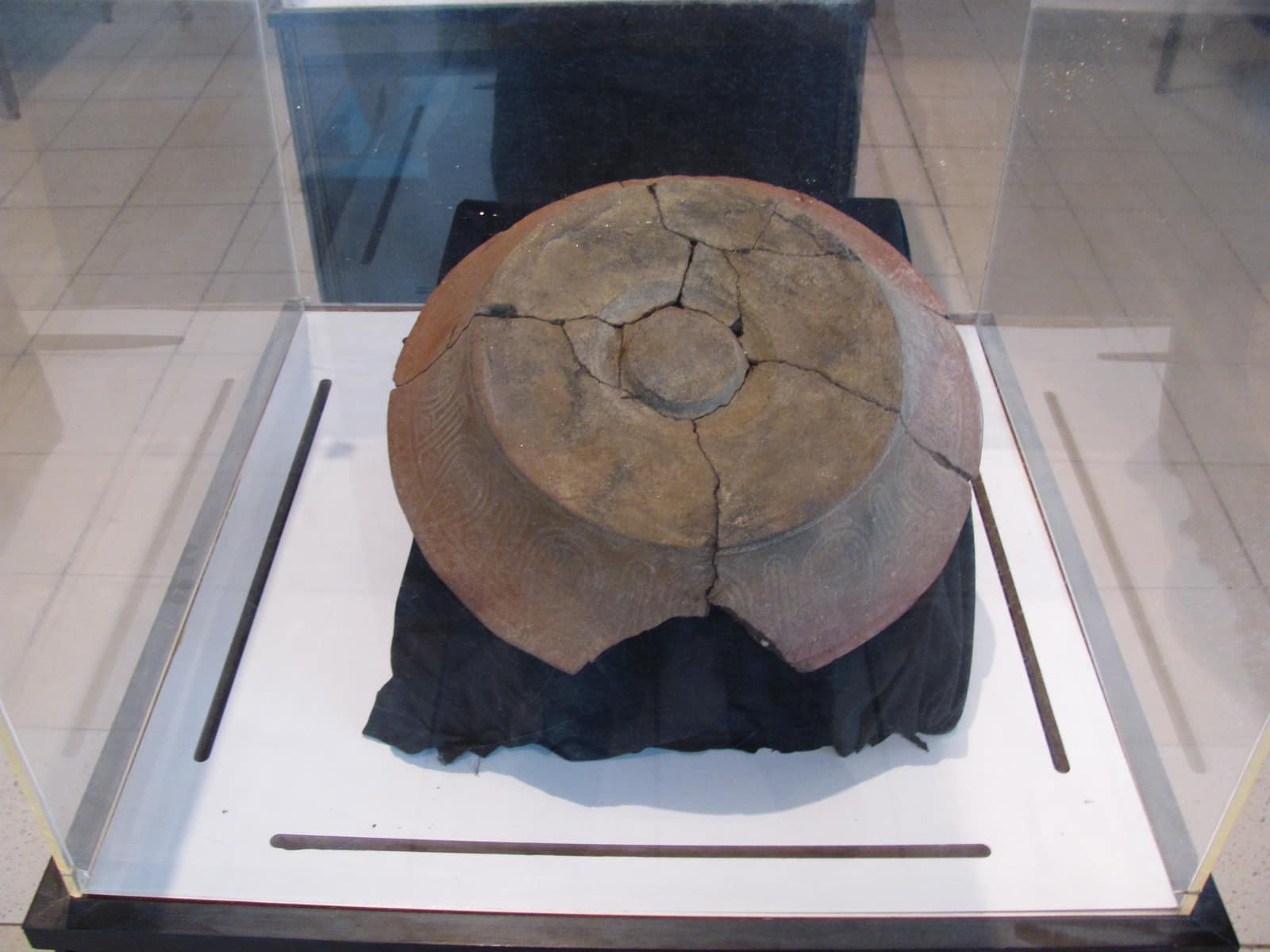

Image veiled by default
Torbenbrinker, CC BY-SA 3.0, via Wikimedia CommonsCC-BY-SA-3.0Original record
Data saver is on. Images load only when you ask. You can change this in Settings at any time.
From the archivist
The makers of this dish came from the west by sea, in canoes, to islands where no one had ever stood. They carried plants, animals and clay-working skills, and wherever they settled, from the Bismarck Archipelago to Tonga, they made pots of the same kind.
They pressed their designs into the wet clay with a toothed tool, row upon row of tiny dots, forming bands, curves and sometimes faces. Their descendants spread the style across three thousand kilometres of ocean in a few centuries.
At Teouma, on the island of Efate, a bulldozer levelling ground in 2003 turned up sherds. Beneath them lay a cemetery of the first people of Vanuatu. The dead had been treated with care over long periods; some heads had been removed and placed elsewhere. This dish was found whole, turned upside down to close a pot in which a skull had been laid.
It was made for the living, perhaps, and given to the dead. It stays now in the islands where it was found.
Established
- The Teouma site on Efate, Vanuatu, was found in 2003 during earthworks and proved to hold a cemetery of the first settlers of the archipelago, about 3,000 years old, with decorated Lapita pots (Bedford, Spriggs and Regenvanu 2006).
- Lapita pottery is known for designs pressed into the wet clay with toothed tools, known as dentate stamping; the style appears in the Bismarck Archipelago around 3,300 years ago and spreads east as far as Tonga and Samoa within a few centuries (Bedford, Spriggs and Regenvanu 2006; Skoglund et al. 2016).
- The dish shown was found intact at Teouma, used as a lid over a carinated pot that held a human skull (Sand and Bedford 2010).
- Ancient DNA from individuals buried at Teouma and at Talasiu in Tonga, between about 3,100 and 2,300 years ago, shows ancestry closest to peoples of Taiwan and the northern Philippines, with little Papuan ancestry (Skoglund et al. 2016).
Interpretation
What the faces and patterns on Lapita pots meant, and whether the finest vessels were made for everyday use, for exchange or mainly for ceremonies and burial, is debated. The origins of the Lapita people themselves, and how they mixed with those already living in Near Oceania, are still being revised as genetic results accumulate.
In 10,000 years
In 10,000 years, will a broken dish still tell someone that the sea was crossed on purpose?
Sources (4)
- Bedford, S., Spriggs, M., Regenvanu, R. The Teouma Lapita site and the early human settlement of the Pacific Islands. Antiquity 80 (310), 2006, p. 812-828. · doi.org
- Skoglund, P. et al. Genomic insights into the peopling of the Southwest Pacific. Nature 538 (7626), 2016, p. 510-513. · doi.org
- Sand, C., Bedford, S. (eds). Lapita: ancêtres océaniens / Oceanic ancestors. Paris, Somogy and Musée du quai Branly, 2010, p. 146-148.
- Australian Academy of the Humanities. Lapita cemetery in Vanuatu helps solve ancient mystery. · humanities.org.au
Related fragments
1976
Hōkūleʻa
Hawaiʻi, United States, to Tahiti, French Polynesia · Oceania
1920 to 1929
A map of the swell: Marshall Islands stick charts
Majuro, Marshall Islands · Oceania