The Epic of Gilgamesh (Flood Tablet)
- Dated
- Place
- Mosul, Iraq · Neo-Assyrian scribes of Nineveh, copying a Babylonian epic
- Coordinates
- 36° 22′ N · 43° 09′ E (approximate)
- Remains
- Fragmentary
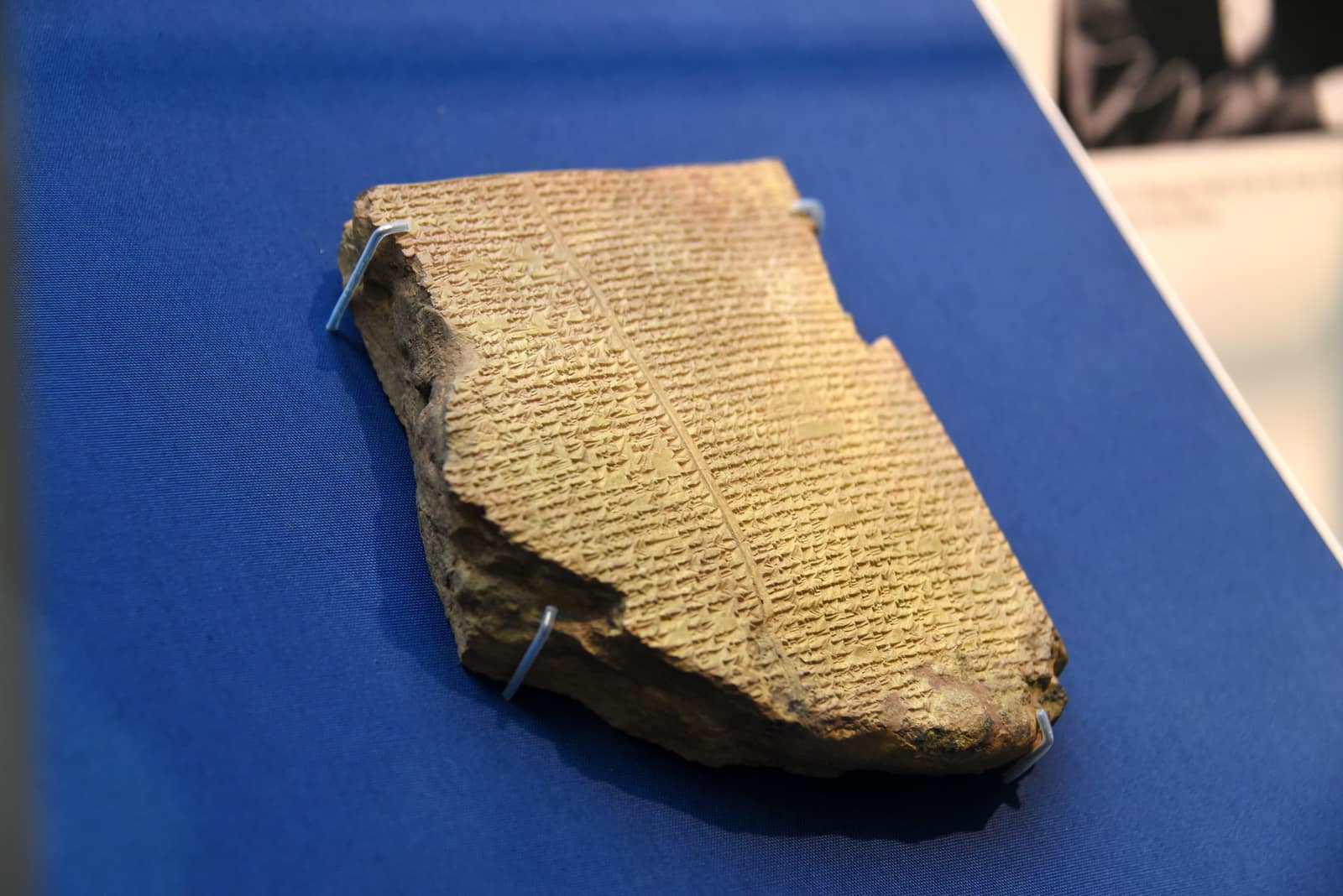
Osama Shukir Muhammed Amin FRCP(Glasg), CC BY-SA 4.0, via Wikimedia CommonsCC-BY-SA-4.0Original record
Data saver is on. Images load only when you ask. You can change this in Settings at any time.
From the archivist
A man is told in a dream to tear down his house and build a boat. He does it. He loads it with silver and gold, with his family and kin, with the animals of the field and with craftsmen. The storm comes; for six days and seven nights the wind and the flood flatten the land. Even the gods cower like dogs.
When the waters sink, the boat comes to rest on a mountain. He sends out a dove; it comes back. A swallow; it comes back. A raven; it does not return.
This civilization pressed its words into wet clay with the cut end of a reed, then let the clay dry or baked it hard. Scribes at Nineveh copied the long poem of Gilgamesh, the king who searched for a way not to die, onto a series of tablets for the king's collection. This is the eleventh.
It lay in the ruins for more than two thousand years. In 1872, a man at the British Museum, trained as an engraver, who had taught himself to read cuneiform, recognised what it said.
Established
- The Flood Tablet, British Museum K.3375, is a Neo-Assyrian clay tablet of the 7th century BCE from Nineveh, inscribed in cuneiform with the eleventh tablet of the Standard Babylonian Epic of Gilgamesh (British Museum; George 2003).
- It comes from the tablet collections of the Assyrian king Ashurbanipal (reigned 669 to about 631 BCE), excavated at Nineveh in the 1850s by Hormuzd Rassam for the British Museum (British Museum).
- On 3 December 1872 George Smith, an assistant at the British Museum, announced to the Society of Biblical Archaeology that he had read on it a Babylonian account of the flood (Smith 1873).
- In the story, the god Ea warns Utnapishtim of a coming flood; he builds a boat, takes aboard his family, craftsmen and animals, and after the waters subside sends out a dove, a swallow and a raven (George 2003).
- Stories of Gilgamesh were first told in Sumerian poems of the late third millennium BCE; the Standard Babylonian version is traditionally attributed to a scholar named Sin-leqi-unninni (George 2003).
Interpretation
The close parallels between this flood story, the older Babylonian poem of Atrahasis and the flood in the Book of Genesis are generally explained by a shared Mesopotamian tradition, but how and when the stories passed from one culture to another is debated. When Smith announced his reading, it was taken by many as independent confirmation of the Bible, and by others as proof that the biblical story had older sources.
In 10,000 years
In 10,000 years, will a story of the flood be read again from clay, when our own screens have gone dark?
Sources (4)
- The British Museum. The Flood Tablet (Tablet XI of the Epic of Gilgamesh), K.3375. · www.britishmuseum.org
- George, A. R. The Babylonian Gilgamesh Epic: Introduction, Critical Edition and Cuneiform Texts. Oxford, Oxford University Press, 2003.
- Smith, G. The Chaldean account of the Deluge. Transactions of the Society of Biblical Archaeology 2, 1873, p. 213-234.
- Damrosch, D. The Buried Book: The Loss and Rediscovery of the Great Epic of Gilgamesh. New York, Henry Holt, 2007.