The Code of Hammurabi
- Dated
- Place
- Made in present-day Iraq; found at Susa (Shush), Iran; now in the Louvre, Paris · Old Babylonian kingdom (First Dynasty of Babylon)
- Coordinates
- 32° 32′ N · 44° 25′ E (approximate)
- Remains
- Intact
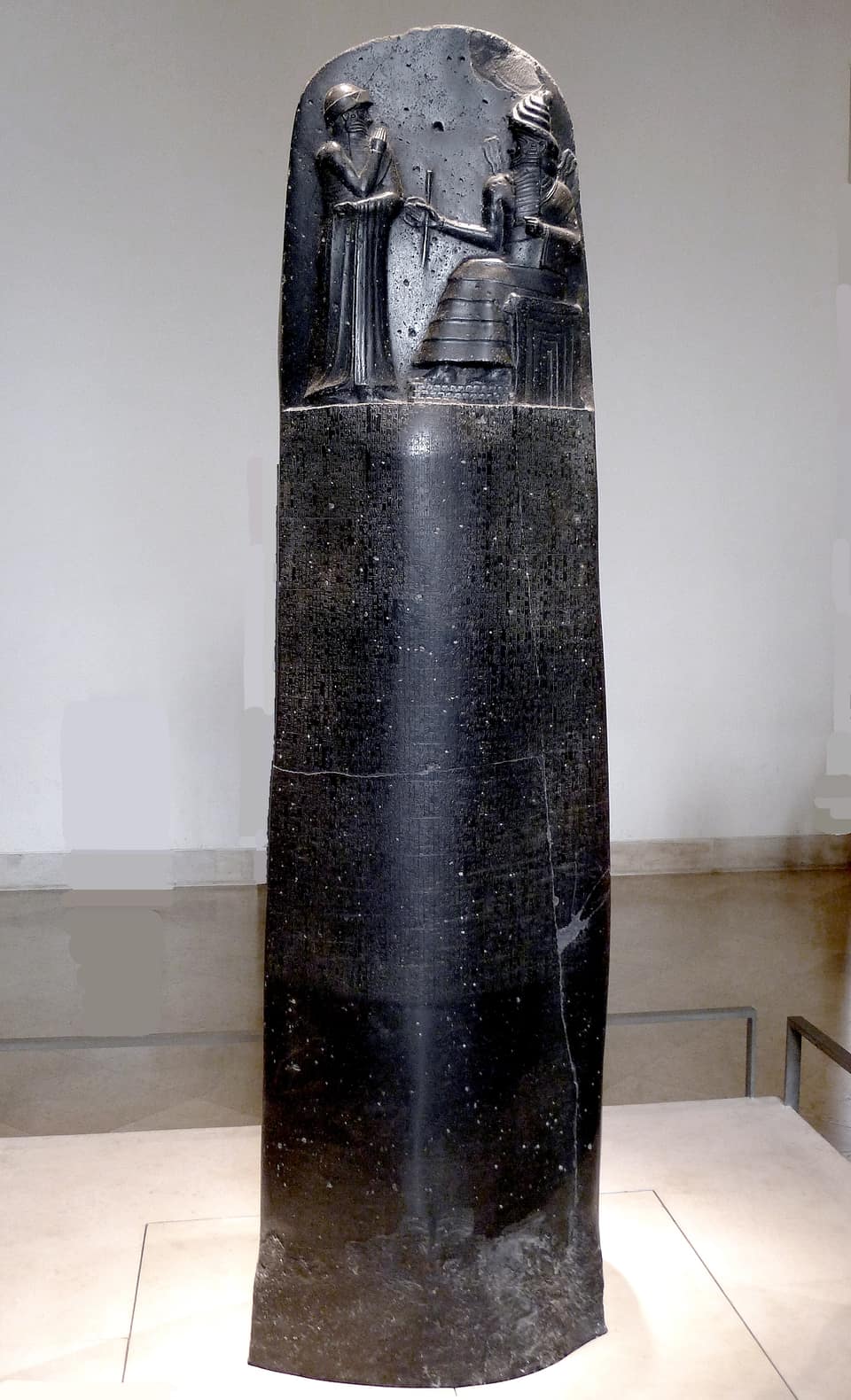
Mbzt, CC BY 3.0, via Wikimedia CommonsCC-BY-3.0Original record
Data saver is on. Images load only when you ask. You can change this in Settings at any time.
From the archivist
The king stands with his hand raised to his mouth, a gesture of respect. Before him, on a throne, sits the sun god Shamash, who sees all things and judges them; flames rise from his shoulders. Below them, around the entire black stone, runs the writing.
It speaks in the form: if a man does this, then that shall follow. If a builder builds a house and it falls and kills its owner, the builder shall be put to death. If a man puts out the eye of a free man, his own eye shall be put out. The sentence depended on who you were: free person, dependant or slave.
Hammurabi had the stone set up so that anyone wronged could come and stand before it, have it read aloud and understand their case. So says the epilogue.
Six hundred years later a king of Elam carried the stele across the mountains to Susa as a trophy. There it lay until French excavators found it, in three pieces, in the winter of 1901.
Established
- The stele is a block of basalt 2.25 m high, inscribed in Old Babylonian cuneiform under a relief showing King Hammurabi standing before the seated sun god Shamash (Louvre, Sb 8).
- Hammurabi ruled Babylon from 1792 to 1750 BCE (Louvre).
- The text sets a prologue and an epilogue around some 282 legal provisions in modern numbering, covering trade, debt, property, family, wages, injury and the conduct of judges (Roth 1997).
- The stele was carried off as booty to Susa in Elam, probably in the 12th century BCE, where the French Delegation in Persia led by Jacques de Morgan found it in 1901 and 1902 (Louvre).
- Vincent Scheil published the first edition and translation of the text in 1902 (Scheil 1902).
Interpretation
Whether Hammurabi's laws were a code applied in the courts is debated. Contemporary legal documents almost never cite them, and many scholars, following Jean Bottéro, read them rather as a royal statement of justice and a collection of model verdicts, a monument to the king as a just ruler as much as a rule book. Several columns at the base were erased in antiquity, perhaps to make room for an Elamite inscription that was never carved.
In 10,000 years
In 10,000 years, which of our laws will still be carved in stone, and which will anyone still obey?
Sources (4)
- Musée du Louvre, département des Antiquités orientales. Code de Hammurabi, stèle, basalte, Sb 8. · collections.louvre.fr
- Roth, M. T. Law Collections from Mesopotamia and Asia Minor. 2nd ed. Atlanta, Scholars Press, 1997 (Writings from the Ancient World 6).
- Bottéro, J. Le « Code » de Hammu-rabi. Annali della Scuola Normale Superiore di Pisa, Classe di Lettere e Filosofia, serie III, 12 (2), 1982, p. 409-444.
- Scheil, V. Code des lois de Hammurabi, roi de Babylone, vers l'an 2000 av. J.-C. Mémoires de la Délégation en Perse 4. Paris, Leroux, 1902.