The Antikythera mechanism
- Dated
- Place
- Antikythera, Greece (find spot); National Archaeological Museum, Athens · Hellenistic Greek world
- Coordinates
- 35° 53′ N · 23° 19′ E (approximate)
- Remains
- Fragmentary
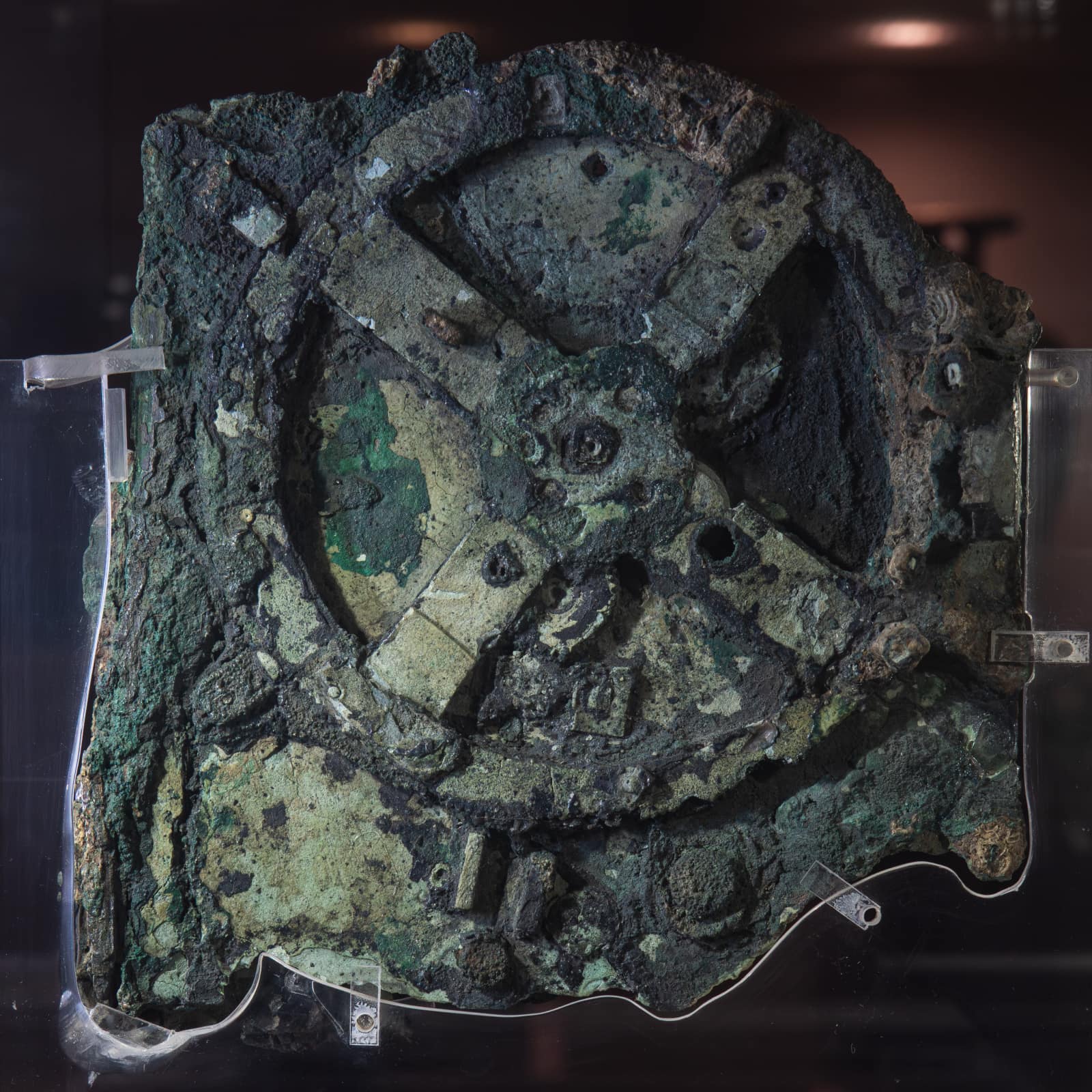
.webp)
Logg Tandy, CC BY 4.0, via Wikimedia CommonsCC-BY-4.0Original record
Data saver is on. Images load only when you ask. You can change this in Settings at any time.
From the archivist
In the first century BCE, a cargo ship went down off the small island of Antikythera, between Kythira and Crete. It carried statues of bronze and marble, glassware, coins, and a wooden case not much larger than a stack of books. Two thousand years under the sea turned the case into lumps of green stone. In 1902, a year after they were brought up, someone looking closely saw a toothed wheel.
This civilization had built a machine to hold the sky. Turn a handle, and pointers moved across its dials: the Moon with its phases and its uneven pace, the Sun through the signs of the zodiac, the calendar of the games, the months in which an eclipse would come. Its teeth were cut by hand in thin bronze, its instructions engraved in tiny Greek letters on its plates.
We do not know who turned the handle, for whom, or how often the machine was right. We know that its makers trusted numbers enough to set the heavens in bronze.
Established
- 82 surviving fragments of a geared bronze device, about a third of the original, including 30 corroded gearwheels (Freeth et al., 2021).
- The fragments were recovered in 1901 from a shipwreck off the island of Antikythera, found by sponge divers in 1900; in 1902 the archaeologist Valerios Stais noticed a gearwheel in one of them.
- X-ray computed tomography in 2005 revealed its gearing and doubled the number of deciphered inscriptions: the mechanism predicted lunar and solar eclipses from Babylonian cycles and reproduced the uneven motion of the Moon described by Hipparchos (Freeth et al., Nature, 2006).
- Its inscriptions describe a display of the Sun, the Moon and the five planets known in antiquity (Freeth et al., Scientific Reports, 2021).
- It is kept at the National Archaeological Museum in Athens.
Interpretation
The date is debated. Freeth and his colleagues place its construction around the end of the second century BCE; Carman and Evans (2014) set the starting point of its eclipse dial in 205 BCE; the ship itself sank in the first century BCE. Who made it, and where, is unknown: Rhodes, Corinth's colonies and the tradition of Archimedes have all been proposed. The planetary gearing of the front is lost and rebuilt from the inscriptions, so every reconstruction, including that of 2021, remains a hypothesis. Nothing of comparable mechanical complexity is known for at least a thousand years afterwards.
In 10,000 years
In 10,000 years, could anyone rebuild one of our machines from a handful of corroded parts and the words written on them?
Sources (4)
- Freeth, T., Bitsakis, Y., Moussas, X., Seiradakis, J. H., Tselikas, A., Mangou, H., Zafeiropoulou, M., et al. Decoding the ancient Greek astronomical calculator known as the Antikythera Mechanism. Nature 444, 2006, p. 587-591. · doi.org
- Freeth, T., Higgon, D., Dacanalis, A., MacDonald, L., Georgakopoulou, M., Wojcik, A. A Model of the Cosmos in the ancient Greek Antikythera Mechanism. Scientific Reports 11, 5821, 2021. · doi.org
- Carman, C. C., Evans, J. On the epoch of the Antikythera mechanism and its eclipse predictor. Archive for History of Exact Sciences 68, 2014, p. 693-774. · doi.org
- Antikythera Mechanism Research Project. The Antikythera Mechanism at the National Archaeological Museum. · www.antikythera-mechanism.gr