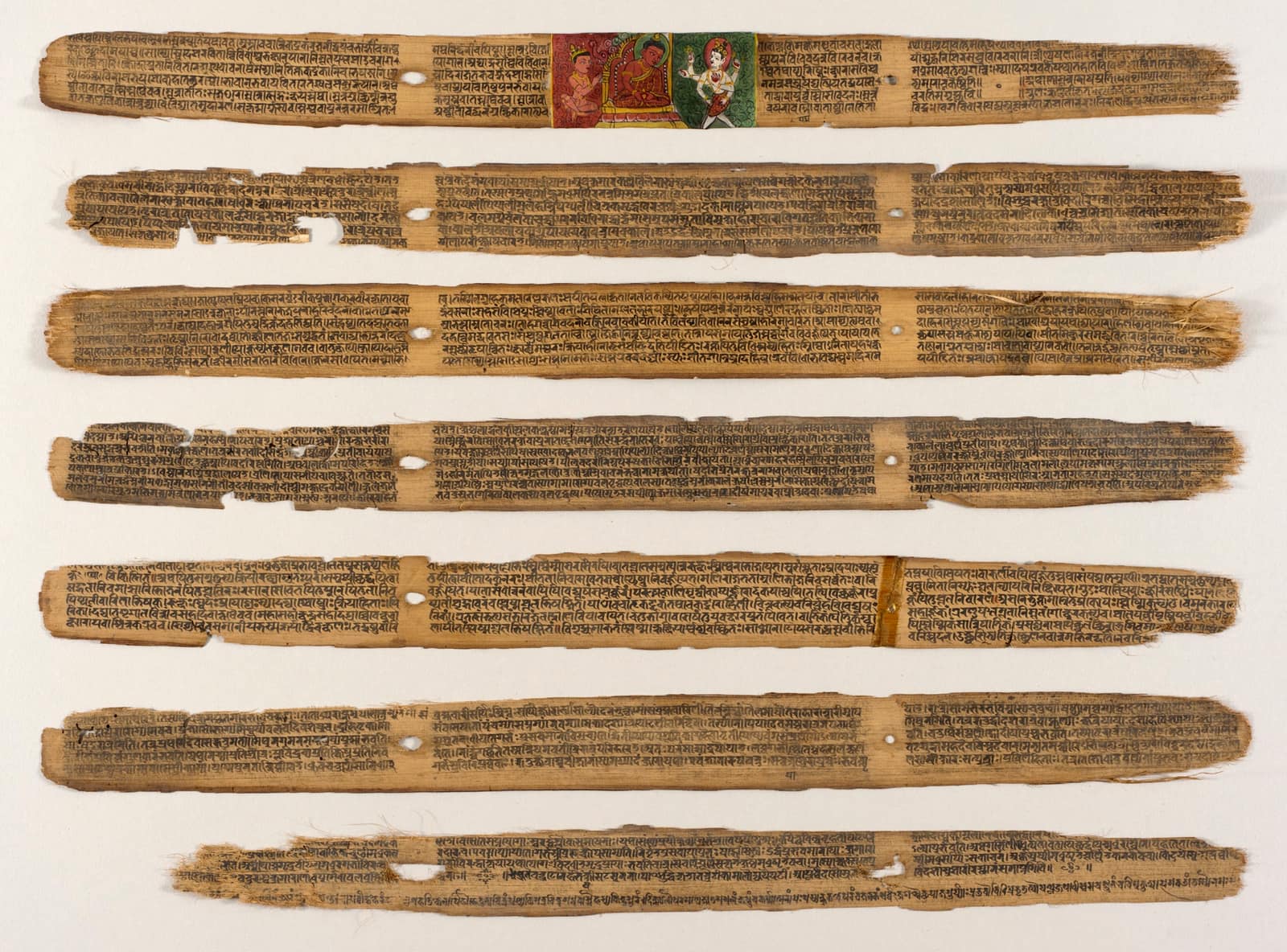
The Bakhshali manuscript
- Dated
- Place
- Near Mardan, Khyber Pakhtunkhwa, Pakistan · Mathematicians of north-western South Asia writing in Sanskrit (Śāradā script)
- Coordinates
- 34° 15′ N · 72° 04′ E (approximate)
- Remains
- Fragmentary
Bodleian Libraries, University of Oxford (MS. Sansk. d. 14), domaine public, via Wikimedia CommonsPDMOriginal record
Data saver is on. Images load only when you ask. You can change this in Settings at any time.
From the archivist
Someone wrote down a problem. A certain number of people share a certain amount of money; how much does each receive? Then the rule to solve it, then the working, set out in boxes of ruled lines, then a check that the answer is right.
The leaves are birch bark, the thin inner skin of a tree that grows in the mountains, dried and cut to size. The ink sits on them in lines of a script once used across the north-west of South Asia. Many leaves are torn; some survive only as scraps.
Among the numbers, again and again, there is a small solid dot. It marks an empty place: tens with no units, hundreds with no tens. It does what our zero does. This civilization did not yet treat it everywhere as a number of its own, but it had found how to write nothing so that the other figures kept their value.
The leaves were buried in a ruin until a farmer dug them up in 1881. How old they are is still argued over, leaf by leaf.
Established
- The Bakhshali manuscript is a mathematical text in Sanskrit, written in Śāradā script on 70 leaves of birch bark (Bodleian Libraries; Hayashi 1995).
- A tenant farmer found it in 1881 in a ruined enclosure on a mound near the village of Bakhshali, near Mardan in the Peshawar valley, in present-day Pakistan (Hayashi 1995).
- Rudolf Hoernle presented the manuscript to the Bodleian Library in Oxford in 1902, where it is kept as MS. Sansk. d. 14 (Bodleian Libraries).
- It is a collection of worked problems and rules, for example on arithmetic, series and equations, and uses a solid dot as a placeholder for zero in its decimal numerals (Hayashi 1995).
- In 2017 the Bodleian Library reported radiocarbon dates for samples from three leaves: 224 to 383 CE, 680 to 779 CE and 885 to 993 CE (Bodleian Libraries 2017).
Interpretation
The Bodleian announced the earliest date as that of the oldest recorded use of a zero symbol. Historians of Indian mathematics, among them Kim Plofker, Agathe Keller, Takao Hayashi, Clemency Montelle and Dominik Wujastyk, replied that the three leaves share one hand and one text, so they were probably written at the same time, which can be no earlier than the latest date; they also regretted that the result was announced by press release before peer review. Earlier palaeographic study had placed the manuscript between the 8th and the 12th century.
In 10,000 years
In 10,000 years, will the dot that stood for nothing still be the most useful mark we made?
Sources (4)
- Plofker, K., Keller, A., Hayashi, T., Montelle, C., Wujastyk, D. The Bakhshālī manuscript: a response to the Bodleian Library's radiocarbon dating. History of Science in South Asia 5 (1), 2017, p. 134-150. · journals.library.ualberta.ca
- Bodleian Libraries, University of Oxford. Radiocarbon dating of the Bakhshālī manuscript (research statement), 2017. · ora.ox.ac.uk
- Hayashi, T. The Bakhshālī Manuscript: An Ancient Indian Mathematical Treatise. Groningen, Egbert Forsten, 1995.
- Kaye, G. R. The Bakhshālī Manuscript: A Study in Mediaeval Mathematics. Calcutta, Archaeological Survey of India, 1927-1933.