The Sushruta Samhita
- Dated
- Place
- Varanasi, India; manuscript in Kathmandu, Nepal · Physicians of ancient South Asia writing in Sanskrit, in the tradition attributed to Sushruta
- Coordinates
- 25° 19′ N · 82° 58′ E (approximate)
- Remains
- Intact
_LACMA_M.87.271a-g_(1_of_8).jpg)
Los Angeles County Museum of Art (M.87.271a-g), domaine public, via Wikimedia CommonsPDMOriginal record
Data saver is on. Images load only when you ask. You can change this in Settings at any time.
From the archivist
To learn to cut, the text says, the student should first practise on things that are not alive: on gourds and cucumbers, on a leather bag filled with water, on the hide of an animal with its hair still on, on the stems of lotus flowers. Only then should the knife touch a patient.
This civilization gathered its knowledge of the body into verse and prose in Sanskrit. The compendium names instruments, sharp and blunt; it tells how to set bones, draw out arrows, drain a wound, stitch skin, and, when a nose has been cut off, how to shape a new one from a flap of the cheek.
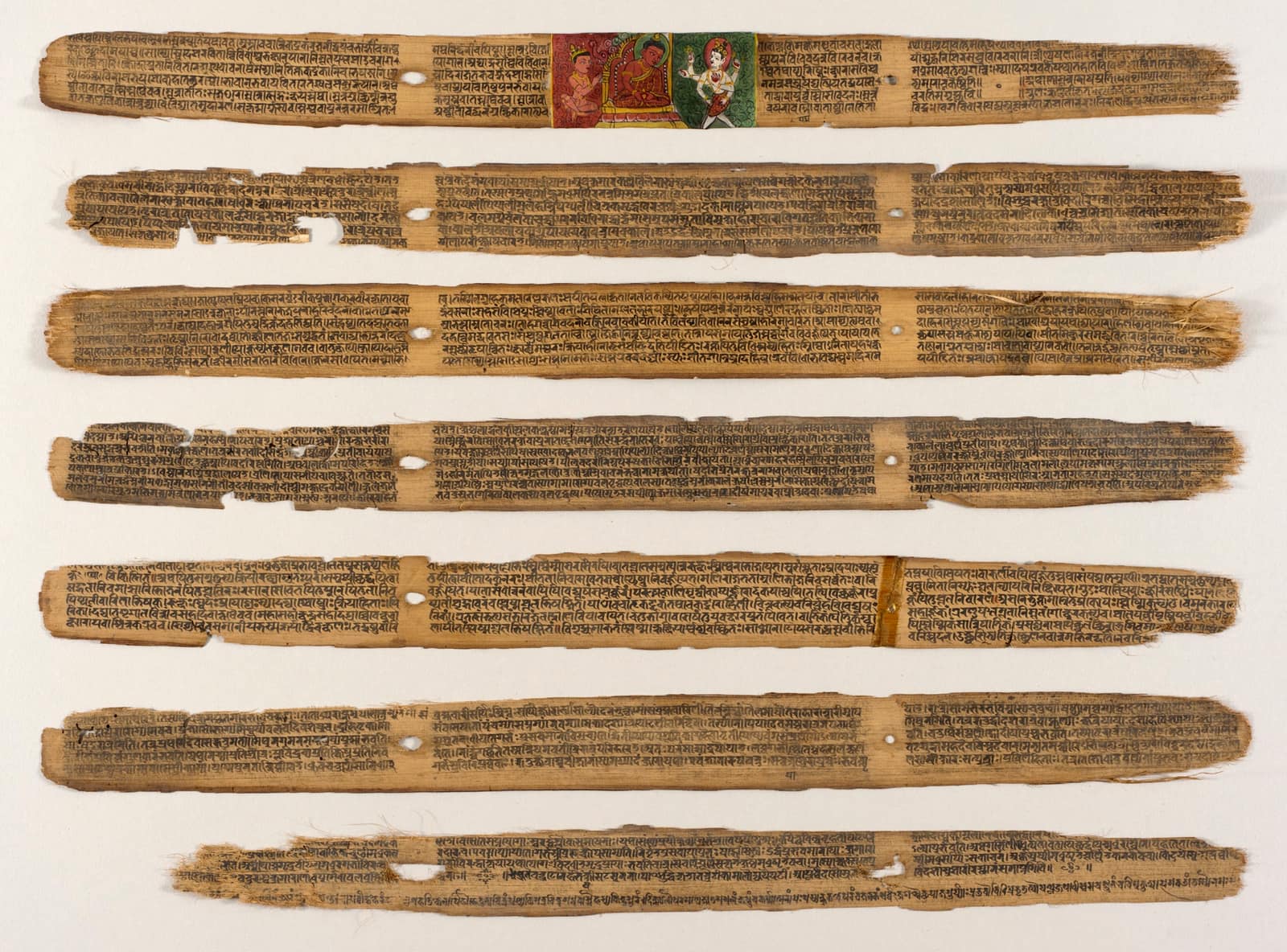
The copy that has come down to us from the furthest back was written in Nepal in the year 878, on dried leaves of the palm, and kept there through eleven centuries of monsoons. The leaves shown here are a later Nepalese copy, with small painted figures among the lines.
The author's name is known. Almost nothing else about him is.
Established
- The Sushruta Samhita, the Compendium of Sushruta, is a Sanskrit treatise on medicine that gives particular attention to surgery; it is one of the foundational texts of Ayurveda (UNESCO; Wujastyk 2003).
- The oldest known manuscript of the text is a palm-leaf manuscript copied in Nepal and dated to 878 CE, kept in the Kaiser Library in Kathmandu as MS KL 699 (Harimoto 2014; Suśruta Project).
- This manuscript was entered on UNESCO's Memory of the World Register in 2013 (UNESCO).
- The Nepalese manuscripts preserve an earlier version of the text than the one known from later Indian manuscripts and printed editions (Harimoto 2014; Suśruta Project).
- The treatise describes surgical instruments and procedures, including the repair of a severed nose with a flap of skin from the cheek (Wujastyk 2003).
Interpretation
When the Sushruta Samhita was composed is uncertain. Many scholars place its core in the centuries before about 500 CE, with sections added and revised over a long period; claims that it dates from the first millennium BCE or earlier rest on tradition rather than on dated evidence. Sushruta himself, presented as the pupil of Divodasa, king of Kashi, cannot be identified as a historical person.
In 10,000 years
In 10,000 years, will the hands that mend a body still learn from words first written on leaves?
Sources (5)
- UNESCO Memory of the World. Susrutamhita (Sahottartantra) manuscript, Kaiser Library, Kathmandu, inscribed 2013. · www.unesco.org
- Harimoto, K. Nepalese manuscripts of the Suśrutasaṃhitā. Journal of Indian and Buddhist Studies 62 (3), 2014, p. 1087-1093.
- Wujastyk, D. The Roots of Ayurveda: Selections from Sanskrit Medical Writings. London, Penguin Classics, 2003.
- Wujastyk, D., et al. The Suśruta Project: the textual and cultural history of medicine in South Asia based on newly discovered manuscript evidence. · sushrutaproject.org
- Los Angeles County Museum of Art. The Susruta-Samhita or Sahottara-Tantra, Nepal, text 12th to 13th century, M.87.271a-g.