The book of al-jabr: al-Khwarizmi's algebra
Before this book, problems with an unknown were solved case by case, as recipes; after it, they could be reduced step by step to a few standard forms with general methods of solution, and the name of that art, al-jabr, became algebra.
- Dated
- Place
- Baghdad, Iraq · Muhammad ibn Musa al-Khwarizmi, a scholar at the court of the Abbasid caliph al-Ma'mun in Baghdad, writing in Arabic; the copy pictured was made in 1342
- Coordinates
- 33° 19′ N · 44° 22′ E (approximate)
- Remains
- Fragmentary
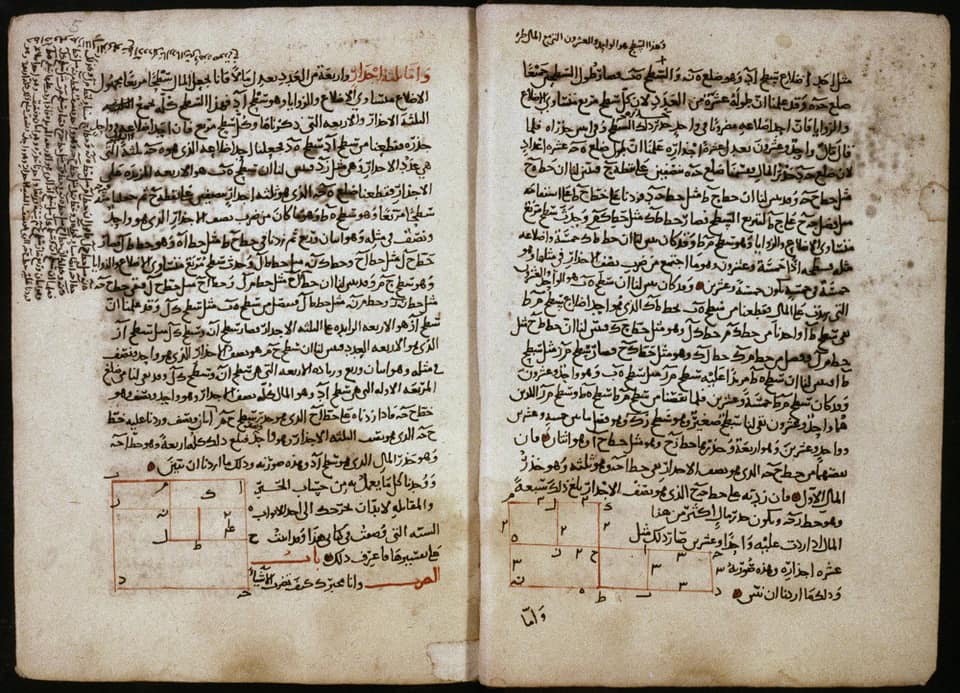

Bodleian Libraries, University of Oxford, MS. Huntington 214, public domain, via Wikimedia CommonsPDMOriginal record
Data saver is on. Images load only when you ask. You can change this in Settings at any time.
From the archivist
It opens, as books of this time and place often did, with praise to God and to the caliph who had encouraged the work. Then it turns to what people need every day: inheritances, trade, the measuring of land.
A man in Baghdad, around 820, set out to teach what he called the art of restoring and balancing. You have a quantity you do not know. You write down what you know about it, in words, for this civilization had not yet invented the signs. Then you restore, moving what was taken away to the other side; you balance, removing what is alike on both. What is left belongs to one of six forms, and each form has its method.
For the hardest ones he drew a square and added strips around it, until the unknown could be seen as the side of a larger square.
The copy kept here was made in 1342, by a hand long after his. Latin readers turned his title into algebra, and his name into algorithm. Both words are still in daily use.
Established
- In Baghdad, under the Abbasid caliph al-Ma'mun (reigned 813 to 833), Muhammad ibn Musa al-Khwarizmi wrote al-Kitab al-mukhtasar fi hisab al-jabr wa'l-muqabala, the concise book of calculation by restoring and balancing, which he dedicated to the caliph; it is usually dated to about 820 (MacTutor; Rosen 1831).
- Al-jabr, restoring, moved a subtracted quantity to the other side of an equation; al-muqabala, balancing, cancelled like terms on both sides. With them he reduced problems to six standard forms of equations of the first and second degree and gave a method for each (MacTutor).
- The book is written entirely in words, without symbols; the solutions of quadratic equations are justified by diagrams of squares and rectangles, and its second half applies the methods to inheritance, trade and measurement (MacTutor; Rosen 1831).
- The copy pictured, MS. Huntington 214 in the Bodleian Library, Oxford, was made in 1342, more than five centuries after the author's lifetime; Friedrich Rosen based the first printed edition and English translation on it in 1831 (Bodleian Libraries; Rosen 1831).
- Robert of Chester translated the book into Latin at Segovia in about 1145 as the Liber algebrae et almucabola, and the word algebra comes from its al-jabr (Karpinski 1915).
- Al-Khwarizmi's treatise on calculating with Indian numerals is lost in Arabic but survives in Latin, where the opening words Dixit Algorizmi, thus spoke al-Khwarizmi, turned his name into algorism, and later algorithm (MacTutor).
Interpretation
Calling al-Khwarizmi the father of algebra is a matter of debate. Babylonian scribes had solved problems equivalent to quadratic equations some two thousand years earlier, Diophantus of Alexandria wrote on such problems in the 3rd century, and Brahmagupta gave rules for them in India in 628; historians disagree on how much al-Khwarizmi drew on Greek, Mesopotamian or Indian traditions. What is widely credited to him is algebra taught for its own sake, as a general method. Later sources place him at the House of Wisdom in Baghdad, but whether that institution was a palace library or a true academy is still discussed.
In 10,000 years
In 10,000 years, when machines follow algorithms no one reads, will anyone remember that the word was once a man's name?
Sources (4)
- Rosen, F. (ed. and trans.). The Algebra of Mohammed ben Musa. London, Oriental Translation Fund, 1831 (edition made from Bodleian MS. Huntington 214). · archive.org
- O'Connor, J. J., Robertson, E. F. Abu Ja'far Muhammad ibn Musa Al-Khwarizmi. MacTutor History of Mathematics Archive, University of St Andrews. · mathshistory.st-andrews.ac.uk
- Bodleian Libraries, University of Oxford. MS. Huntington 214, Kitab al-mukhtasar fi hisab al-jabr wa'l-muqabala, copied 1342 (Digital Bodleian). · digital.bodleian.ox.ac.uk
- Karpinski, L. C. Robert of Chester's Latin Translation of the Algebra of Al-Khowarizmi. New York, Macmillan, 1915. · archive.org
Related fragments
224 to 993 CE
The Bakhshali manuscript
Near Mardan, Khyber Pakhtunkhwa, Pakistan · Asia
1950
"Computing Machinery and Intelligence" (Turing, 1950)
Manchester, United Kingdom · Europe
200 BCE to 105 CE
Paper: a sheet of pounded rags and bark
Luoyang, Henan, China · Asia