The Timbuktu manuscripts
- Dated
- Place
- Timbuktu, Mali · Scholars, copyists and family libraries of Timbuktu and the Sahel
- Coordinates
- 16° 46′ N · 3° 01′ W (approximate)
- Remains
- Fragmentary
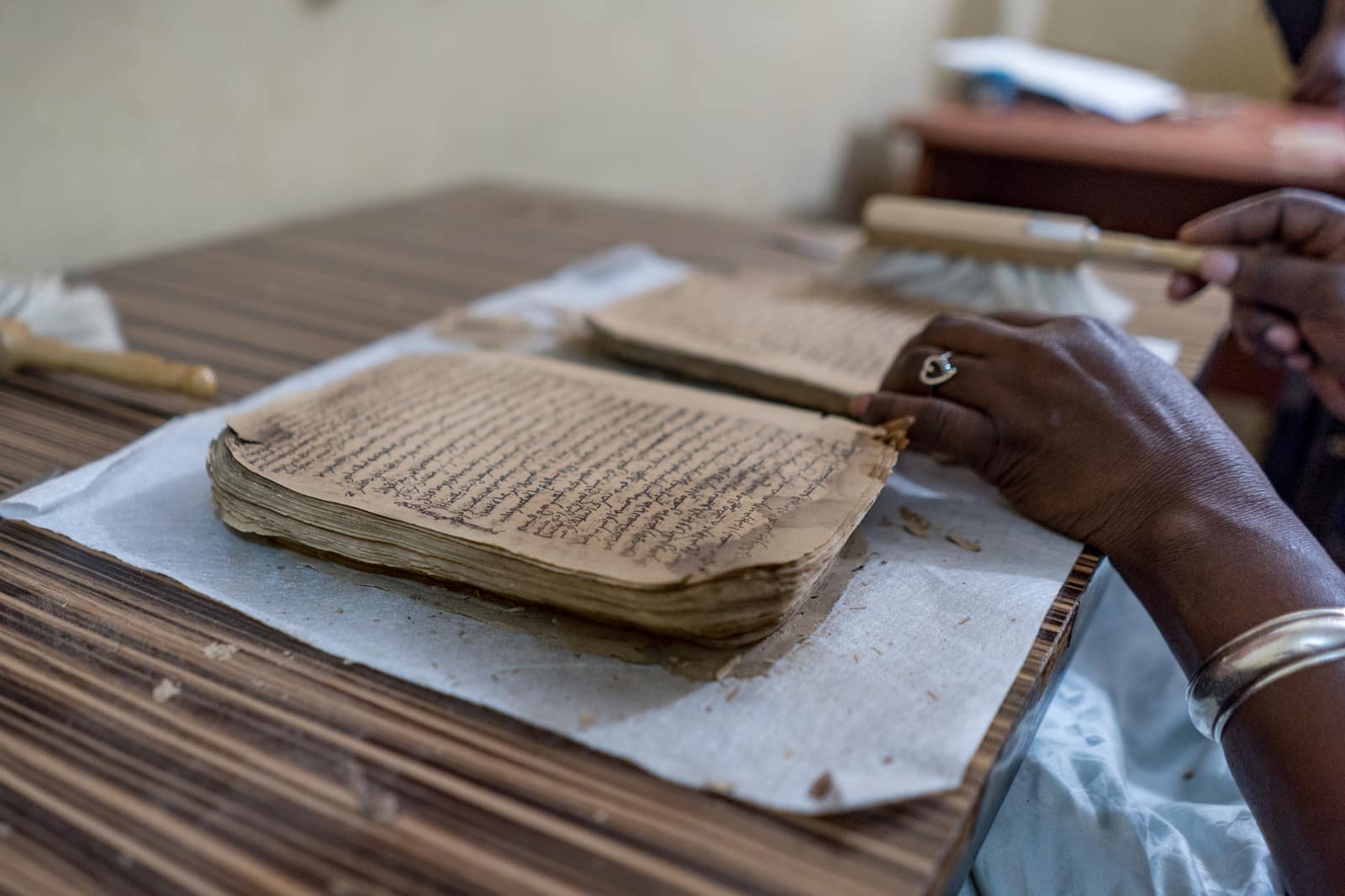
.jpg)
Mark Fischer, CC BY-SA 2.0, via Wikimedia Commons (Flickr: fischerfotos)CC-BY-SA-2.0Original record
Data saver is on. Images load only when you ask. You can change this in Settings at any time.
From the archivist
This civilization wrote at the edge of a desert. Timbuktu stood where the caravans from the Sahara met the boats of the Niger, and with salt, gold and cloth came paper and books. Families copied them, bought them, annotated their margins, and passed them down.
The pages speak of everything. How to read the stars to know the seasons. How to divide an inheritance. How to treat a fever with plants and minerals. How to add and multiply. How the soul draws nearer to God. Some are in Arabic, others in African languages written in Arabic letters. Kept in chests and in family rooms, they survived heat, dust and termites for centuries.
In 2012, armed men took the city. The keepers of the libraries decided not to wait. For months they packed the manuscripts into rice sacks and metal trunks and sent them south, on carts, in cars, on boats down the river, to Bamako. When the occupiers withdrew in January 2013, they set fire to part of a library, and more than four thousand manuscripts were lost. Almost all the rest had already gone.
In August 2025, the first crates began to fly home.
Established
- The manuscripts are written in Arabic script, in Arabic and in African languages transcribed in that script (Ajami), and cover astronomy, arithmetic, medicine, Islamic law and Sufism, among other subjects (Library of Congress).
- Some of the manuscripts date back to the 13th century (United Nations expert mission, reported by the Associated Press, 2025).
- During the armed occupation of Timbuktu in 2012 and 2013, 4,203 manuscripts held at the Ahmed Baba Institute were burned or stolen (UNESCO, 2015).
- About 90% of Timbuktu's ancient manuscripts were saved by local people with the help of the association SAVAMA-DCI, most of them evacuated to Bamako (UNESCO, 2015).
- The custodians carried them out of the occupied city in rice sacks, on donkey carts, by motorcycle, by boat and in four-wheel drive vehicles; the Malian authorities began returning them to Timbuktu in August 2025 (Associated Press, 2025).
Interpretation
The total number of manuscripts in Timbuktu and the region is uncertain: estimates range from tens of thousands to several hundred thousand, and many remain uncatalogued in private hands. How far these libraries reflect original scholarship rather than the copying of works from North Africa and the Middle East is still being studied, and the answer differs from one manuscript to the next.
In 10,000 years
In 10,000 years, who will carry our libraries out of a burning city?
Sources (3)
- UNESCO World Heritage Centre. International conference on the Timbuktu manuscripts, Bamako, 28 to 30 January 2015 (news 1228). · whc.unesco.org
- Library of Congress. Ancient Manuscripts from the Desert Libraries of Timbuktu, exhibition, 2003. · www.loc.gov
- Associated Press. Timbuktu's famed manuscripts return home after 13 years in Mali's capital. PBS News, 12 August 2025. · www.pbs.org
Related fragments
c. 20,000 years ago
The Ishango bone
Ishango, Virunga National Park, North Kivu, Democratic Republic of the Congo · Africa
1100 to 1500
Great Zimbabwe
Near Masvingo, Zimbabwe · Africa