The Dresden Codex: eight scribes who counted the sky
- Dated
- Place
- Yucatán Peninsula, Mexico (presumed place of origin) · Maya scribes and daykeepers of the Postclassic period, probably northern Yucatán
- Coordinates
- 20° 42′ N · 89° 06′ W (approximate)
- Remains
- Fragmentary
This fragment shows an object held as sacred.
It is shown here as the institution that holds it presents it. Some communities connected to it ask that it be viewed with care. You may choose to see the image, or read the record without it.
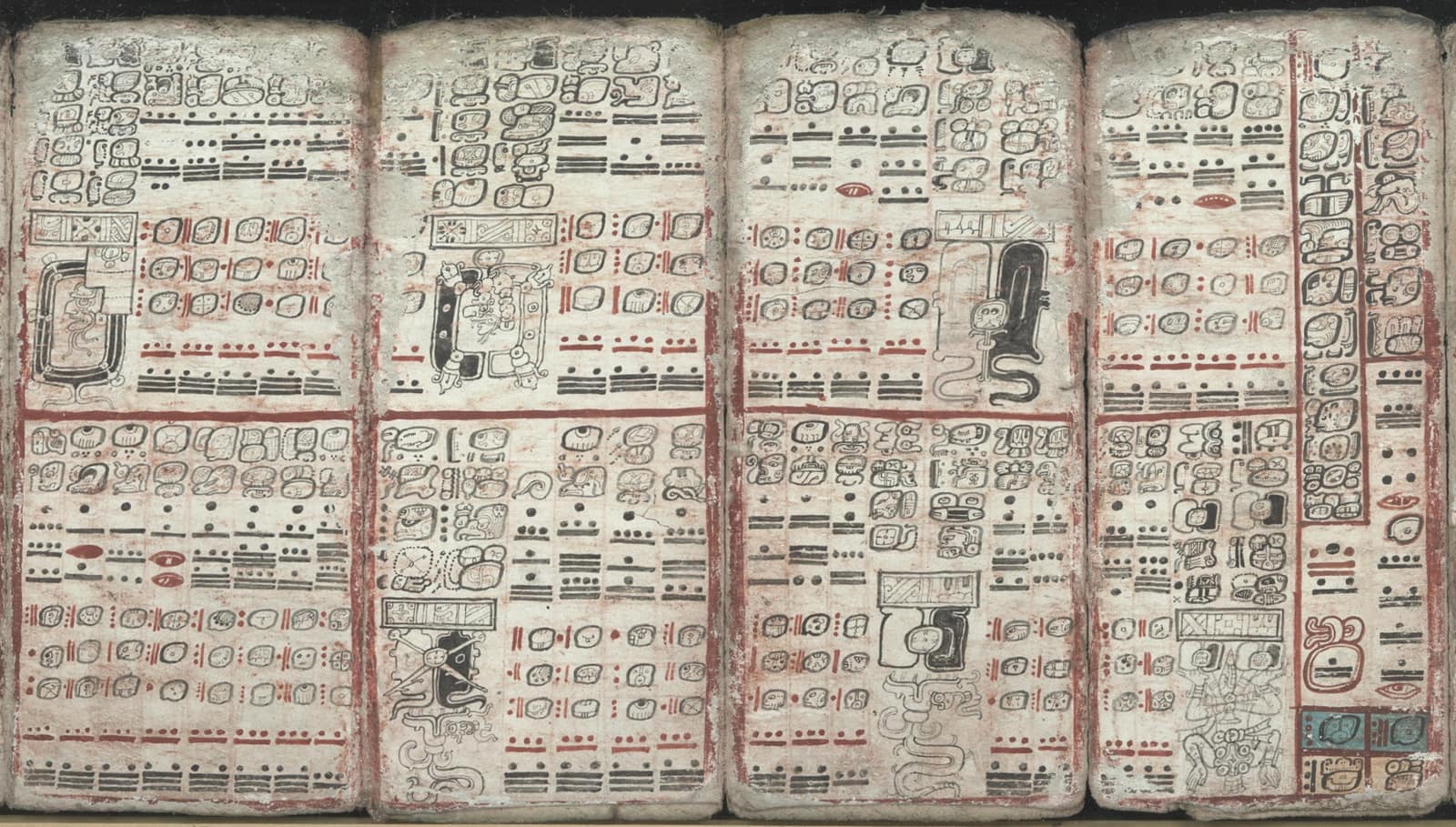
Image veiled by default
Dresden Codex (Codex Dresdensis), SLUB Dresden, Mscr.Dresd.R.310, public domain, via Wikimedia CommonsPDMOriginal record
Data saver is on. Images load only when you ask. You can change this in Settings at any time.
From the archivist
At least eight scribes painted this book, under a master who knew the sky. We do not know their names. We know their hands: one wrote several chapters in a row, two shared a page, another stopped halfway.
They worked on a long strip of fig-bark paper, folded like a screen and coated with white plaster. When a scribe made a mistake, the white was scraped away and laid on again. In black and red they wrote numbers as dots and bars, and where a count was empty they drew a small shell.
With those numbers they followed Venus as she rose before the dawn, and they kept watch on the Sun. Their table marked, months and years ahead, the days on which the Sun might go dark, so that the darkness would not come unannounced.
On page 42 the outlines of the signs are drawn but never filled in. Some pages were left white.
In 1562, a friar burned the Maya books he could find. This one had probably already crossed the ocean. It is one of four that remain, its colours softened by the water that reached it in Dresden in 1945.
Established
- The codex is a strip of fig-bark paper (hu'un) folded like a screen into 39 leaves of about 20.5 by 9.1 cm, painted on both sides; mounted under glass for more than a century, it is kept in two parts 182 and 174 cm long (Bittinger et al.; Grube).
- Before painting, each page was coated with a smooth white layer of calcium carbonate or gypsum; a mistake could be corrected by scraping off the layer and applying it again (Grube).
- Differences in hand show that at least eight scribes worked on it in a workshop, under an experienced master scribe; some pages were shared by two scribes (Grube).
- The book was never finished: some prepared pages were left blank, and on others, such as page 42, the scribe drew only the outlines of the hieroglyphs without the fine inner lines (Grube).
- Numbers are written with bars for five, dots for one and a stylised shell for zero (Grube).
- A chapter of five pages, including page 50, follows the positions of the planet Venus and shows two morning-star gods and one of their victims (Grube).
- Its eclipse table gives 69 new-moon dates within a span of 405 lunar months; 55 of them were meant to warn of days on which a solar eclipse might occur (Justeson and Lowry 2025).
- On 14 July 1562, the Franciscan Diego de Landa had Maya books burned at Maní, in Yucatán; the Dresden Codex is one of only four Maya books known to survive (Grube).
- In 1945, during the Second World War, water damage made parts of the painted surface stick to the glass; the paint is powdery and has losses (Bittinger et al.).
Interpretation
The date of the codex is debated: older studies place it around 1200 to 1250, more recent ones in the fourteenth or fifteenth century, and the astronomical tables it copies may be older than the book itself (Justeson and Lowry 2025 place the last station of the eclipse table no later than about 1148 CE). It may be a copy or new edition of a lost model. Whether readers used carved pointers of wood or bone to follow the columns, as Grube suggests, is a reasonable inference rather than a record. The route by which it reached Vienna, through Franciscans in Campeche and the court of Charles V, is a reconstruction. Sources differ on the year of its acquisition for Dresden, 1734 or 1739.
Looking ahead
A thousand years from now, which of our calculations will still be correct, and which page will we have left unfinished?
Sources (4)
- Grube, N. A 'priceless Mexican book written in hieroglyphs': the Dresden Codex. Artefact of the Month 23, Centre for the Study of Manuscript Cultures, University of Hamburg. · www.csmc.uni-hamburg.de
- Justeson, J., Lowry, J. The design and reconstructible history of the Mayan eclipse table of the Dresden Codex. Science Advances 11 (43), 2025, eadt9039. · doi.org
- Bittinger, C., Trautmann, A., Mayer, M., Banik, G. Codex Dresdensis: Zustandsbeschreibung, Aufbewahrungs- und Ausstellungsbedingungen, Transportkonzeption. Conservation study on the manuscript held by the SLUB Dresden (published online by Conservation OnLine). · cool.culturalheritage.org
- Sächsische Landesbibliothek, Staats- und Universitätsbibliothek Dresden (SLUB). Codex Dresdensis, Mscr.Dresd.R.310, digital collections (page not reachable when this fragment was written; cited from the shelfmark).
Related fragments
224 to 993 CE
The Bakhshali manuscript
Near Mardan, Khyber Pakhtunkhwa, Pakistan · Asia
1400 to 1800
The khipu
Peru · Americas
1431 to 1582
Only a little while here: the songs of Nezahualcóyotl
Texcoco, State of Mexico, Mexico · Americas