Only a little while here: the songs of Nezahualcóyotl
- Dated
- Place
- Texcoco, State of Mexico, Mexico · Nahua (Acolhua) of Texcoco, songs recorded under Spanish rule
- Coordinates
- 19° 31′ N · 98° 53′ W (approximate)
- Remains
- Fragmentary
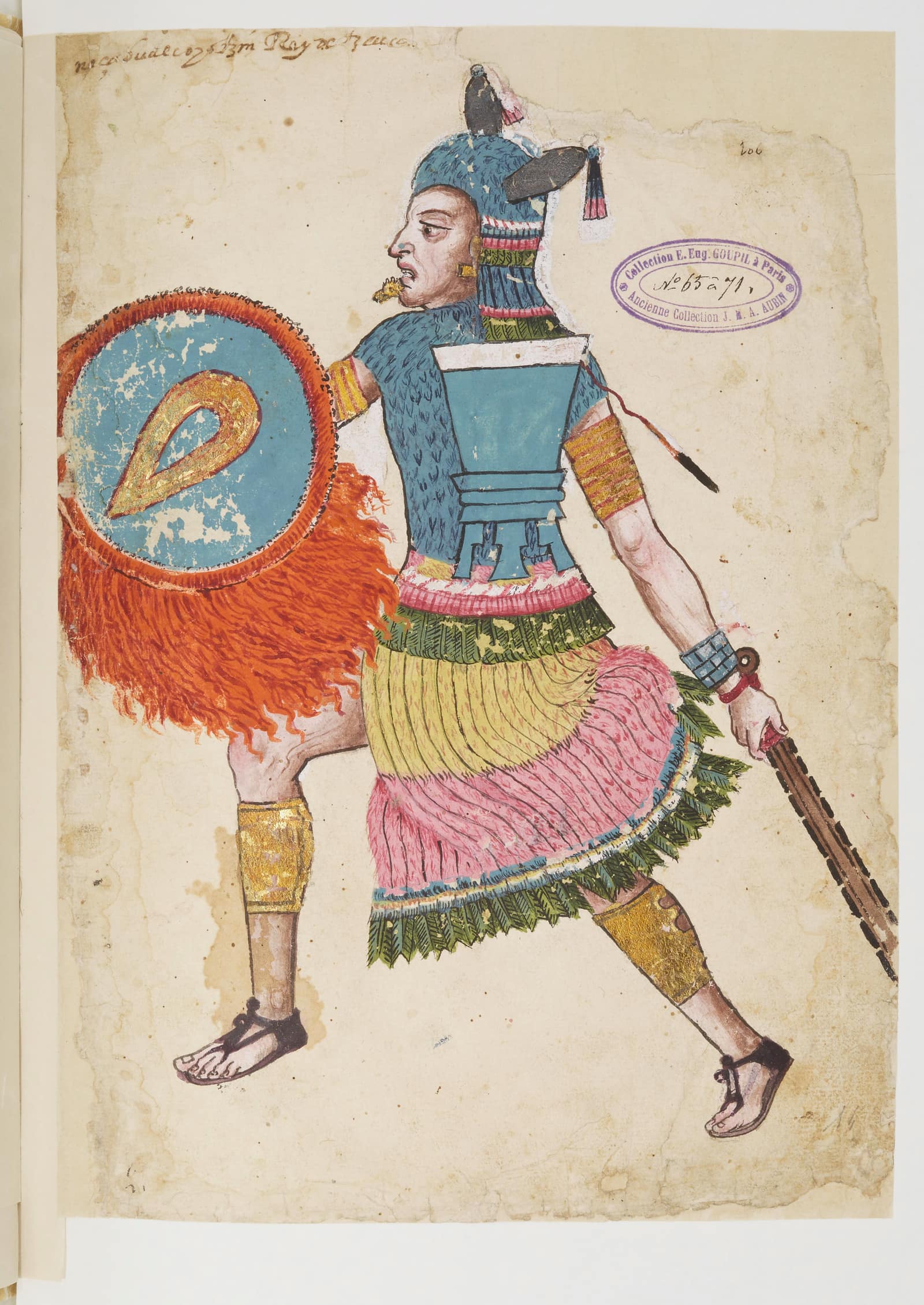
Codex Ixtlilxochitl, folio 106r, Bibliothèque nationale de France (Mexicain 65-71), domaine public, via Wikimedia CommonsPDMOriginal record
Data saver is on. Images load only when you ask. You can change this in Settings at any time.
From the archivist
A lord of Texcoco, in the fifteenth century, is remembered less for his wars than for a question. Nezahualcóyotl, whose name speaks of a fasting coyote, ruled the city on the eastern shore of the lake of Mexico from 1431 until 1472. Around his name, songs were sung to the beat of drums, and some of them outlived the fall of his world.
One of them asks whether it is true that one lives on earth, and answers: "Not forever on earth, only a little while here." Then it counts what does not last. Jade cracks. Gold breaks. The long green feathers of the quetzal tear.
This civilization held jade and plumes to be the most precious things it knew. The song names them only to let them go.
We do not have his voice. We have words that Nahua scribes wrote down in Latin letters a few decades after the conquest, in a land now ruled by Spain, and copied again at the end of the century. Whether he made this song, or others sang it in his name, can no longer be settled.
The sorrow in it needs no author. It belongs to anyone who has held something beautiful and known it would not stay.
Established
- Nezahualcóyotl, born in 1402 according to the colonial chronicles, ruled Texcoco, on the eastern shore of the lake of Mexico, from 1431 until his death in 1472; his fame as a maker of songs was recorded around 1600 by the chroniclers Juan de Torquemada and Fernando de Alva Ixtlilxóchitl (León-Portilla 2011).
- The songs linked to his name survive in two manuscripts written in Nahuatl with Latin letters after the conquest: the Cantares mexicanos, kept at the Biblioteca Nacional de México, and the Romances de los señores de la Nueva España, kept at the Benson Latin American Collection in Austin (León-Portilla 2011; Martínez Baracs 2013).
- The stanza on impermanence, in the Cantares mexicanos (folio 17r), reads in Nahuatl: "an nochipa tlalticpac, zan achica ye nican", "not forever on earth, only a little while here"; it goes on to say that even jade cracks, gold breaks and quetzal plumes tear (Mexicolore, after Bierhorst).
- The Romances contain other songs on the same theme, such as the line "zan achica netlalcahuilo nican", "only for a short while is the earth lent to us here" (Dirección General de Bibliotecas 2023, after Garibay).
- These songs were sung to the upright drum (huehuetl) and the slit drum (teponaztli); their music was not written down (León-Portilla 2011).
Interpretation
Whether Nezahualcóyotl himself composed any of these songs is disputed. Miguel León-Portilla, following Ángel María Garibay, attributed some thirty compositions to him, taking the first person ("I, Nezahualcóyotl") and the glosses of the manuscripts as signs of authorship. Jongsoo Lee argues that most attributions do not withstand scrutiny and that the image of a peaceful philosopher king was largely built in colonial times. John Bierhorst reads the Cantares as colonial-era "ghost songs" in which jade, gold and plumes are code words for warriors, so that the stanza speaks of death in battle more than of a general meditation on transience; other specialists, among them León-Portilla and James Lockhart, have rejected his wider thesis. The dates of the ruler's life also come from colonial chronicles.
Looking ahead
You who read this a thousand years from now: if these lines still reach you, you will have kept a lament about not lasting, which is a strange way to last.
Sources (5)
- León-Portilla, M. (ed.). Cantares mexicanos, 3 vol. Mexico, Universidad Nacional Autónoma de México, Instituto de Investigaciones Históricas and Fideicomiso Teixidor, 2011; Estudio introductorio, p. 151-295. · historicas.unam.mx
- Martínez Baracs, R. Review of Cantares mexicanos (ed. M. León-Portilla, 2011). Estudios de Cultura Náhuatl 45, 2013. · www.scielo.org.mx
- Lee, J. The Allure of Nezahualcoyotl: Pre-Hispanic History, Religion, and Nahua Poetics. Albuquerque, University of New Mexico Press, 2008. · www.unmpress.com
- Dirección General de Bibliotecas, Secretaría de Cultura (Mexico). "No acabarán mis flores, no cesarán mis cantos": poemas del Rey Poeta Nezahualcóyotl, texts after Garibay (Romances de los señores de la Nueva España) and León-Portilla (Cantares mexicanos), 2023. · dgb.cultura.gob.mx
- Mexicolore. Is this a Nezahualcoyotl poem? (with comments by John Bierhorst on Cantares mexicanos, folio 17r). · www.mexicolore.co.uk
Related fragments
170 to 310 CE
The Pyramid of the Sun, Teotihuacan
San Juan Teotihuacán, State of Mexico, Mexico · Americas
1400 to 1800
The khipu
Peru · Americas