The Pyramid of the Sun, Teotihuacan
- Dated
- Place
- San Juan Teotihuacán, State of Mexico, Mexico · The people of Teotihuacan, a multiethnic city of the Basin of Mexico
- Coordinates
- 19° 42′ N · 98° 51′ W (approximate)
- Remains
- Reconstructed
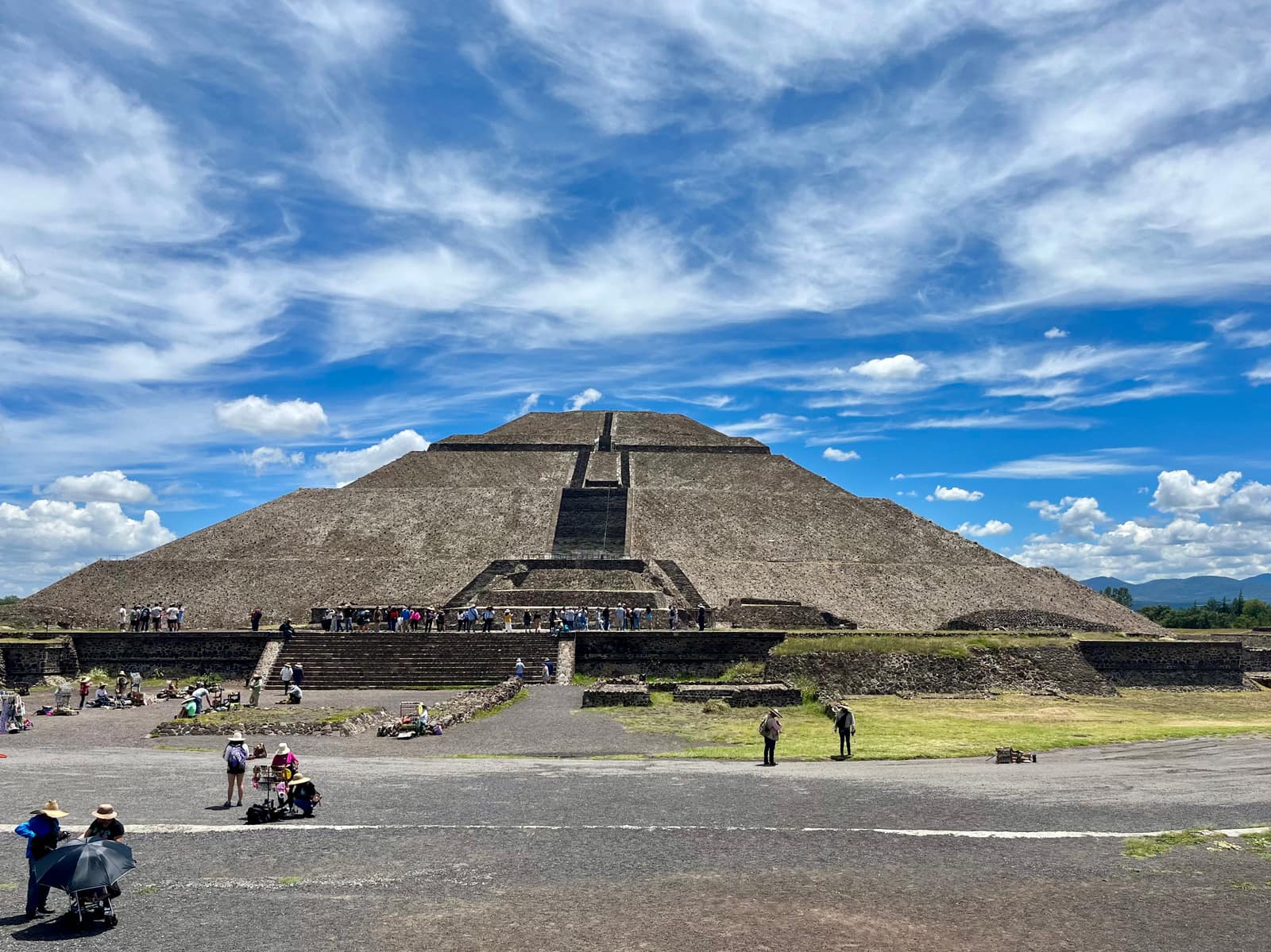

Malkowo, CC BY 4.0, via Wikimedia CommonsCC-BY-4.0Original record
Data saver is on. Images load only when you ask. You can change this in Settings at any time.
From the archivist
This civilization built a mountain of its own. Around the end of the second century, the people of a great city in the highlands of Mexico heaped earth and rubble, faced it with stone and plaster, and raised it in stepped terraces until it stood about sixty-five metres above the valley floor. Beneath it, earlier, someone had dug a long passage into the rock, as if the monument had to rest upon a hidden place.
The pyramid faced a broad avenue, several kilometres long, lined with temples, palaces and apartment compounds where people from many regions lived side by side. Painted walls showed goddesses, jaguars and flowing water.
We do not know what the builders called it, nor what they called themselves. The city had already burned and emptied by the time the Mexica arrived, centuries later, walked among its ruins, and named it Teotihuacan, the place where gods were made. The name we give the pyramid is theirs, or ours.
In 1910 it was rebuilt to celebrate a young nation, and some of its skin was lost. It remains a mountain nobody forgets.
Established
- The Pre-Hispanic City of Teotihuacan, whose monuments line the Avenue of the Dead, was inscribed on the UNESCO World Heritage List in 1987 (UNESCO).
- Excavations inside the pyramid from 2008 to 2011, with ceramic and radiocarbon dating, place its construction between about 170 and 310 CE, later than once believed (Sugiyama, Sugiyama and Sarabia 2013).
- A tunnel discovered in 1971 runs beneath the pyramid; the same excavators argue that it was dug by people rather than formed naturally, and date it to about 140 to 240 CE (Sugiyama, Sugiyama and Sarabia 2013).
- Between 1905 and 1910 the archaeologist Leopoldo Batres restored the pyramid for the centenary of Mexican independence, removing much of its outer facing (Britannica).
- The names Teotihuacan and Pyramid of the Sun are later names in Nahuatl and Spanish; what the city's own people called the pyramid is not known (The Met).
Interpretation
Which god the pyramid honoured is uncertain: the link with the sun is a later tradition, and some researchers connect the monument with water, the rain god or the cave beneath it. The size of the city at its height, often estimated at tens of thousands to more than 100,000 people, and the reasons for its decline around the 6th century are still debated.
In 10,000 years
In 10,000 years, will a mountain made by hand still be taken for a mountain, or for a message?
Sources (4)
- UNESCO World Heritage Centre. Pre-Hispanic City of Teotihuacan (property 414), inscribed 1987. · whc.unesco.org
- Sugiyama, N., Sugiyama, S., Sarabia G., A. Inside the Sun Pyramid at Teotihuacan, Mexico: 2008-2011 excavations and preliminary results. Latin American Antiquity 24 (4), 2013, p. 403-432. · doi.org
- The Metropolitan Museum of Art. Teotihuacan: Pyramids of the Sun and the Moon, Heilbrunn Timeline of Art History essay. · www.metmuseum.org
- Encyclopaedia Britannica. Pyramid of the Sun. · www.britannica.com
Related fragments
1180 to 1500
Nan Madol
Madolenihmw, Pohnpei State, Federated States of Micronesia · Oceania
1100 to 1500
Great Zimbabwe
Near Masvingo, Zimbabwe · Africa