Stone poured like water: Roman concrete and the Pantheon dome
Before, great spaces were roofed with stone, timber or brick laid piece by piece; after Roman builders learned to cast lime, volcanic ash and rubble into moulds, vaults and domes could be poured as a single mass, a way of building the modern world later took up at a scale Rome never knew.
- Dated
- Place
- Piazza della Rotonda, Rome, Italy · Builders of the Roman Empire, under the emperors Trajan and Hadrian; the lime burners and ash diggers of the Bay of Naples
- Coordinates
- 41° 54′ N · 12° 29′ E (approximate)
- Remains
- Intact
This fragment shows an object held as sacred.
It is shown here as the institution that holds it presents it. Some communities connected to it ask that it be viewed with care. You may choose to see the image, or read the record without it.
.jpg)
Image veiled by default
Dennis Jarvis from Halifax, Canada, CC BY-SA 2.0, via Wikimedia CommonsCC-BY-SA-2.0Original record
Data saver is on. Images load only when you ask. You can change this in Settings at any time.
From the archivist
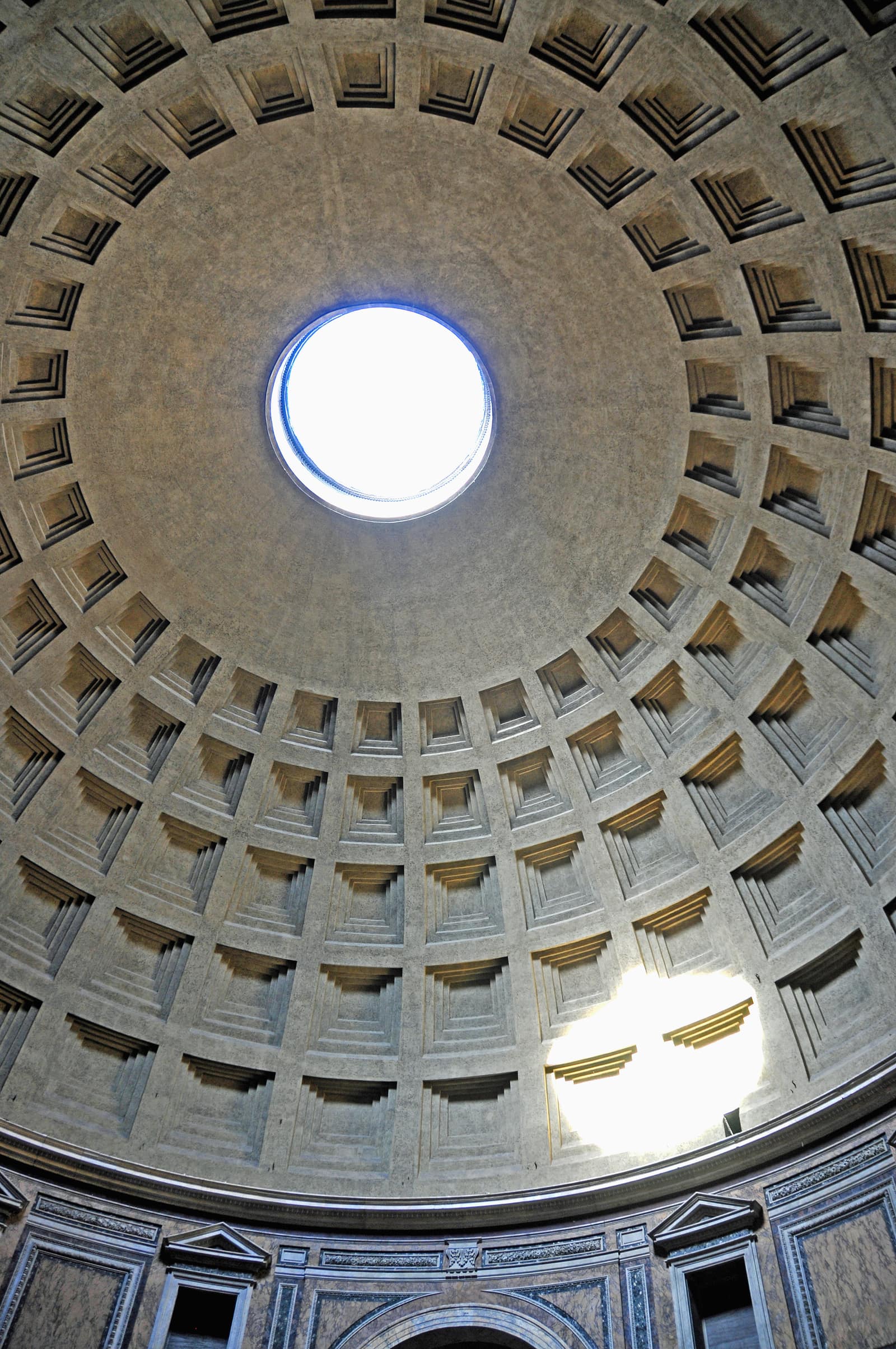
Under the dome there is no column. Nothing holds up the roof but the roof itself, a single shell cast in grey stone, pierced at the top by a round hole open to the sky. When it rains, the rain falls through onto the marble floor.
The builders poured it. They mixed lime, burned from limestone, with a volcanic ash dug near the Bay of Naples, and packed the paste with rubble: heavy stone at the base, lighter stone above, and near the crown a stone so light it could float. They shaped the inside into rings of hollow coffers, to take away more weight.
The inscription on the porch gives the name of Agrippa, who had built an earlier temple here. The dome itself was finished nearly a century and a half after him, under Hadrian.
It has stood for close to nineteen hundred years. The concrete of this civilization's own last centuries, stronger and far more abundant, is rarely asked to last so long.
Established
- Roman builders made concrete, opus caementicium, by binding lumps of stone or broken brick with a mortar of lime and volcanic ash; Vitruvius wrote in the 1st century BCE that the ash found between Baiae and Mount Vesuvius, mixed with lime and rubble, hardened even under water (De architectura 2.6; Jackson et al. 2017).
- The Pantheon in Rome was rebuilt in its present form in the 2nd century CE and completed under Hadrian by about 125 to 128; its concrete dome spans about 43.3 m, with an open oculus at the top, and the aggregate in the concrete becomes lighter towards the crown (Mark and Hutchinson 1986).
- The brick stamps in the building date almost all to the 110s, which led Lise Hetland to argue in 2007 that construction began under Trajan, around 114, and was finished under Hadrian (Hetland 2007).
- In 2023 a team led from the Massachusetts Institute of Technology (MIT) reported that the white lime clasts found in Roman mortars, sampled at the city wall of Privernum, point to hot mixing with quicklime, and that these clasts can supply calcium that refills cracks when water enters (Seymour et al. 2023; MIT News).
- In Roman harbour structures, seawater percolating through the concrete over centuries has grown interlocking crystals of aluminous tobermorite and phillipsite in the mortar (Jackson et al. 2017).
- Modern concrete relies on Portland cement: global CO2 emissions reached 36.8 billion tonnes in 2023, of which cement production accounted for about 7 to 8% (Wu et al. 2024).
Interpretation
The Pantheon dome is often described as the largest unreinforced concrete dome in the world, a claim repeated by many sources rather than a formally measured record. Roman concrete is weaker in compression than modern concrete; much of its reputation for durability rests on the fact that, without steel bars, it had nothing to rust, and on the survival of the best buildings while failed ones vanished. Whether the lime clasts were a deliberate recipe or a by-product of mixing is still discussed, and the date at which the Pantheon was begun, under Trajan or under Hadrian, is argued from the same brick stamps.
In 10,000 years
In 10,000 years, will the concrete of this civilization's cities still stand, or will its oldest domes outlast its newest ones?
Sources (6)
- Mark, R., Hutchinson, P. On the structure of the Roman Pantheon. The Art Bulletin 68 (1), 1986, p. 24-34. · doi.org
- Hetland, L. M. Dating the Pantheon. Journal of Roman Archaeology 20, 2007, p. 95-112.
- Seymour, L. M., Maragh, J., Sabatini, P., Di Tommaso, M., Weaver, J. C., Masic, A. Hot mixing: mechanistic insights into the durability of ancient Roman concrete. Science Advances 9 (1), 2023, eadd1602. · doi.org
- Jackson, M. D., Mulcahy, S. R., Chen, H., Li, Y., Li, Q., Cappelletti, P., Wenk, H.-R. Phillipsite and Al-tobermorite mineral cements produced through low-temperature water-rock reactions in Roman marine concrete. American Mineralogist 102 (7), 2017, p. 1435-1450. · pubs.geoscienceworld.org
- Wu, S., Shao, Z., Andrew, R. M. et al. Global CO2 uptake by cement materials accounts 1930-2023. Scientific Data 11, 2024. · doi.org
- Massachusetts Institute of Technology, MIT News. Riddle solved: Why was Roman concrete so durable? 6 January 2023. · news.mit.edu
Related fragments
c. 2560 BCE
The Great Pyramid of Giza
Giza, Greater Cairo, Egypt · Africa
before 2014
Plastiglomerate from Kamilo Beach: a stone of our own making
Kamilo Beach, Hawai'i Island, Hawaii, United States · Oceania