The Great Pyramid of Giza
- Dated
- Place
- Giza, Greater Cairo, Egypt · Ancient Egypt, Old Kingdom (Fourth Dynasty, reign of Khufu)
- Coordinates
- 29° 59′ N · 31° 08′ E (approximate)
- Remains
- Intact
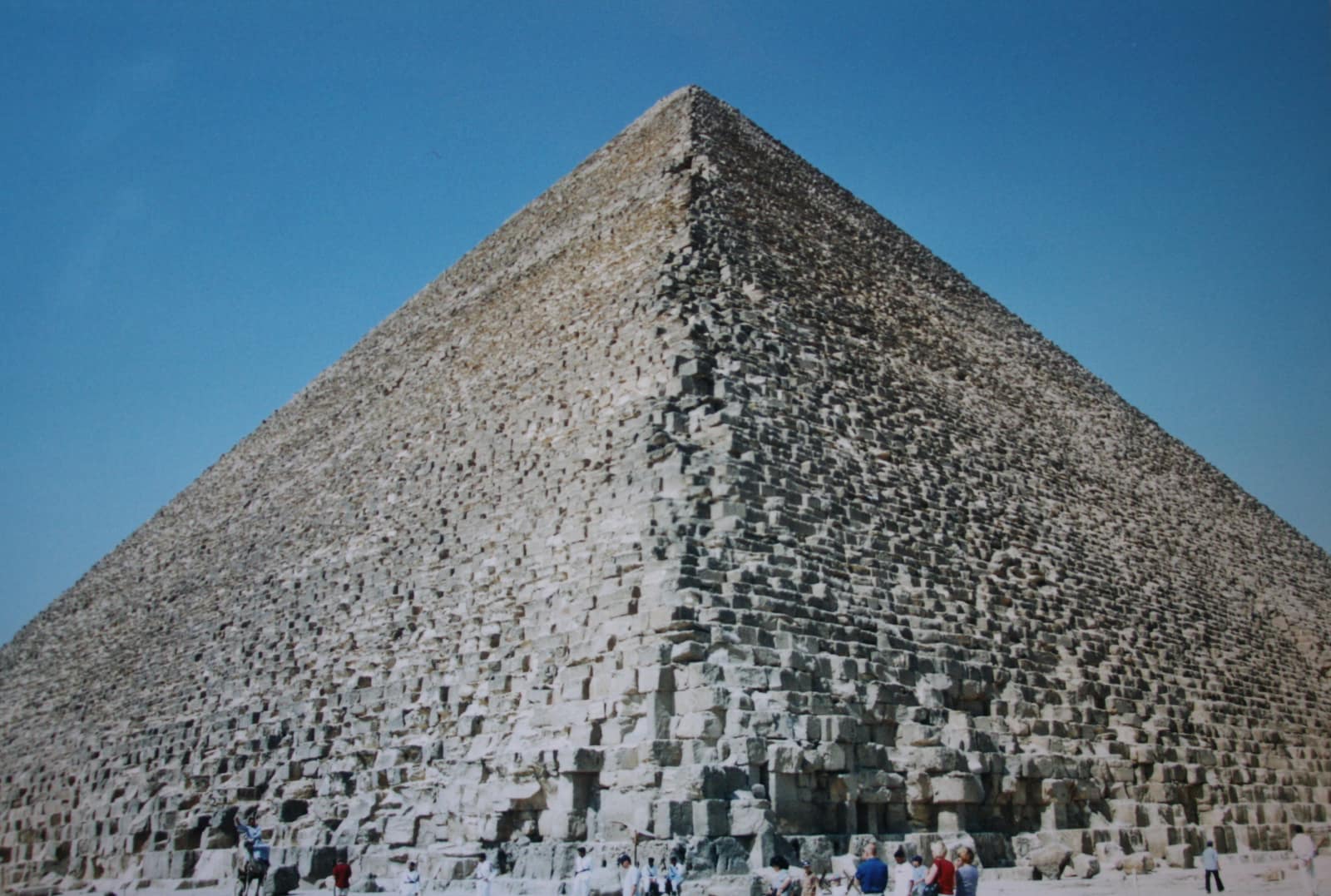
Gary Todd, CC0, via Wikimedia CommonsCC0-1.0Original record
Data saver is on. Images load only when you ask. You can change this in Settings at any time.
From the archivist
This civilization once built a mountain for a single man. On the desert edge west of the Nile, the workers of King Khufu set more than two million blocks of stone, course upon course, until the point stood about one hundred and forty-six metres above the sand.
When it was finished, it was white. Its faces were cased in fine limestone from the quarries of Tura, across the river, dressed so smoothly that the sun would have struck it like a blade. Inside, narrow passages lead up to a granite room where the king was laid in a stone coffin.
We know a little of those who built it. In a cave harbour on the Red Sea, papyri kept the diary of an inspector called Merer. For months, his crew loaded limestone at Tura and sailed it along canals to Giza, noting each trip, each day.
Most of the white casing was later carried away to build other cities. What remains is the core, stepped and weathered, and for some three thousand eight hundred years nothing made by human hands stood taller.
Established
- The Great Pyramid was built for King Khufu of the Fourth Dynasty, who reigned about 2589 to 2566 BCE; it originally stood about 146.5 metres high and is the last surviving monument of the Seven Wonders of the ancient world (Egyptian Ministry of Tourism and Antiquities).
- It holds three chambers, one cut into the bedrock beneath it and two built high in the masonry; the upper one, the King's Chamber, contains the sarcophagus in which Khufu was laid (Egyptian Ministry of Tourism and Antiquities).
- Its outer casing was of fine limestone brought from the quarries of Tura, across the Nile; most of these stones are gone today (Egyptian Ministry of Tourism and Antiquities).
- Papyri found in 2013 at Wadi al-Jarf on the Red Sea include the logbook of an inspector named Merer, whose crew ferried limestone from Tura to Giza by boat in about year 27 of Khufu's reign (Tallet 2017).
- The pyramid fields from Giza to Dahshur were inscribed on the UNESCO World Heritage List in 1979 (UNESCO).
Interpretation
How the blocks were raised is still argued: straight, spiralling or internal ramps, levers, or a combination. The size and organisation of the workforce, long imagined as slaves, are now reconstructed from the workers' town and papyri as rotating crews of paid and fed labourers, though the details remain debated.
In 10,000 years
In 10,000 years, when its name is forgotten, will this mountain of stone still say that someone wanted to outlast death?
Sources (4)
- UNESCO World Heritage Centre. Memphis and its Necropolis, the Pyramid Fields from Giza to Dahshur (property 86), inscribed 1979. · whc.unesco.org
- Egyptian Ministry of Tourism and Antiquities. The Great Pyramid. · egymonuments.gov.eg
- Tallet, P. Les papyrus de la mer Rouge I. Le « journal de Merer » (papyrus Jarf A et B). Le Caire, Institut français d'archéologie orientale, MIFAO 136, 2017.
- Lehner, M., Hawass, Z. Giza and the Pyramids. London, Thames and Hudson, 2017.
.jpg)