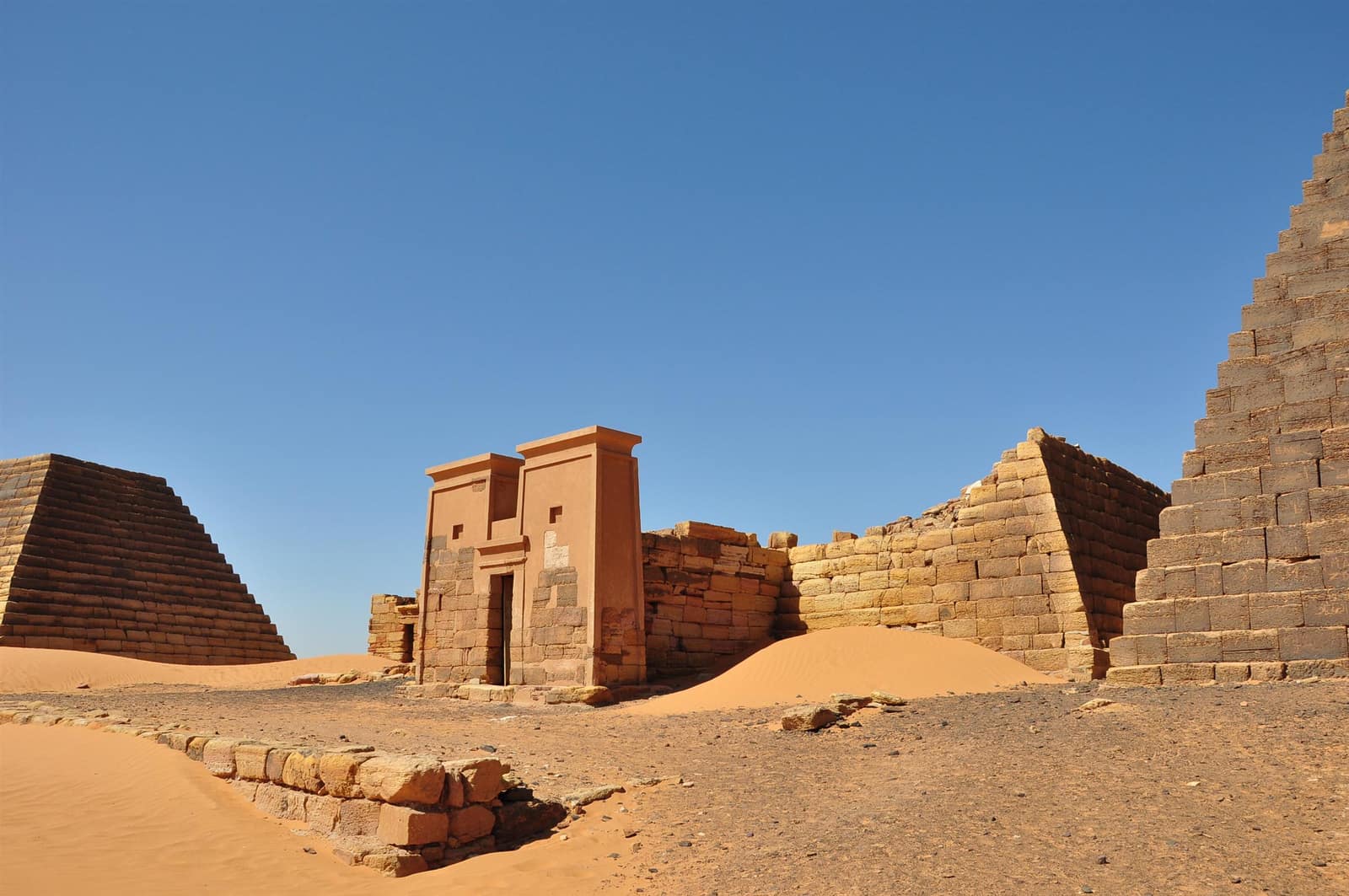
The pyramids of Meroë
- Dated
- Place
- Begrawiya (Bajrawiya), River Nile State, Sudan · Kingdom of Kush, Meroitic period
- Coordinates
- 16° 56′ N · 33° 45′ E (approximate)
- Remains
- Fragmentary
TrackHD, CC BY-SA 3.0, via Wikimedia CommonsCC-BY-SA-3.0Original record
Data saver is on. Images load only when you ask. You can change this in Settings at any time.
From the archivist
East of the Nile, north of where it meets the Atbara, the sand rises in low ridges and on them stand pyramids: dozens of them, narrow and steep, in rows. Here this civilization buried the kings and ruling queens of Kush for some six hundred years, from about the third century before the common era.
They are smaller than the pyramids of Egypt, none higher than thirty metres, and sharper. Before each one stood a small chapel with a gateway, its walls carved with the dead ruler receiving offerings, so that the living could come and remember.
In 1834 an Italian adventurer named Giuseppe Ferlini came looking for gold. He had his workers pull down several pyramids from the top. In the tomb of Queen Amanishakheto he found what he wanted: bracelets, rings and amulets of gold and coloured glass. He sold them in Europe, where at first no one believed they were real.
Many of the pyramids still stand without their summits. The queen's gold lies in museums in Berlin and Munich, far from her sand.
Established
- From the 3rd century BCE most royal burials of the Kingdom of Kush took place at Meroë; the North Royal Cemetery at Begrawiya, used from about 270 BCE to 350 CE, holds the pyramids of Meroitic kings, ruling queens and princes (Yellin 2021).
- The pyramids of Meroë are under 30 metres high, far smaller than those of Giza, and small chapels built against them bear reliefs of funeral rites and of the cult of their owners (Yellin 2021).
- In 1834 Giuseppe Ferlini found a hidden chamber with a hoard of jewellery in the largest pyramid at Meroë, pyramid N 6 of Queen Amanishakheto, who ruled Kush in the 1st century BCE; the pieces are now in Berlin and Munich (Society for the Promotion of the Egyptian Museum Berlin).
- Ferlini dismantled several pyramids to reach their contents; Lepsius, visiting in 1844, wrote that Ferlini's discovery had brought many a pyramid to ruin (Lepsius 1853).
- The royal city of Meroë and the nearby sites of Naqa and Musawwarat es-Sufra were inscribed on the UNESCO World Heritage List in 2011 as the Archaeological Sites of the Island of Meroe (UNESCO).
Interpretation
The Kushite pyramids are sometimes read as copies of Egyptian ones; most scholars now see a distinct tradition, steeper and smaller, with its own gods, script and royal rites, borrowing from Egypt without imitating it.
In 10,000 years
In 10,000 years, which will be remembered: the queens who were buried here, or the man who tore their tombs apart?
Sources (4)
- UNESCO World Heritage Centre. Archaeological Sites of the Island of Meroe (property 1336), inscribed 2011. · whc.unesco.org
- Yellin, J. W. The Royal and Elite Cemeteries at Meroe. In Emberling, G., Williams, B. B. (eds), The Oxford Handbook of Ancient Nubia. Oxford University Press, 2021, chapter 29.
- Society for the Promotion of the Egyptian Museum Berlin. The Ancient Sudan (the treasure of Queen Amanishakheto found by G. Ferlini in 1834). · www.egyptian-museum-berlin.com
- Lepsius, C. R. Letters from Egypt, Ethiopia, and the Peninsula of Sinai. London, Henry G. Bohn, 1853.