The Terracotta Army
- Dated
- Place
- Lintong district, Xi'an, Shaanxi, China · Qin state and empire, workshops of the First Emperor, Qin Shi Huang
- Coordinates
- 34° 23′ N · 109° 16′ E (approximate)
- Remains
- Reconstructed
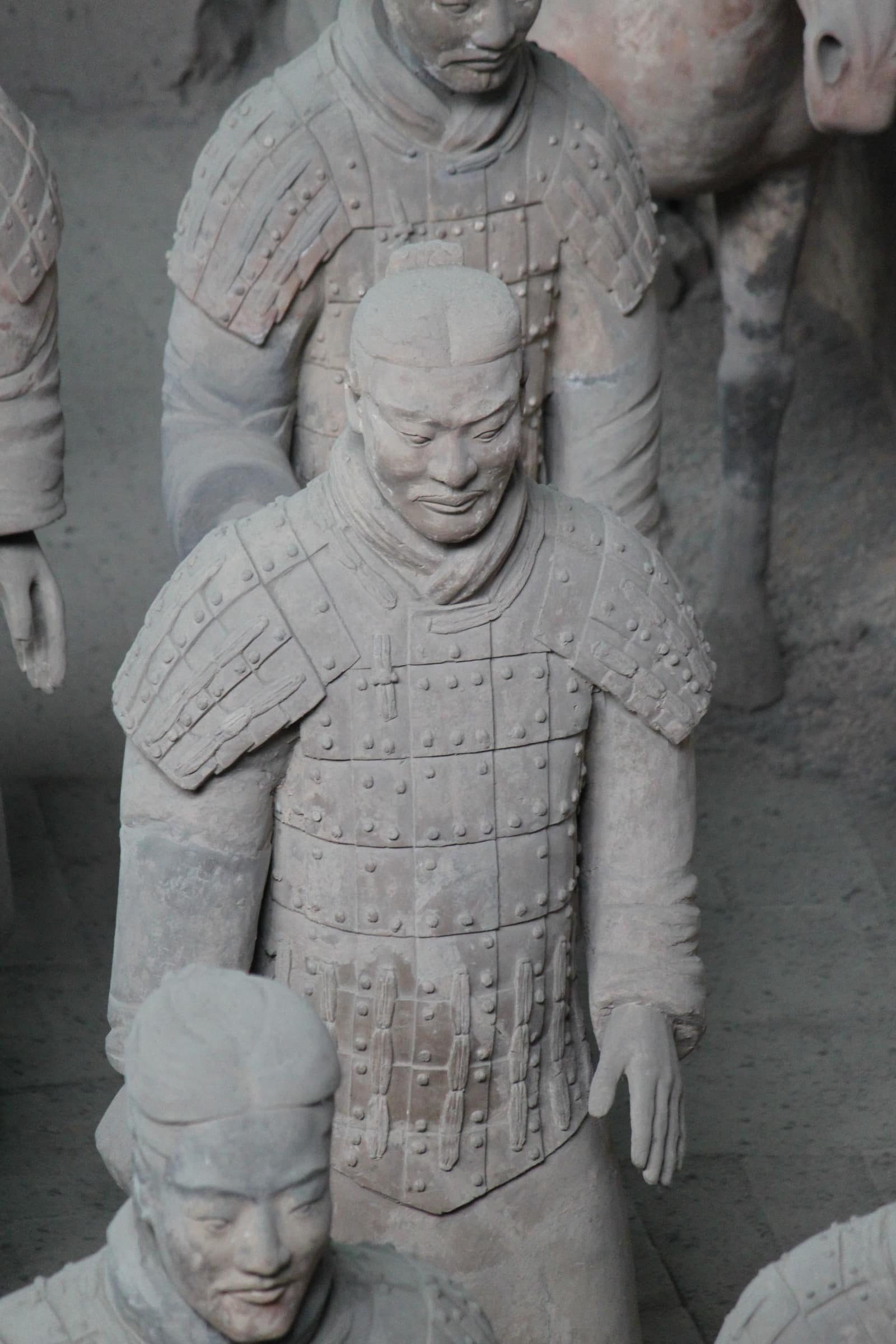
Gary Lee Todd, CC0, via Wikimedia CommonsCC0-1.0Original record
Data saver is on. Images load only when you ask. You can change this in Settings at any time.
From the archivist
They were made to stand in the dark forever. Row upon row, facing east, the soldiers of clay wait in long trenches roofed with timber and matting, beside a king who wished to keep his army after death.
Each figure was built by hand: legs, body, arms and head shaped separately, then joined, fired and painted. Armour of small plates, the knot of the hair, the set of the mouth were finished one by one. Measured closely, even their ears differ. In their hands they held real weapons of bronze: crossbows, spears, halberds, swords, many inscribed with the names of the officials and workshops that made them.
The colour did not last. When the pits were opened, the paint on many figures curled and flaked within minutes in the dry air, leaving the grey of the clay.
Farmers found them in 1974, looking for water. The emperor's own mound, a short walk away, has been left closed. What lies inside is still not known.
Established
- The Mausoleum of the First Qin Emperor, including the pits of the Terracotta Army, was inscribed on the UNESCO World Heritage List in 1987 (UNESCO).
- Qin Shi Huang, who unified China in 221 BCE and died in 210 BCE, had his funerary complex built at Mount Li, near present-day Xi'an (UNESCO; Portal 2007).
- Farmers digging a well found the first fragments in March 1974, about 1.5 km east of the burial mound (Portal 2007).
- The three pits are estimated to hold more than 8,000 figures of soldiers, with chariots and horses, most of them not yet excavated (Portal 2007).
- The figures were coated with lacquer and painted; they carried real bronze weapons, and 3D measurement of their ears shows that no two are strictly identical (Bevan et al. 2014; Martinón-Torres et al. 2019).
Interpretation
Whether each face portrays a real soldier is not known: the figures were assembled from moulded and hand-modelled parts, and their variety may reflect many workshops and craftsmen rather than portraits. Why an army of this size was placed facing east, and what else the unopened tomb mound contains, remain open questions.
In 10,000 years
In 10,000 years, will this army of clay still stand guard over a tomb no one has opened?
Sources (4)
- UNESCO World Heritage Centre. Mausoleum of the First Qin Emperor (property 441), inscribed 1987. · whc.unesco.org
- Portal, J. (ed.). The First Emperor: China's Terracotta Army. London, British Museum Press, 2007.
- Bevan, A., Li, X., Martinón-Torres, M., Green, S., Xia, Y., Zhao, K., Zhao, Z., Ma, S., Cao, W., Rehren, T. Computer vision, archaeological classification and China's terracotta warriors. Journal of Archaeological Science 49, 2014, p. 249-254. · doi.org
- Martinón-Torres, M., Li, X., Xia, Y., et al. Surface chromium on Terracotta Army bronze weapons is neither an ancient anti-rust treatment nor the reason for their good preservation. Scientific Reports 9, 2019, 5289. · doi.org