The Hiroshima Peace Memorial (Genbaku Dome)
- Dated
- Place
- Hiroshima Peace Memorial Park, Hiroshima, Japan · Japan; the people of Hiroshima, who chose to keep the ruin
- Coordinates
- 34° 24′ N · 132° 27′ E (approximate)
- Remains
- Fragmentary
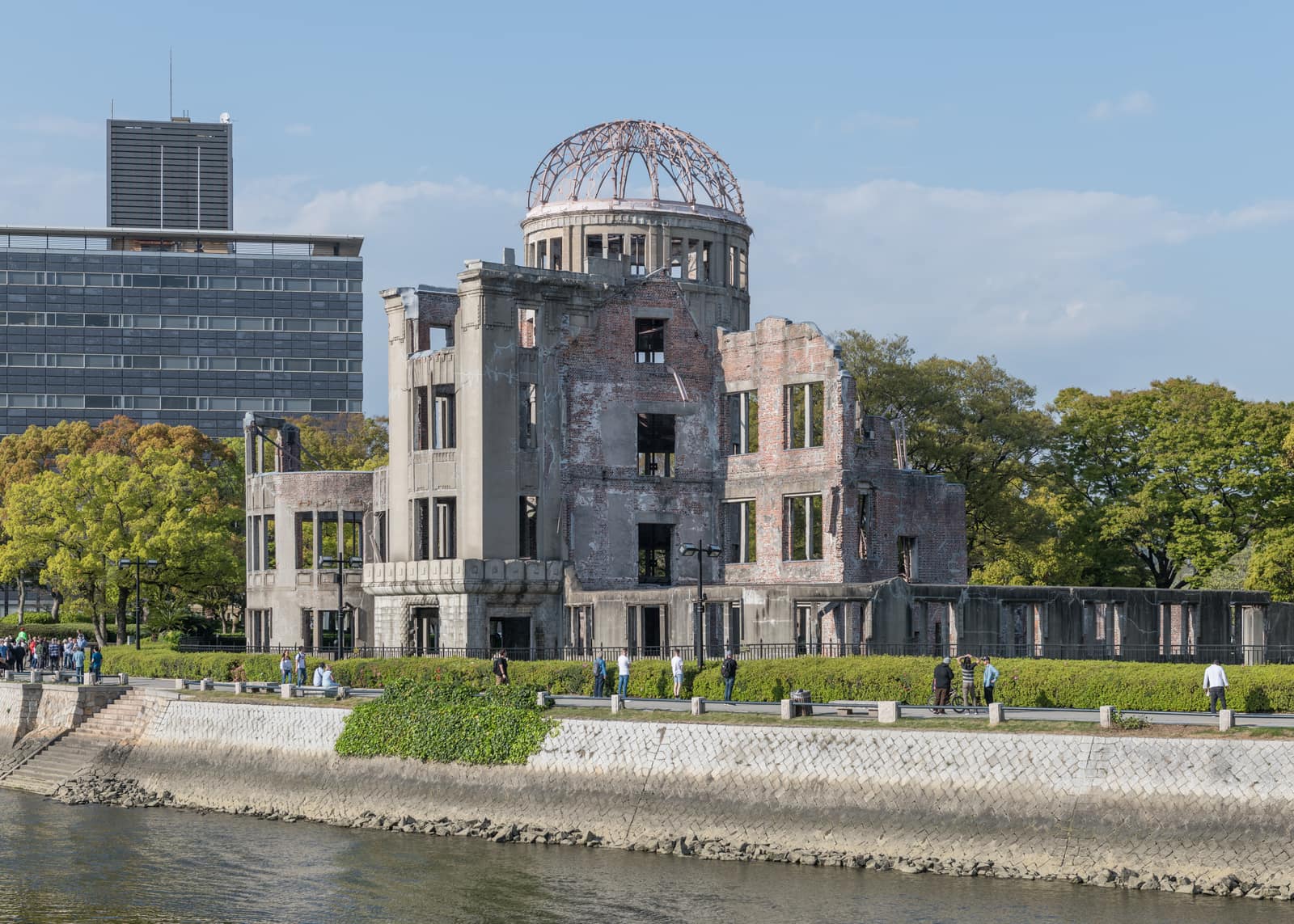
DXR, CC BY-SA 4.0, via Wikimedia CommonsCC-BY-SA-4.0Original record
Data saver is on. Images load only when you ask. You can change this in Settings at any time.
From the archivist
It was built to show off the goods of a prefecture: a hall of brick and stone with a green copper dome, designed by an architect from Bohemia, reflected in the river.
At a quarter past eight on the morning of 6 August 1945, a single bomb exploded in the air above the city, almost directly over the building. The blast came down from above. The walls around the central stairwell stood; the people inside did not survive. The copper of the dome burned away and left its steel frame.
Most of the city around it was flattened and burned. Tens of thousands died that day, and many more in the months and years after.
For twenty years the ruin was argued over. Some wanted it gone. In 1966, after a campaign that began with the diary of a girl who had died of leukaemia at sixteen, the city decided to keep it as it was.
This civilization chose to preserve a wound, and to hold it open.
Established
- The building was designed by the Czech architect Jan Letzel and completed in 1915 as the Hiroshima Prefectural Commercial Exhibition Hall; from 1933 it was named the Hiroshima Prefectural Industrial Promotion Hall (City of Hiroshima).
- On 6 August 1945 the first atomic bomb used in war exploded in the air over Hiroshima; the point directly below the blast lay about 160 metres from the building, which was one of the few structures near the hypocentre to remain standing (City of Hiroshima; UNESCO).
- On 11 July 1966 the Hiroshima City Council resolved to preserve the dome permanently; a public fundraising campaign followed (City of Hiroshima).
- The Hiroshima Peace Memorial (Genbaku Dome) was inscribed on the World Heritage List in 1996, exceptionally on the basis of criterion (vi) alone (UNESCO).
- At the inscription the delegation of the United States dissociated itself from the decision, citing the lack of historical context, and the delegation of China expressed reservations (UNESCO World Heritage Committee 1996).
Interpretation
What the ruin means is not agreed. For Hiroshima and for UNESCO it is a symbol of the hope for world peace and for the elimination of nuclear weapons; others have argued that presenting it without the events that led to the bombing narrows the history of the war in Asia and the Pacific. Whether a ruin should be kept at all was itself debated in the city for twenty years.
In 10,000 years
In 10,000 years, will this ruin still be kept so that no one forgets why it was left broken?
Sources (4)
- UNESCO World Heritage Centre. Hiroshima Peace Memorial (Genbaku Dome) (property 775), inscribed 1996. · whc.unesco.org
- UNESCO World Heritage Committee, 20th session (Merida, 1996). Decision on the inscription of the Hiroshima Peace Memorial (Genbaku Dome), with the statements of the delegations of the United States and China. · whc.unesco.org
- City of Hiroshima. The Story of the Atomic Bomb Dome; Preservation of the Atomic Bomb Dome. · www.city.hiroshima.lg.jp
- Nippon.com. Hiroshima Genbaku Dome. · www.nippon.com