Bread from the air: the Haber-Bosch synthesis of ammonia
Before 1913, the nitrogen that crops need came from manure, legumes and a few mined deposits such as Chilean saltpetre; after it, nitrogen could be taken from the air by industry, and by 2008 fertiliser made this way was estimated to feed nearly half of humanity.
- Dated
- Place
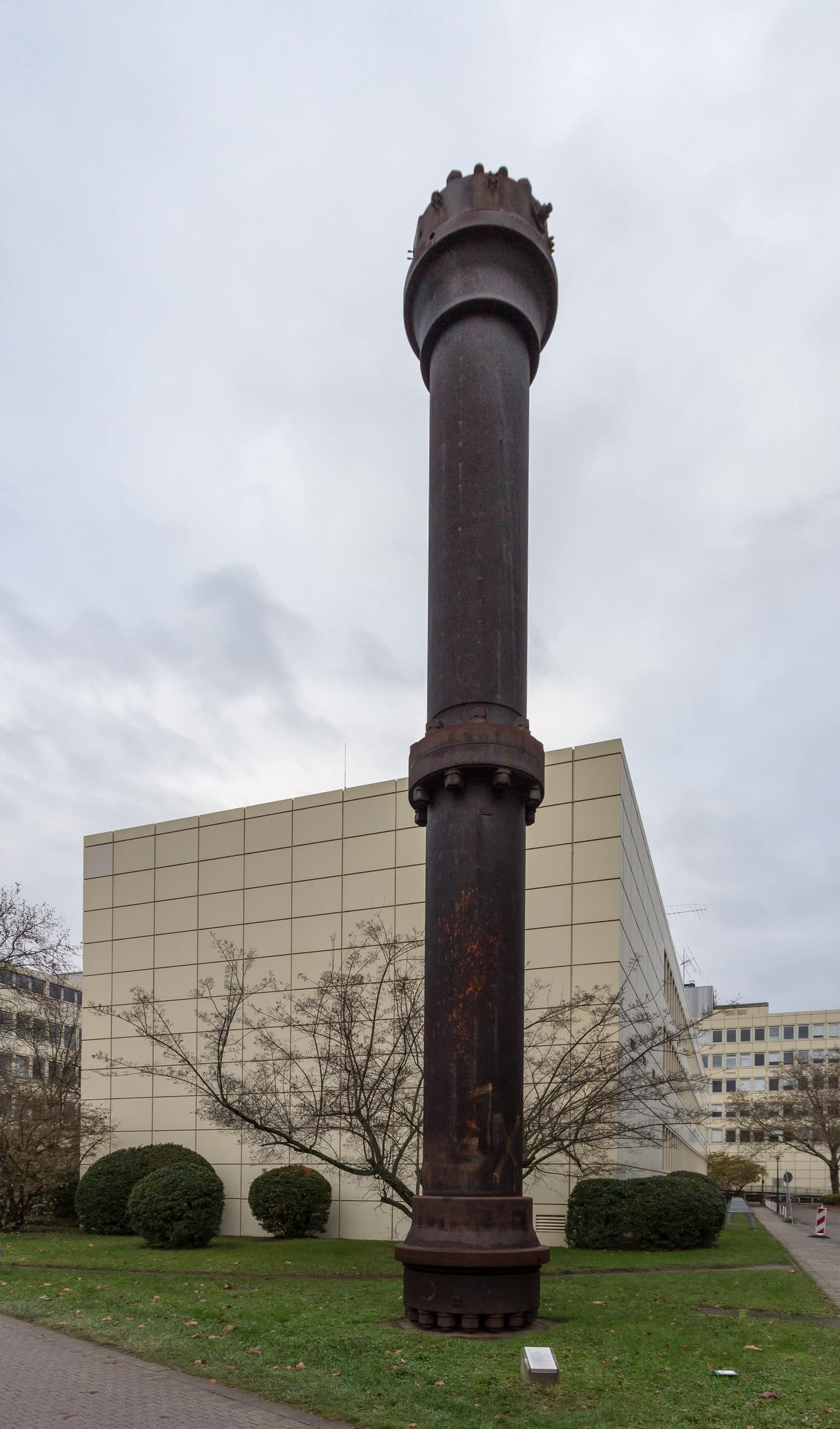
- Karlsruhe Institute of Technology, Karlsruhe, Germany · Fritz Haber and his assistant Robert Le Rossignol at the Technische Hochschule in Karlsruhe; Carl Bosch and the engineers of the Badische Anilin- und Soda-Fabrik (BASF) at Ludwigshafen and Oppau
- Coordinates
- 49° 01′ N · 8° 25′ E (approximate)
- Remains
- Intact

Dietmar Rabich, CC BY-SA 4.0, via Wikimedia CommonsCC-BY-SA-4.0Original record
Data saver is on. Images load only when you ask. You can change this in Settings at any time.
From the archivist
Nitrogen is most of the air this civilization breathed, and yet its fields went hungry for it. The gas would not combine with anything. For centuries, farmers returned it to the soil with manure and beans; later, ships carried seabird droppings from Peru and saltpetre from the Chilean desert.
In a laboratory in Karlsruhe, on 2 July 1909, a chemist named Fritz Haber and his young assistant showed visitors from a dye company a small steel apparatus. Gas went in under great pressure; from a narrow tube, clear drops of liquid ammonia fell, one after another. The assistant kept two sealed tubes of them.
The company's engineer, Carl Bosch, spent four years making the table-sized device into towers of steel like the one kept here. In 1913 the first plant opened at Oppau. Within two years its ammonia was also making explosives for a war, and Haber was sending chlorine across the fields of Ypres.
Both men received the Nobel Prize. Much of the bread of the following century grew from their reaction, and much of the nitrogen it released ran on into rivers, seas and sky.
Established
- On 2 July 1909, in Karlsruhe, Fritz Haber and his assistant Robert Le Rossignol demonstrated to representatives of BASF a laboratory apparatus that combined nitrogen from the air with hydrogen, under high pressure and over a catalyst, into liquid ammonia, drop by drop (Sheppard 2017; Science Museum Group).
- BASF had funded Haber's work since March 1908 and bought the rights to the process; a team led by Carl Bosch replaced Haber's costly osmium and uranium catalysts with iron and additives, and built vessels able to withstand the pressure and heat (Sheppard 2017; Nobel Prize, Bosch biography).
- The first industrial ammonia synthesis plant went into operation at Oppau, near Ludwigshafen, in 1913 (BASF; Nobel Prize, Bosch biography).
- During the First World War, when Chilean saltpetre could no longer reach Germany, synthetic ammonia was turned into nitric acid for explosives (Erisman et al. 2008). Haber also developed poison gas for the German army and supervised the first use of chlorine on the Western Front, at Ypres in 1915 (Science History Institute).
- Haber received the Nobel Prize in Chemistry for 1918, awarded in 1919, for the synthesis of ammonia from its elements; Bosch shared the 1931 prize with Friedrich Bergius for chemical high pressure methods (Nobel Prize).
- Erisman and colleagues estimated in 2008 that nitrogen fertiliser had supported approximately 27% of the world's population over the past century, and that by 2008 it was responsible for feeding 48% (Erisman et al. 2008).
- In 2005, about 100 Tg of Haber-Bosch nitrogen was used in world agriculture, while only 17 Tg reached people in food; most of the rest escaped into water and air (Erisman et al. 2008). In 2021 the International Energy Agency put ammonia production at around 2% of the world's final energy consumption and 1.3% of CO2 emissions from the energy system (IEA 2021).
Interpretation
The 48% figure is a model estimate: it rests on assumptions about what yields would have been without synthetic nitrogen, and Erisman and colleagues present it as such, adding that on balance it remains questionable how far the consequences can be counted as beneficial. How to share the credit between Haber, who showed the reaction could work, Le Rossignol, who engineered the apparatus, and Bosch and the BASF engineers, who made it industrial, is still discussed. Haber's role in gas warfare, and the suicide of his wife, the chemist Clara Immerwahr, in 1915, have made him one of the most divided memories in the history of science; Haber, born into a Jewish family, resigned in 1933 rather than dismiss his staff under the Nazi race laws, and died at Basel in January 1934.
In 10,000 years
In 10,000 years, will the nitrogen that ran off these fields still be readable in lake muds and ice, the chemical signature of a species that learned to feed itself from the air?
Sources (9)
- Erisman, J. W., Sutton, M. A., Galloway, J., Klimont, Z., Winiwarter, W. How a century of ammonia synthesis changed the world. Nature Geoscience 1, 2008, p. 636-639. · doi.org
- Sheppard, D. Robert Le Rossignol, 1884-1976: Engineer of the 'Haber' process. Notes and Records of the Royal Society 71 (3), 2017, p. 263-296. · doi.org
- Science Museum Group. Sample of Haber's synthetic ammonia, 2 July 1909, object number 1952-391/2. · collection.sciencemuseumgroup.org.uk
- The Nobel Prize in Chemistry 1918: Fritz Haber, summary and biographical notice (Nobel Lectures, Chemistry 1901-1921). · www.nobelprize.org
- The Nobel Prize in Chemistry 1931: Carl Bosch and Friedrich Bergius, summary and biographical notice of Carl Bosch. · www.nobelprize.org
- BASF. 1913: First ammonia synthesis plant (corporate history chronology). · www.basf.com
- Science History Institute. Fritz Haber (scientific biography). · www.sciencehistory.org
- International Energy Agency. Ammonia Technology Roadmap: Towards more sustainable nitrogen fertiliser production, Paris, October 2021 (with the International Fertilizer Association summary for policymakers, November 2021). · www.iea.org
- Karlsruhe Institute of Technology. 100 Objekte: 036, Reaktor zur Ammoniaksynthese. · www.100objekte.kit.edu
Related fragments
c. 7000 BCE
Maize, from teosinte
Near Iguala, Guerrero, Mexico · Americas
c. 8500 BCE
Einkorn and emmer: the first wheats
Karacadağ mountains, southeastern Türkiye · Asia
1044 CE
The fire drug: the first written formulas for gunpowder
Kaifeng, Henan, China · Asia
2008
The Svalbard Global Seed Vault
Longyearbyen, Svalbard, Norway · Europe
1712 to 1769
Fire made to work: from Newcomen's engine to Watt's condenser
Coneygree, Tipton, near Dudley, West Midlands, United Kingdom · Europe