The letter S across the Atlantic
Before December 1901 no wireless signal was known to have crossed an ocean; after it, the idea that words could travel between continents without any cable became the goal of radio.
- Dated
- Place
- St. John's, Newfoundland and Labrador, Canada · Guglielmo Marconi, an Italian inventor, with the engineers of his British wireless company in Cornwall and Newfoundland
- Coordinates
- 47° 34′ N · 52° 41′ W (approximate)
- Remains
- Fragmentary
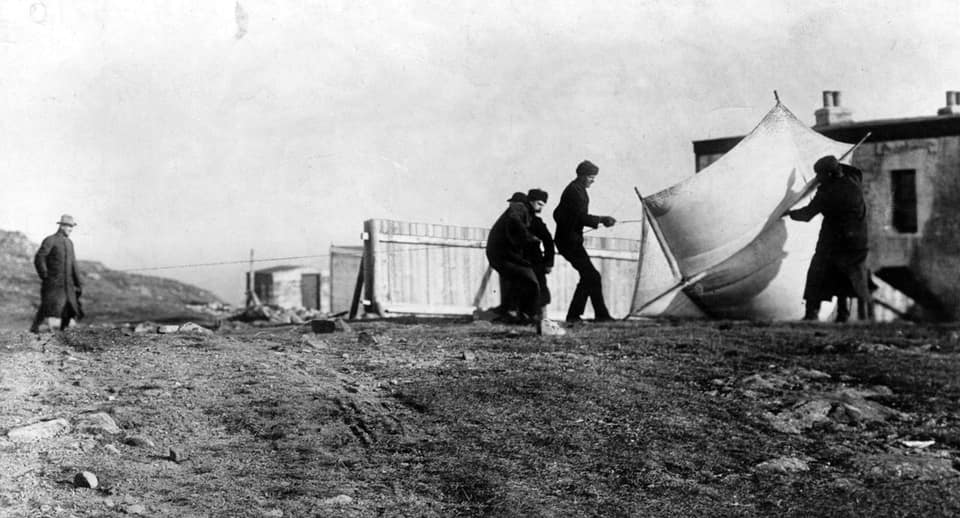

James M. Vey, Marconi's Achievement, McClure's Magazine, February 1902, public domain, via Wikimedia CommonsPDMOriginal record
Data saver is on. Images load only when you ask. You can change this in Settings at any time.
From the archivist
It was cold on Signal Hill, and the wind kept tearing things away. On 12 December 1901, above the harbour of St. John's, Newfoundland, a small team of men fought to keep a kite in the air. From it hung a long wire. Inside an empty building nearby, a young Italian named Guglielmo Marconi sat with a telephone receiver pressed to his ear.
Some 3,500 kilometres to the east, at Poldhu in Cornwall, his engineers were sending the same letter again and again: S, three short dots, the simplest sign in Morse code.
At one point Marconi passed the receiver to his assistant, George Kemp. Both men later said they had heard the three dots, faint among the crackle of the sky. Marconi wrote the times in his notebook. There was no other witness, and no machine recorded it.
This civilization has never agreed on what was heard that day. But it had begun to believe that a message could leave a shore with nothing to hold it and arrive on another continent. Within a few decades, radio carried music, news and cries for help across every ocean.
Established
- On 12 December 1901, at Signal Hill, St. John's, Newfoundland, Guglielmo Marconi and his assistant George Kemp reported hearing the Morse code for the letter S, three dots, sent by wireless from Poldhu, Cornwall (IEEE Milestone).
- They listened with a telephone receiver connected to a wire antenna held aloft by a kite (IEEE Milestone).
- The only record of the reception is Marconi's notebook entry of signals at 12:30, 1:10 and 2:20 local time (Belrose, 1995).
- The transmitter at Poldhu was a spark transmitter radiating, by later estimates, at about 850 kHz (Belrose, 1995).
- The Poldhu station operated until 1933; a memorial column erected by the Marconi Company in 1937 marks its site (Historic England).
Interpretation
Whether Marconi really heard Poldhu that day is still debated. The receiver had no amplification and was not tuned, the whole path lay in daylight, when such signals are weakest, and only Marconi and Kemp listened; some engineers, then and now, think they may have taken atmospheric crackle for the rhythm of three dots. Others argue that reception was possible on a higher frequency than intended. Later transatlantic tests by Marconi, from 1902, were better documented and are not in doubt.
In 10,000 years
In 10,000 years, will anyone still hear the three faint dots, or only the static around them?
Sources (4)
- IEEE. Milestone: Reception of Transatlantic Radio Signals, 1901 (dedicated 4 October 1985, Signal Hill, St. John's). Engineering and Technology History Wiki. · ethw.org
- Belrose, J. S. Fessenden and Marconi: their differing technologies and transatlantic experiments during the first decade of this century. International Conference on 100 Years of Radio, Institution of Electrical Engineers, London, 5 to 7 September 1995. · ewh.ieee.org
- Historic England. Marconi Memorial, Mullion (list entry 1141890). · historicengland.org.uk
- Marconi's Achievement. McClure's Magazine, February 1902 (source of the photograph).
Related fragments
1858 to 1866
The cable under the Atlantic
Valentia Island, County Kerry, Ireland; and Heart's Content, Newfoundland and Labrador, Canada · Europe
1876
The telephone: a patent and a sentence
Boston, Massachusetts, United States · Americas

1973
A telephone call from the street
New York City, New York, United States · Americas