A telephone call from the street
Before April 1973 a telephone was tied to a place, a house, an office or a car; after it, the telephone began to belong to a person, and by 2025 about 82 per cent of people aged ten and over owned a mobile phone (ITU).
- Dated
- Place
- New York City, New York, United States · Martin Cooper and the engineers of Motorola, an American radio company, in rivalry with the Bell System
- Coordinates
- 40° 46′ N · 73° 59′ W (approximate)
- Remains
- Fragmentary
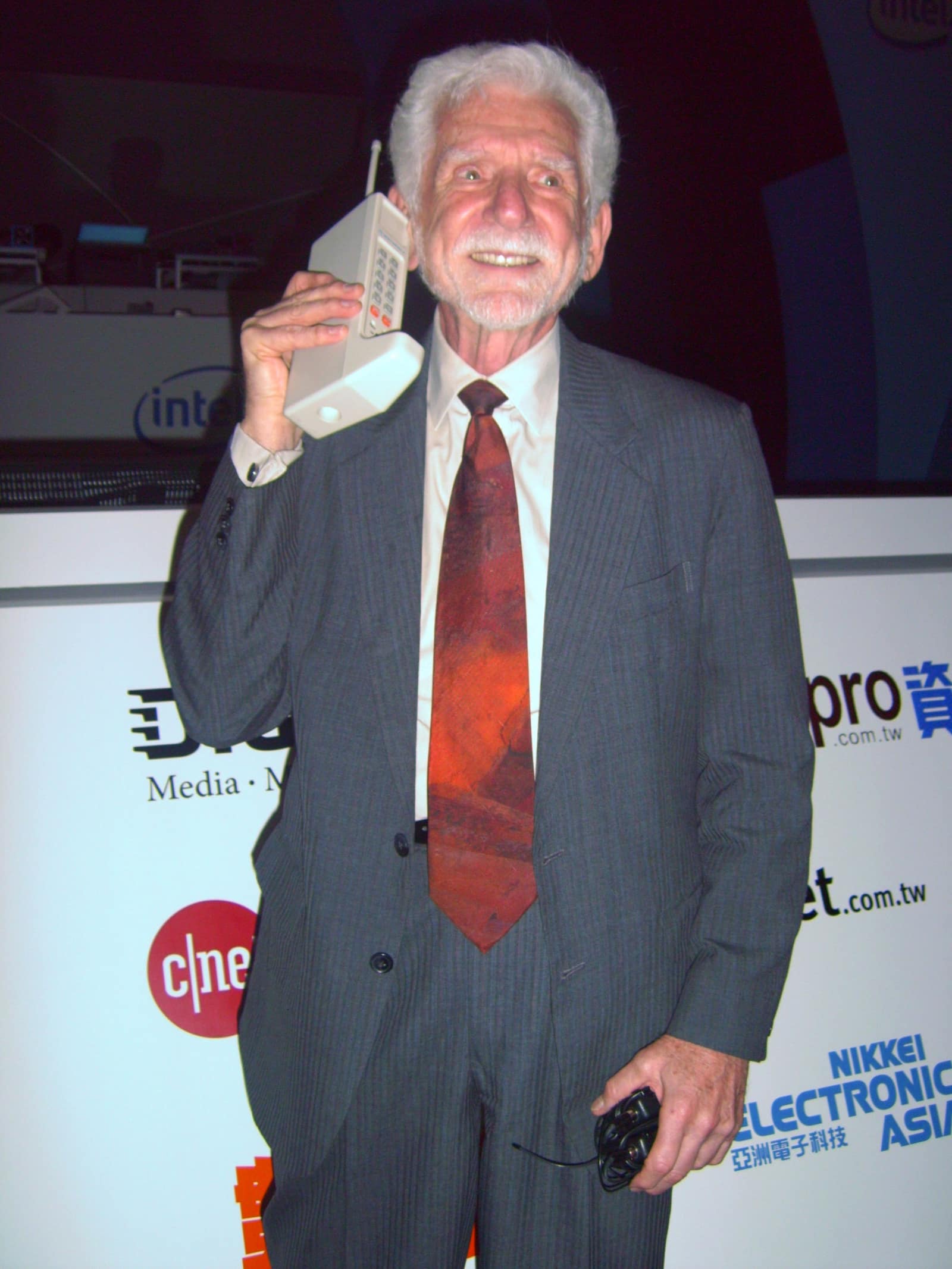

Rico Shen, CC BY-SA 3.0, via Wikimedia CommonsCC-BY-SA-3.0Original record
Data saver is on. Images load only when you ask. You can change this in Settings at any time.
From the archivist
The object was cream coloured, as long as a forearm, and as heavy as a bag of flour. It had a keypad, a short antenna, and a battery that would not last long.
On 3 April 1973, on Sixth Avenue in Manhattan, an engineer named Martin Cooper held it to his ear among the passers by. He was on his way to a press conference. He dialled the number of his rival, Joel Engel, who led the same research at the great telephone company, and told him that he was calling from a real handheld cellular telephone.
Until then, in this civilization, a telephone belonged to a place: a house, an office, a booth, at most a car. Cooper's call was a demonstration, meant for regulators as much as for engineers, and a whole decade passed before such telephones could be bought.
What followed took a single lifetime. By 2025 there were more mobile subscriptions on Earth than people, and more than four people in five over the age of ten carried a telephone of their own. In the poorest countries, it was still about half. For many, it was the first telephone they ever had, and it went wherever they went.
Established
- On 3 April 1973, in New York, Martin Cooper, an engineer at Motorola, made a public call from a handheld prototype cellular telephone, the DynaTAC, standing on a street before a press conference (Illinois Institute of Technology; IEEE Spectrum).
- He called Joel Engel, who led the rival cellular research effort at AT&T's Bell Labs (IEEE Spectrum).
- The prototype weighed about 2.5 pounds, a little over one kilogram (Illinois Institute of Technology).
- DynaTAC stood for Dynamic Adaptive Total Area Coverage (IEEE Spectrum).
- In 2025 the world counted 9.2 billion mobile cellular subscriptions, 112 for every 100 inhabitants, and 82 per cent of people aged ten and over owned a mobile phone, against 53 per cent in low income economies (ITU, Facts and Figures 2025).
Interpretation
The call was as much a demonstration aimed at regulators as a technical test: Motorola wanted to show that handheld cellular service could compete with AT&T, which then favoured car telephones. Radiotelephones in cars existed long before 1973, and the cellular principle itself had been worked out at Bell Labs, so first handheld cellular call is the precise claim. Accounts of the conversation rest mainly on Cooper's own later recollection. Subscriptions exceed the world's population because many people hold several, and a large share of humanity still owns no phone at all.
In 10,000 years
In 10,000 years, will anyone know that there was a time when a voice could not follow a person into the street?
Sources (4)
- Illinois Institute of Technology. How a phone call sparked a technological revolution (on Martin Cooper, EE 1950, MS EE 1957). · www.iit.edu
- IEEE Spectrum. First portable telephone call made 40 years ago today. 3 April 2013. · spectrum.ieee.org
- International Telecommunication Union (ITU). Facts and Figures 2025: mobile phone ownership. · www.itu.int
- International Telecommunication Union (ITU). Facts and Figures 2025: mobile network subscriptions. · www.itu.int
Related fragments
1876
The telephone: a patent and a sentence
Boston, Massachusetts, United States · Americas
1901
The letter S across the Atlantic
St. John's, Newfoundland and Labrador, Canada · Americas
1947
The transistor
New Providence, New Jersey, United States · Americas