The Parkes dish and the Moon walk seen by the world
Before July 1969 the people of the Earth could only be told about their explorers' journeys afterwards; after it, an estimated 600 million of them had watched a human being step onto another world at the moment it happened.
- Dated
- Place
- Parkes Observatory, New South Wales, Australia · Australian radio astronomers and engineers of CSIRO at Parkes, with NASA's tracking stations at Honeysuckle Creek, near Canberra, and Goldstone, in California
- Coordinates
- 33° 00′ S · 148° 16′ E (approximate)
- Remains
- Intact
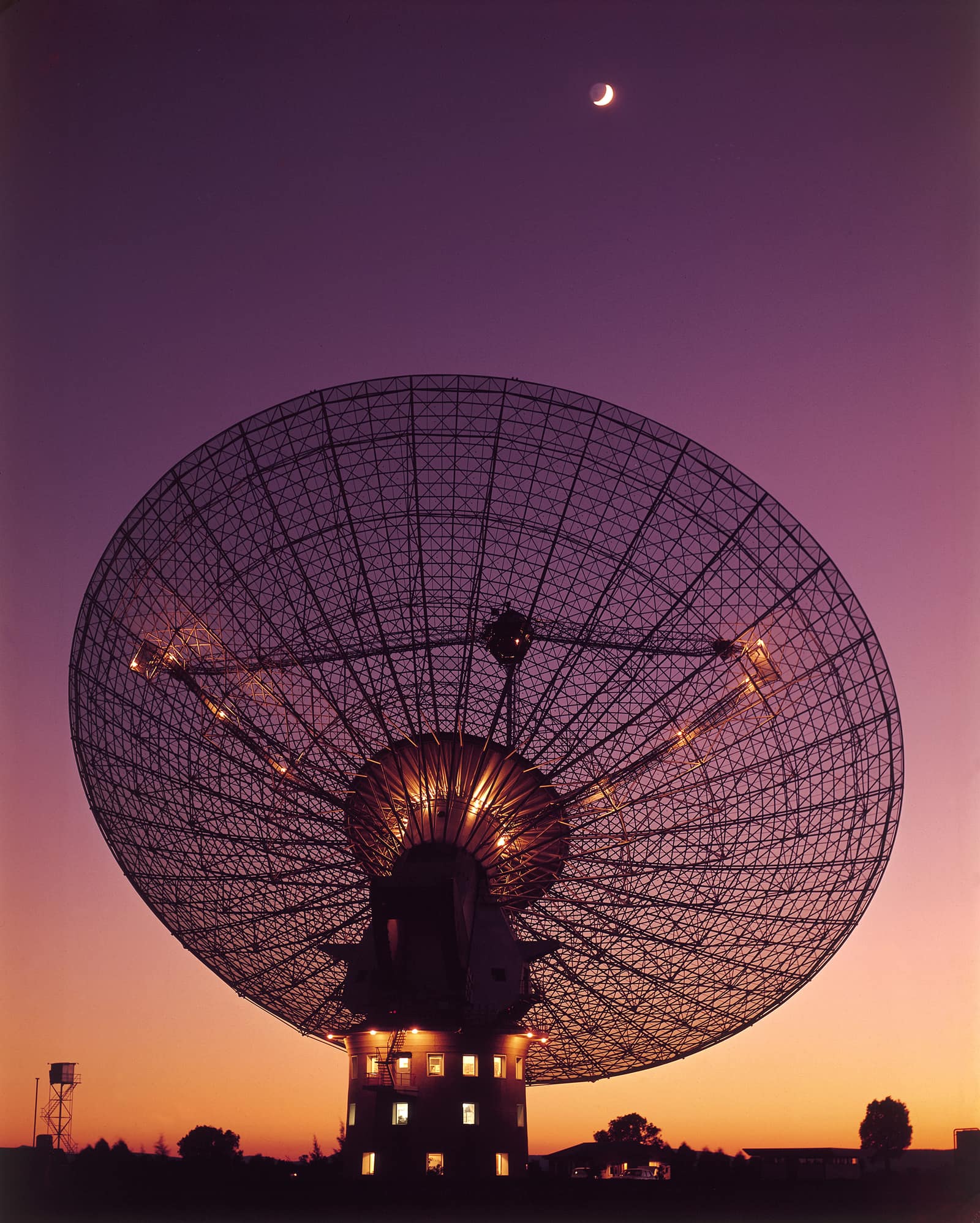

CSIRO, CC BY 3.0, via Wikimedia CommonsCC-BY-3.0Original record
Data saver is on. Images load only when you ask. You can change this in Settings at any time.
From the archivist
The dish stood in a paddock among sheep, far from any city, built to listen to faint radio sources at the edge of the universe. For a few hours in July 1969 it was asked to listen to something much closer.
It was early afternoon of the 21st in Australia and still the evening of the 20th in the Americas. A camera fixed to the side of a small craft was sending pictures across four hundred thousand kilometres. Three antennas on Earth were receiving them: one in the Californian desert, one in the hills near Canberra, and this one.
The first step was seen through the antenna near Canberra. A few minutes later, Houston chose the picture from Parkes, sharper than the others, and kept it for more than two hours. That day, gusts of wind had struck the dish and shaken its tower. The men inside kept it pointed at the Moon.
Across the planet, hundreds of millions of people watched the same grey image at the same moment. Few of them knew where it had come from.
Established
- The Parkes radio telescope, a dish 64 metres across built by CSIRO in New South Wales, was opened on 31 October 1961 (CSIRO).
- Neil Armstrong stepped onto the Moon at 12:56 p.m. Australian Eastern Standard Time on 21 July 1969, the evening of 20 July in the Americas (CSIRO).
- The television broadcast began with the signal received by NASA's 64 metre antenna at Goldstone, California; just before the first step, Houston switched to the 26 metre antenna at Honeysuckle Creek, near Canberra, so the world saw Armstrong's first step through Honeysuckle Creek, while the voices still came through Goldstone (NASA; Honeysuckle Creek logs).
- About eight and a half to nine minutes into the broadcast, NASA selected the pictures received at Parkes, which were clearer, and kept them for the rest of the moonwalk, more than two hours (CSIRO; NASA).
- On the day of the moonwalk, as the dish was being tipped toward the rising Moon, gusts of about 110 km per hour struck it and shook the control room (CSIRO).
Interpretation
The audience is usually given as about 600 million people, an estimate that cannot be checked precisely. The Australian film The Dish (2000) made Parkes famous but, as CSIRO notes, is not entirely accurate; in popular memory Parkes is often credited with the first step itself, which came through Honeysuckle Creek, a station that has since been closed and dismantled. The broadcast was a relay between several stations, and no single dish can claim it.
In 10,000 years
In 10,000 years, will anyone know that the first pictures of a human being walking on another world came to us through a dish in a sheep paddock, turned against the wind?
Sources (5)
- CSIRO. Apollo 11 Moon landing (Murriyang, the Parkes radio telescope). · www.csiro.au
- NASA Space Communications and Navigation. Exploration enabled, then and now. · www.nasa.gov
- Sarkissian, J. M. On Eagle's Wings: the Parkes Observatory's support of the Apollo 11 mission. Publications of the Astronomical Society of Australia 18 (3), 2001, p. 287-310. · doi.org
- Honeysuckle Creek Tracking Station (Colin Mackellar). Apollo 11 TV: Parkes and Honeysuckle Creek, with the station logs and the Sydney Video TWX. · honeysucklecreek.net
- CSIRO. Murriyang: Parkes radio telescope receives Indigenous name, November 2020. · www.csiro.au
Related fragments
1969
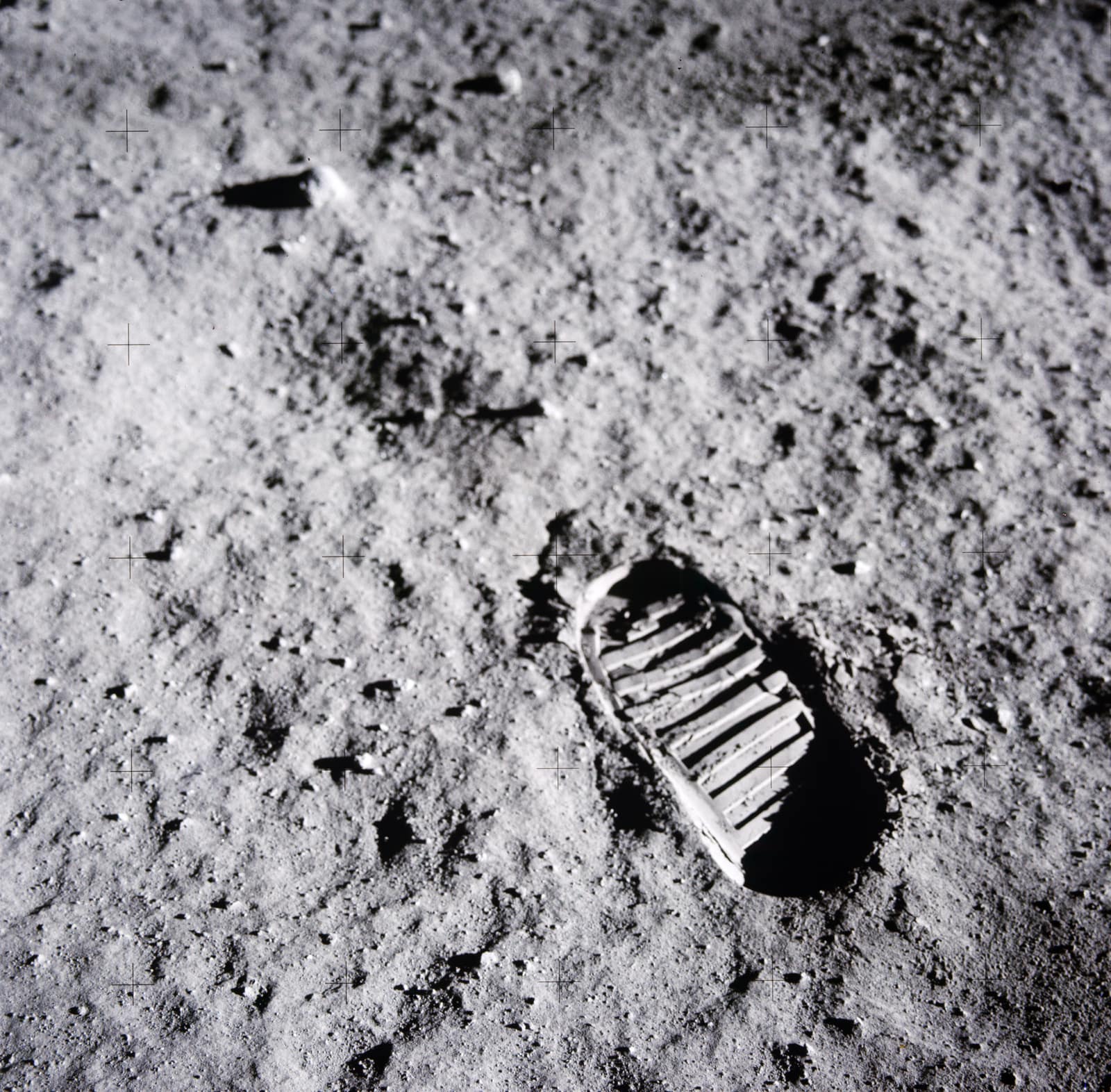
The first footprints on the Moon
Tranquility Base, Sea of Tranquility, the Moon · Americas
1968
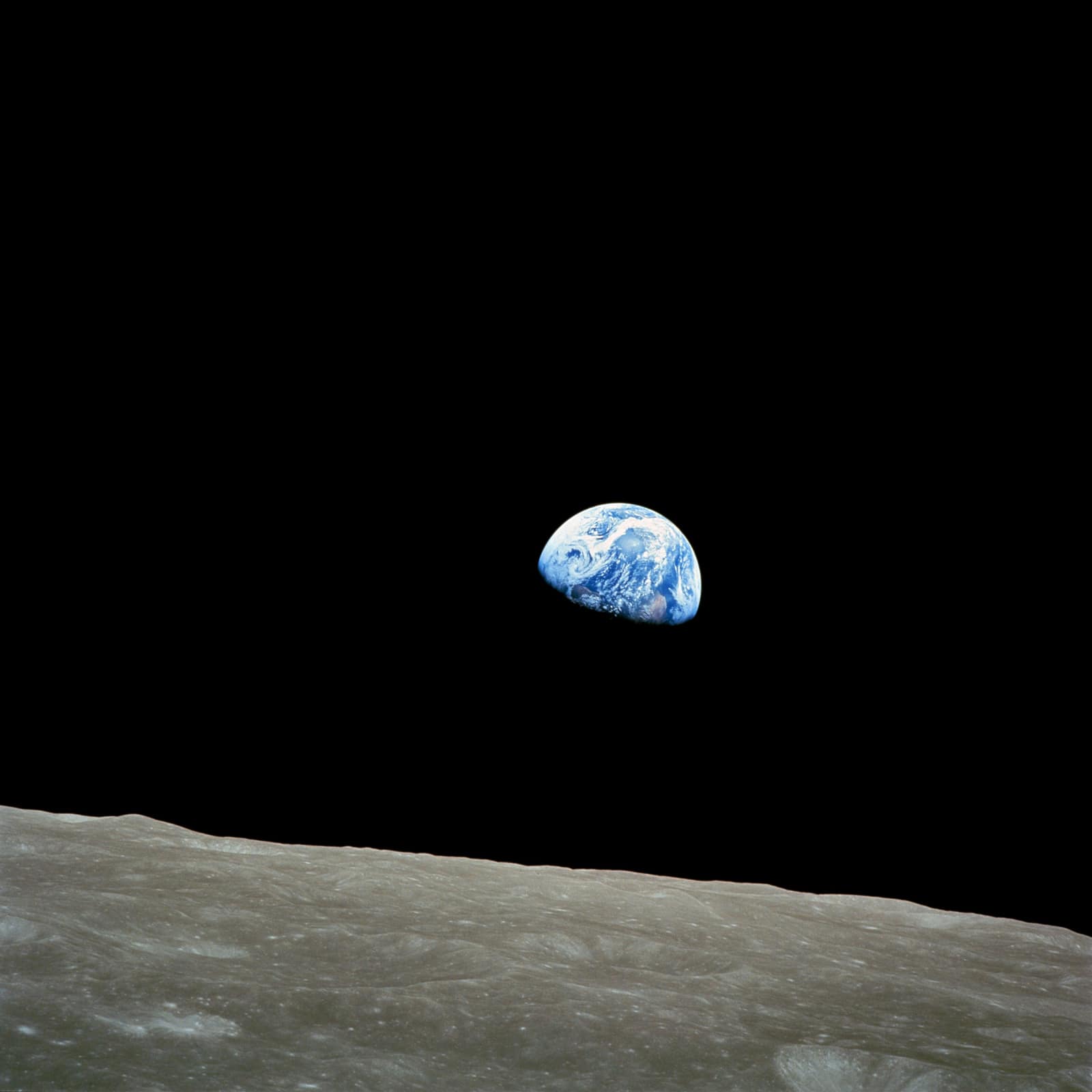
Earthrise
Lunar orbit, above the eastern limb of the Moon's far side · Americas