The transistor
Before it, electronic amplification depended on hot, fragile vacuum tubes; after it, amplifiers and switches could be made of solid crystal, the principle on which every later chip was built.
- Dated
- Place
- New Providence, New Jersey, United States · John Bardeen, Walter Brattain and William Shockley, physicists at Bell Telephone Laboratories, the research arm of the American telephone system
- Coordinates
- 40° 41′ N · 74° 24′ W (approximate)
- Remains
- Reconstructed
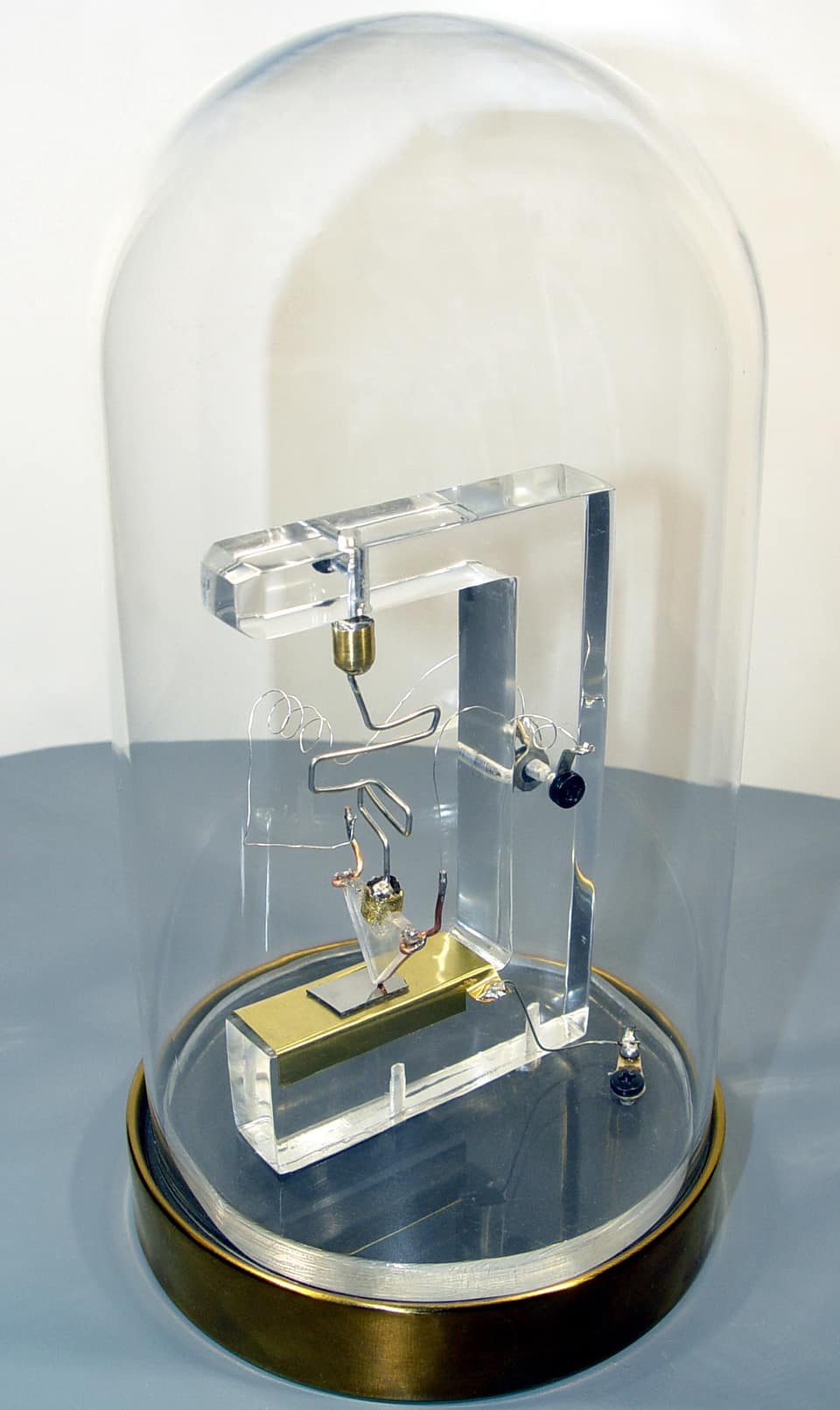

Mister rf, CC BY-SA 4.0, via Wikimedia CommonsCC-BY-SA-4.0Original record
Data saver is on. Images load only when you ask. You can change this in Settings at any time.
From the archivist
A strip of gold foil, a sliver of plastic, a bent wire acting as a spring, and a small slab of grey germanium. The thing looked as if it had been assembled on a kitchen table.
On 23 December 1947, in a laboratory of the telephone company in New Jersey, two physicists, Walter Brattain and John Bardeen, showed it to their managers. A weak signal went into one wire and came out of the other much stronger. Until then, this civilization had amplified sound and current with glass vacuum tubes that glowed, grew hot, used a great deal of power and burned out. Here the same work was done by a solid crystal, cold and silent.
Their group leader, William Shockley, called it a magnificent Christmas present. Within weeks he had designed a better version. In 1956 the three men shared a Nobel Prize, though by then they no longer worked together.
The first transistor could sit in the palm of a hand. Its descendants became so small that billions fit on a fingernail of silicon, and the radios, telephones, computers and satellites that followed were built from them.
Established
- Between 17 November and 23 December 1947, at Bell Telephone Laboratories in New Jersey, Walter Brattain and John Bardeen, in a group directed by William Shockley, discovered the transistor effect and built a point contact germanium transistor (IEEE Milestone).
- The device pressed two closely spaced gold contacts, held by a plastic wedge, onto a small slab of high purity germanium; it amplified a signal up to about 100 times (Computer History Museum).
- It first amplified on 16 December 1947 and was demonstrated to Bell Labs officials on 23 December 1947; Bell Labs announced it to the public in New York on 30 June 1948 (Computer History Museum).
- The name transistor was proposed by the engineer John Pierce (Computer History Museum).
- In 1956 Shockley, Bardeen and Brattain shared the Nobel Prize in Physics for their researches on semiconductors and their discovery of the transistor effect (Nobel Prize).
Interpretation
How credit should be shared among the three men has long been discussed: the point contact device was built by Bardeen and Brattain, while Shockley, their group leader, soon designed the more practical junction transistor. Others had approached the idea, notably Julius Lilienfeld, who filed patents for a solid state amplifier from 1925, and Herbert Mataré and Heinrich Welker, who built a similar device in France in 1948. Calling the transistor the foundation of the digital age is a later reading, since its impact came through decades of work on silicon and integrated circuits.
In 10,000 years
In 10,000 years, will anyone understand that a sliver of crystal once carried all of this civilization's thought?
Sources (4)
- IEEE. Milestone: Invention of the First Transistor at Bell Telephone Laboratories, Inc., 1947 (dedicated 8 December 2009). Engineering and Technology History Wiki. · ethw.org
- Computer History Museum. The Silicon Engine: 1947, Invention of the Point-Contact Transistor. · www.computerhistory.org
- The Nobel Prize in Physics 1956. NobelPrize.org, Nobel Prize Outreach. · www.nobelprize.org
- Nokia. The transistor: 75 years since the famed Nokia Bell Labs invention changed the world. Nokia blog, 2022. · www.nokia.com
Related fragments
1973
A telephone call from the street
New York City, New York, United States · Americas
1983
The network of networks: the switch to TCP/IP
Marina del Rey, California, United States · Americas
1950
"Computing Machinery and Intelligence" (Turing, 1950)
Manchester, United Kingdom · Europe