The discovery of penicillin
Before penicillin, a scratch that became infected could kill; after it, antibiotics made most bacterial infections curable and changed what medicine and surgery could attempt.
- Dated
- Place
- St Mary's Hospital, Paddington, London, United Kingdom · Alexander Fleming at St Mary's Hospital, London; Howard Florey, Ernst Chain, Norman Heatley and their team at Oxford; scientists and industry in the United States
- Coordinates
- 51° 31′ N · 0° 10′ W (approximate)
- Remains
- Intact
.jpg)
Science Museum London / Science and Society Picture Library, CC BY-SA 4.0, via Wikimedia CommonsCC-BY-SA-4.0Original record
Data saver is on. Images load only when you ask. You can change this in Settings at any time.
From the archivist
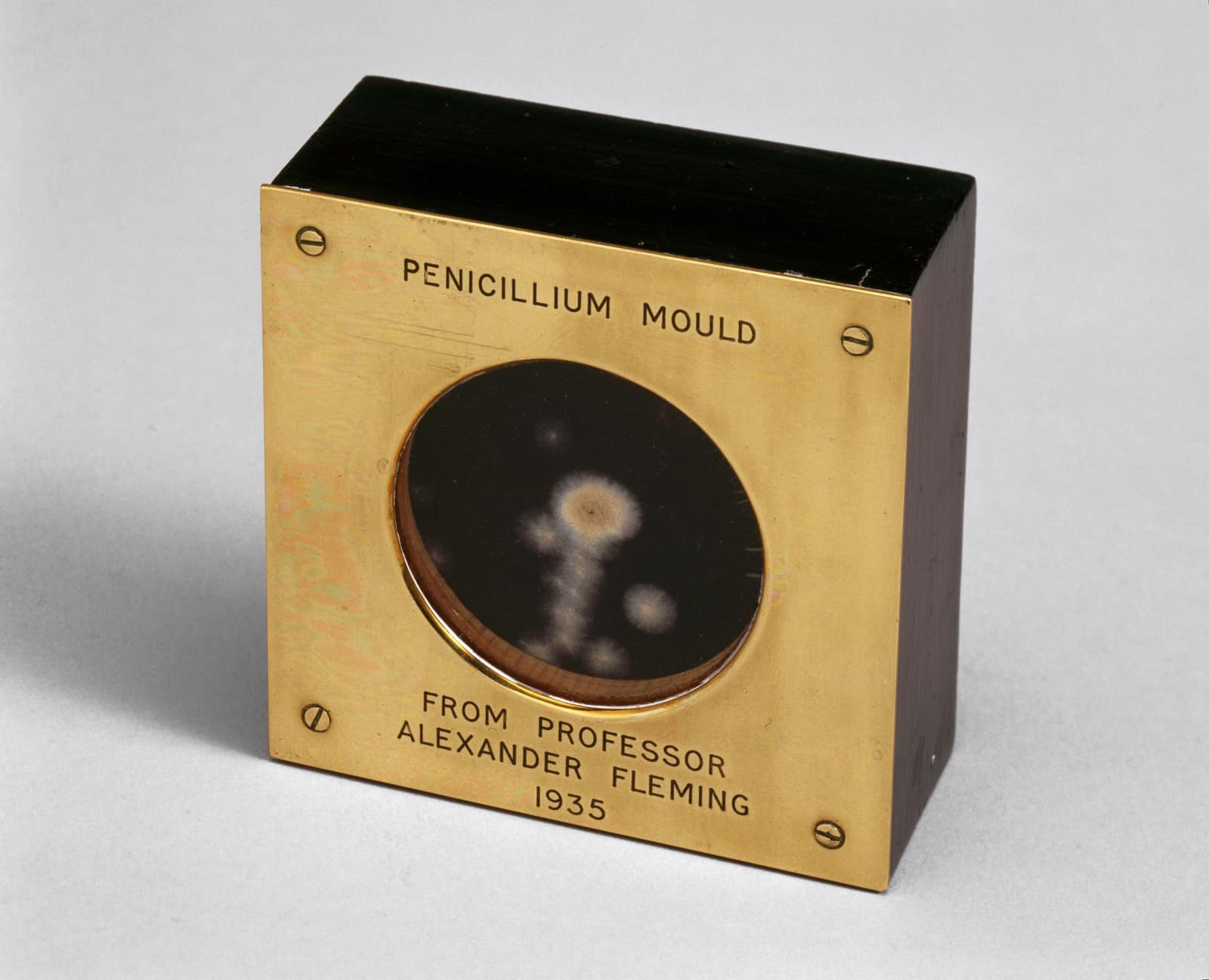
It began, as many things in this archive do, with something that went wrong. A dish of bacteria left on a bench in a London hospital during a summer holiday grew a patch of mould. Around the mould, the bacteria had died.
Alexander Fleming noticed it, kept the mould, gave its juice a name and wrote it up. Then, for ten years, little happened. The substance was fragile and hard to collect.
In Oxford, at the end of the 1930s, a small team took it up again. They grew the mould in whatever vessels they could find, bedpans among them, and extracted a few precious milligrams. In the spring of 1940, the treated mice lived. In 1941 a policeman dying of infection was given it and began to recover; the supply ran out before he was cured.
It was in America, in great fermentation tanks, that the mould was finally made to produce in quantity. By the summer of 1944 there was enough for the wounded of an entire invasion.
Here is the mould itself, dried behind glass, a gift from Fleming to a colleague, grey flowers on a dark field.
Established
- In 1928, at St Mary's Hospital in London, Alexander Fleming returned from holiday to find a culture plate of staphylococcus bacteria on which a mould had grown, with the bacteria around it failing to grow (Science Museum).
- He named the active substance penicillin and described it in 1929 in the British Journal of Experimental Pathology; his peers showed little interest (Fleming 1929; Science Museum).
- At the Sir William Dunn School of Pathology in Oxford, Howard Florey, Ernst Chain, Norman Heatley and colleagues purified it; in 1940 they showed that eight mice infected with streptococci died unless treated, the four given penicillin surviving (Chain et al. 1940; Science Museum).
- On 12 February 1941 the first patient, Albert Alexander, a 43 year old Oxford policeman with a severe infection, was treated; he improved, but the supply ran out and he died (Abraham et al. 1941; Science Museum).
- In the United States, a laboratory in Peoria, Illinois, raised yields with corn steep liquor, deep fermentation tanks and a more productive mould strain found on a cantaloupe by Mary Hunt; industry produced about 2.3 million doses in time for the Normandy landings of June 1944 (Science Museum; American Chemical Society).
- In 1945 Fleming, Chain and Florey shared the Nobel Prize in Physiology or Medicine for the discovery of penicillin and its curative effect in infectious diseases (Nobel Prize).
Interpretation
The story of the stray spore landing by chance on an open plate is a simplification, and how the contamination happened is still discussed. Others had noticed moulds that stopped bacteria before Fleming, and without the Oxford team and American industry his observation would have stayed a curiosity; the share of credit between Fleming, Florey, Chain and Heatley has long been argued. In his Nobel lecture Fleming himself warned that careless underdosing could make microbes resistant, as has since happened.
In 10,000 years
In 10,000 years, will antibiotics be remembered as a short age of grace between two ages of infection?
Sources (7)
- Fleming, A. On the antibacterial action of cultures of a penicillium, with special reference to their use in the isolation of B. influenzae. British Journal of Experimental Pathology 10 (3), 1929, p. 226-236; reprinted in Bulletin of the World Health Organization 79 (8), 2001, p. 780-790. · pmc.ncbi.nlm.nih.gov
- Chain, E., Florey, H. W., Gardner, A. D., Heatley, N. G., Jennings, M. A., Orr-Ewing, J., Sanders, A. G. Penicillin as a chemotherapeutic agent. The Lancet 236 (6104), 1940, p. 226-228. · doi.org
- Abraham, E. P., Chain, E., Fletcher, C. M., Gardner, A. D., Heatley, N. G., Jennings, M. A., Florey, H. W. Further observations on penicillin. The Lancet 238 (6155), 1941, p. 177-189. · doi.org
- Science Museum. How was penicillin developed? · www.sciencemuseum.org.uk
- Science Museum Group. Penicillium mould presented by Alexander Fleming, 1935, object number 1997-731. · collection.sciencemuseumgroup.org.uk
- American Chemical Society. Penicillin production through deep-tank fermentation, National Historic Chemical Landmark. · www.acs.org
- The Nobel Prize in Physiology or Medicine 1945: Sir Alexander Fleming, Ernst Boris Chain, Sir Howard Walter Florey. · www.nobelprize.org
Related fragments
1796 to 1980
The end of smallpox
Berkeley, Gloucestershire, United Kingdom · Europe
c. 1600 BCE
The Edwin Smith Papyrus
Luxor, Egypt (place of purchase); now in New York, United States · Africa
before 500 CE
The Sushruta Samhita
Varanasi, India; manuscript in Kathmandu, Nepal · Asia