The end of smallpox
- Dated
- Place
- Berkeley, Gloucestershire, United Kingdom · From an English country doctor to health workers of every continent, coordinated by the World Health Organization
- Coordinates
- 51° 41′ N · 2° 28′ W (approximate)
- Remains
- Intact
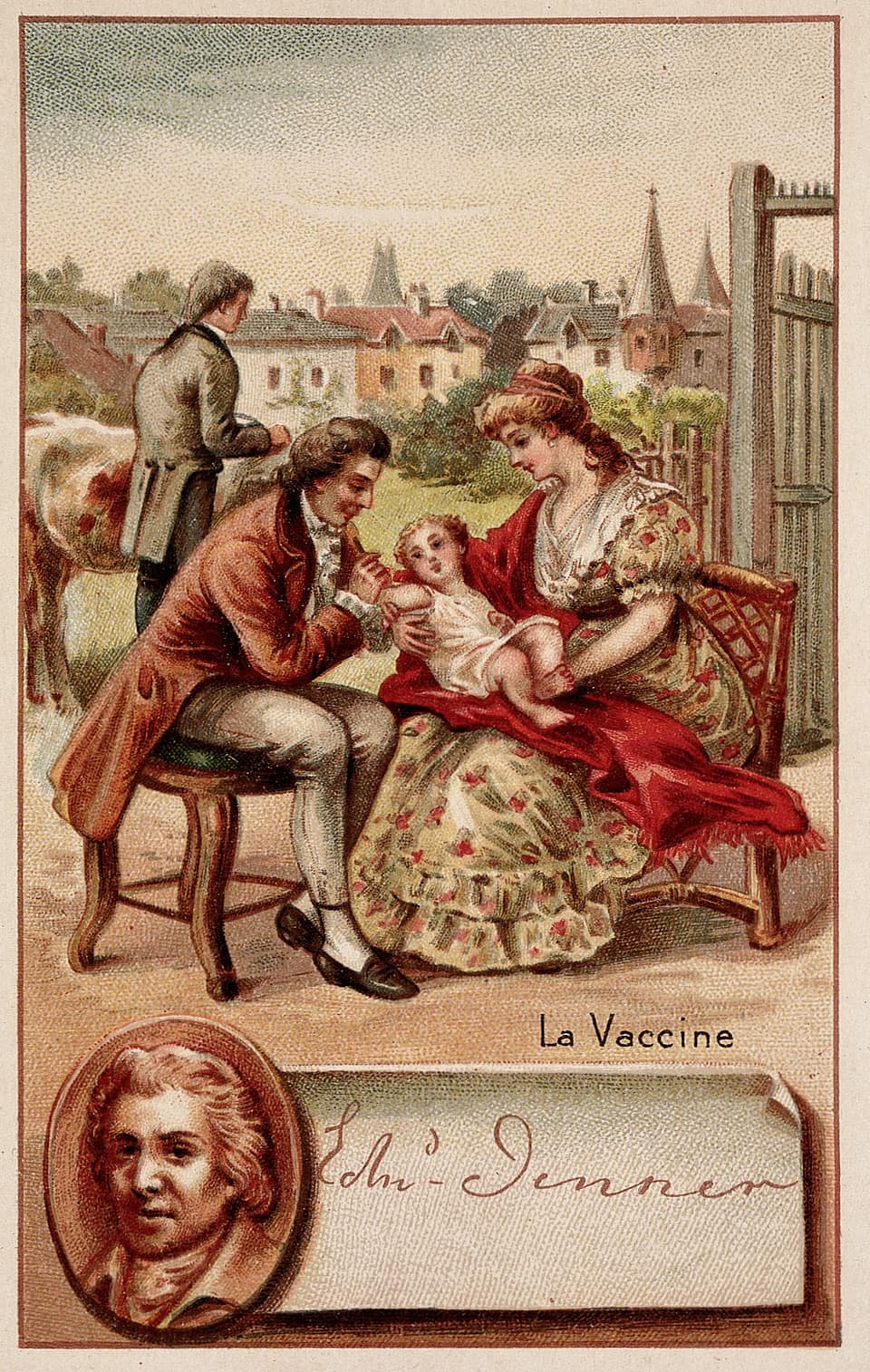
Wellcome Collection, CC BY 4.0, via Wikimedia CommonsCC-BY-4.0Original record
Data saver is on. Images load only when you ask. You can change this in Settings at any time.
From the archivist
For three thousand years at least, this civilization lived with a disease that covered the body in blisters, killed about a third of those it struck in its worst form, and left survivors scarred or blind.
In the spring of 1796, a country doctor in Gloucestershire took matter from a sore on a milkmaid's hand, a sore of cowpox, a mild disease of cattle, and scratched it into the arm of a boy of eight. Weeks later he exposed the boy to smallpox. Nothing happened. From the Latin word for cow came a new word, vaccine.
The protection spread across the world, but the disease did not leave. In 1967 an international campaign began to hunt it case by case, village by village, vaccinating everyone around each patient to close the circle.
In October 1977, in Merca, on the coast of Somalia, a hospital cook named Ali Maow Maalin fell ill and recovered. He was the last. In May 1980 the nations of the world declared the disease gone. It is the only one we have ever ended.
Established
- In May 1796, in Gloucestershire, Edward Jenner inoculated eight year old James Phipps with matter from a cowpox sore on the hand of the milkmaid Sarah Nelmes; the boy later resisted smallpox, and Jenner published his results in 1798 (WHO).
- In 1967 the World Health Organization launched an intensified eradication programme based on surveillance and containment, with freeze dried vaccine that kept without refrigeration (WHO).
- The last naturally occurring case was Ali Maow Maalin, a hospital cook in Merca, Somalia, whose rash appeared on 26 October 1977; he recovered (CDC).
- In 1978 a laboratory accident in Birmingham, England, caused the last known death from smallpox (CDC).
- On 8 May 1980 the World Health Assembly declared the world free of smallpox, the first human disease to be eradicated (CDC).
Interpretation
Estimates of the toll of smallpox in the twentieth century, often given as about 300 million deaths, are approximate. Jenner was not the first to use cowpox or to protect people against smallpox: variolation had long been practised in Africa, Asia and the Ottoman world, and farmers had tried cowpox before him; his contribution was to test it and make it known. Whether the last stocks of the virus should be destroyed is still debated.
In 10,000 years
In 10,000 years, will anyone remember a disease that no longer exists, or the people who ended it?
Sources (4)
- World Health Organization. History of smallpox vaccination. · www.who.int
- Centers for Disease Control and Prevention. History of smallpox. · www.cdc.gov
- Fenner, F., Henderson, D. A., Arita, I., Ježek, Z., Ladnyi, I. D. Smallpox and its Eradication. Geneva, World Health Organization, 1988. · iris.who.int
- Jenner, E. An Inquiry into the Causes and Effects of the Variolae Vaccinae. London, 1798.