Sidereus Nuncius (Galileo, 1610)
- Dated
- Place
- Venice, Italy · Galileo Galilei, professor of mathematics at Padua in the Republic of Venice
- Coordinates
- 45° 26′ N · 12° 20′ E (approximate)
- Remains
- Intact
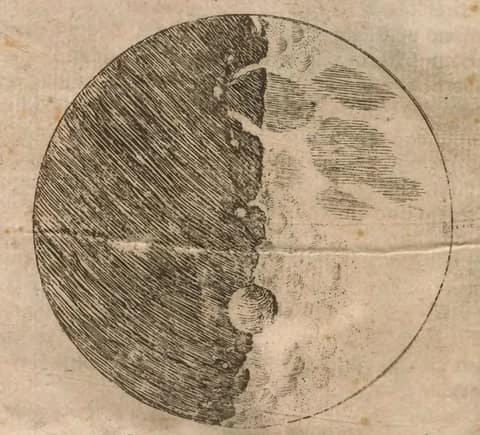

Galileo Galilei, Sidereus Nuncius (Venice, 1610), public domain, via Wikimedia CommonsPDMOriginal record
Data saver is on. Images load only when you ask. You can change this in Settings at any time.
From the archivist
In January 1610, in Padua, a professor of mathematics turned a tube of lenses toward the sky, and the sky was no longer what this civilization had believed it to be.
Galileo Galilei had heard of a Dutch device that brought far things near, built his own, and made it stronger. He looked at the Moon and saw that it was not a polished sphere but a world of mountains, their peaks lit before the valleys. He looked at the pale band of the Milky Way and saw that it was stars, more than anyone could count. He looked at Jupiter and saw four small points beside it that moved, night after night, around the planet.
He wrote it down quickly, in Latin, and had it printed in Venice in March: some sixty short pages with pictures of the Moon, sold out almost at once. He named the moons after the family whose favour he wanted.
Many would not look through the tube, or looked and doubted. The book remained. The sky had been opened, and it would not close again.
Established
- Sidereus Nuncius (The Starry Messenger) was printed in Venice, its printing completed by 12 March 1610, in an edition of 550 copies that sold out soon after publication (Linda Hall Library).
- Galileo reported that the Moon's surface was rough, with mountains and valleys, that the Milky Way was made of countless stars, and that four bodies circled Jupiter (Van Helden 1989).
- He first saw Jupiter's companions on 7 January 1610 and recorded their positions until 2 March; he named them the Medicean Stars in honour of Cosimo II de' Medici, to whom the book is dedicated (Linda Hall Library).
- The observations were made with a telescope that Galileo had built and improved himself, following reports of a Dutch spyglass in 1609 (Whipple Museum).
- The book was illustrated with etchings of the Moon at different phases, made from his drawings (Linda Hall Library).
Interpretation
The moons of Jupiter did not prove that the Earth goes around the Sun, but they showed that not everything in the sky turned around the Earth, and Galileo soon used them in defence of Copernicus; this path led to his trial in 1633. Some of the lunar features in the etchings are exaggerated or misplaced, and historians discuss whether this served clarity, persuasion or the limits of his instrument.
In 10,000 years
In 10,000 years, what will our descendants see that we could not, simply because they looked?
Sources (3)
- Linda Hall Library. Three bright Galilean stars: three copies of Sidereus Nuncius in Kansas City. · www.lindahall.org
- Whipple Museum of the History of Science, University of Cambridge. Starry Messenger: Galileo and Sidereus Nuncius. · www.sites.hps.cam.ac.uk
- Galilei, G. Sidereus Nuncius, or The Sidereal Messenger. Translated with introduction by A. Van Helden. Chicago, University of Chicago Press, 1989 (2nd ed. 2016).
Related fragments
1977
The Golden Record
Voyager 1 · Voyager 2 · Americas
205 to 60 BCE
The Antikythera mechanism
Antikythera, Greece (find spot); National Archaeological Museum, Athens · Europe