The network of networks: the switch to TCP/IP
Before 1 January 1983 the ARPANET was one network speaking its own protocol; after it, its hosts spoke TCP/IP, a common language that let separate networks join into a single internet.
- Dated
- Place
- Marina del Rey, California, United States · Vinton Cerf, Robert Kahn and the research community of the ARPANET, funded by the United States Defense Advanced Research Projects Agency
- Coordinates
- 33° 59′ N · 118° 26′ W (approximate)
- Remains
- Digital
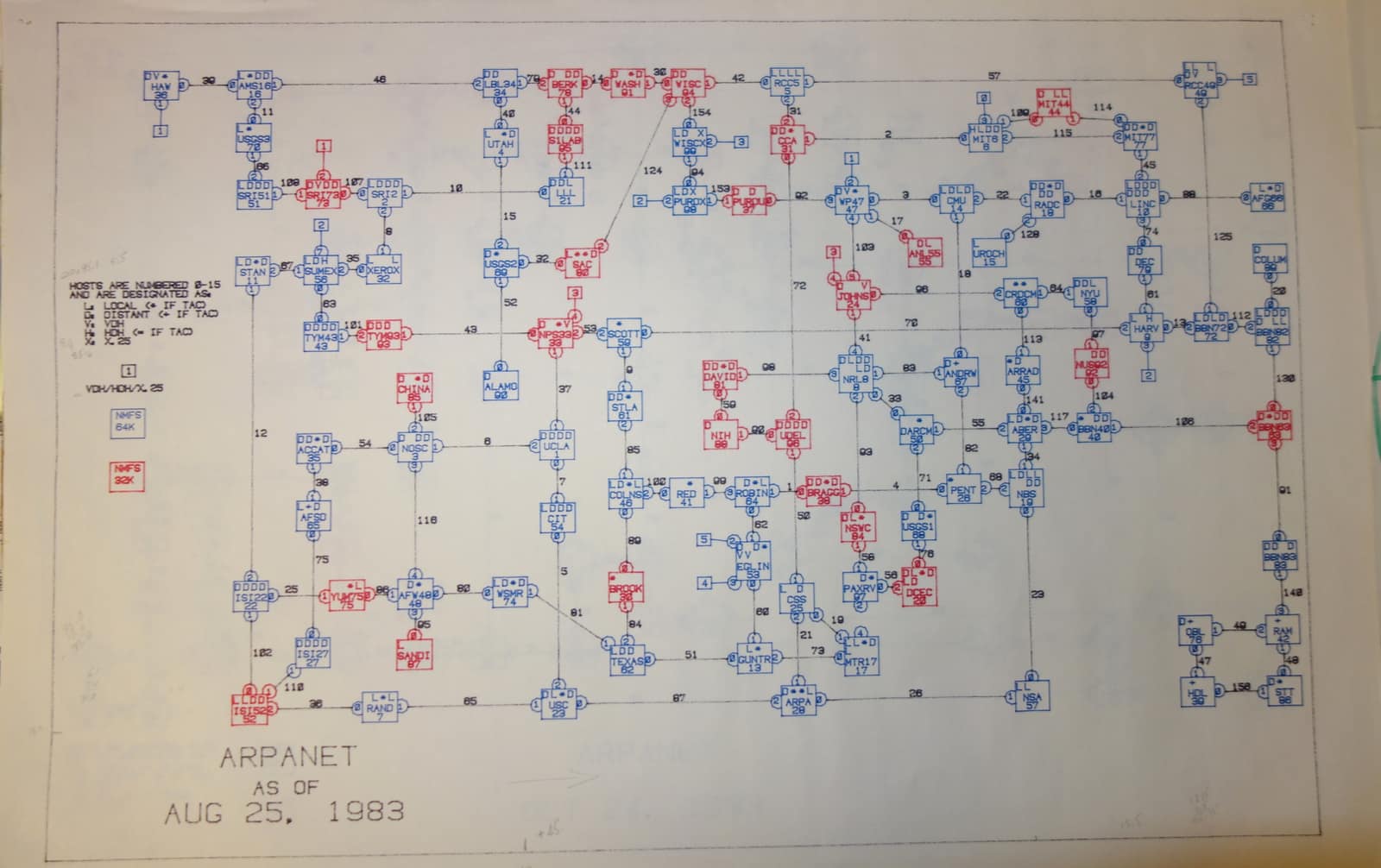

ARPANET as of Aug 25, 1983, map by BBN, public domain, via Wikimedia CommonsPDMOriginal record
Data saver is on. Images load only when you ask. You can change this in Settings at any time.
From the archivist
There was no ceremony. On 1 January 1983 the computers of the ARPANET simply stopped speaking their old language and began to speak a new one.
The new language had two parts, TCP and IP, and a simple ambition. Nine years earlier, two engineers, Vinton Cerf and Robert Kahn, had described how networks built by different people, over cables, radio or satellite, could pass messages to one another as if they were one. Each network could stay as it was. Only the way of addressing and handing on the packets had to be shared.
The switch had been announced more than a year in advance, in a short note by Jon Postel, who edited the series of technical documents known as Requests for Comments. Every machine had to be converted by the same date. Some of those who managed it later wore a small button: I survived the TCP/IP transition.
It seemed an administrative matter. Yet from that day the network was no longer one network but the first piece of a network of networks, open to anyone who spoke the same language. This civilization later called it, simply, the internet. The map kept here was drawn eight months after the change, with pencil notes still in its margins.
Established
- In May 1974 Vinton Cerf and Robert Kahn published A Protocol for Packet Network Intercommunication, describing how separate packet networks could be joined through gateways by a common protocol (IEEE Transactions on Communications).
- An earlier version of their work was presented at the University of Sussex in September 1973 (Internet Society).
- In November 1981 Jon Postel set out, in RFC 801, the goal of a complete switch of the ARPANET from its original protocol, NCP, to IP/TCP by 1 January 1983 (RFC 801).
- The change was a flag day transition that required all hosts to convert at once; it had been planned for several years and went, in the words of the Internet Society's history, surprisingly smoothly (Internet Society).
- The transition was followed by the distribution of buttons reading I survived the TCP/IP transition (Internet Society).
- The move to TCP/IP allowed the ARPANET to be split into MILNET, for operational military needs, and an ARPANET for research (Internet Society).
Interpretation
The birth of the internet has no single date: some place it in 1969 with the first ARPANET link, others in 1974 with the Cerf and Kahn paper, and others on 1 January 1983, when a working network adopted the protocols at scale. The flag day was less instantaneous than its name suggests, since the conversion of hosts had been prepared and tested over the preceding year. The internet's open, decentralised design reflects both engineering choices and the research culture that produced it.
In 10,000 years
In 10,000 years, will the machines still speak a language agreed upon by a small community of researchers in 1983?
Sources (3)
- Cerf, V. G., Kahn, R. E. A Protocol for Packet Network Intercommunication. IEEE Transactions on Communications 22 (5), 637 to 648, May 1974. · doi.org
- Postel, J. NCP/TCP Transition Plan. RFC 801, Internet Engineering Task Force, November 1981. · www.rfc-editor.org
- Leiner, B. M., Cerf, V. G., Clark, D. D., Kahn, R. E., Kleinrock, L., Lynch, D. C., Postel, J., Roberts, L. G., Wolff, S. Brief History of the Internet. Internet Society. · www.internetsociety.org
Related fragments
1969 to 1990
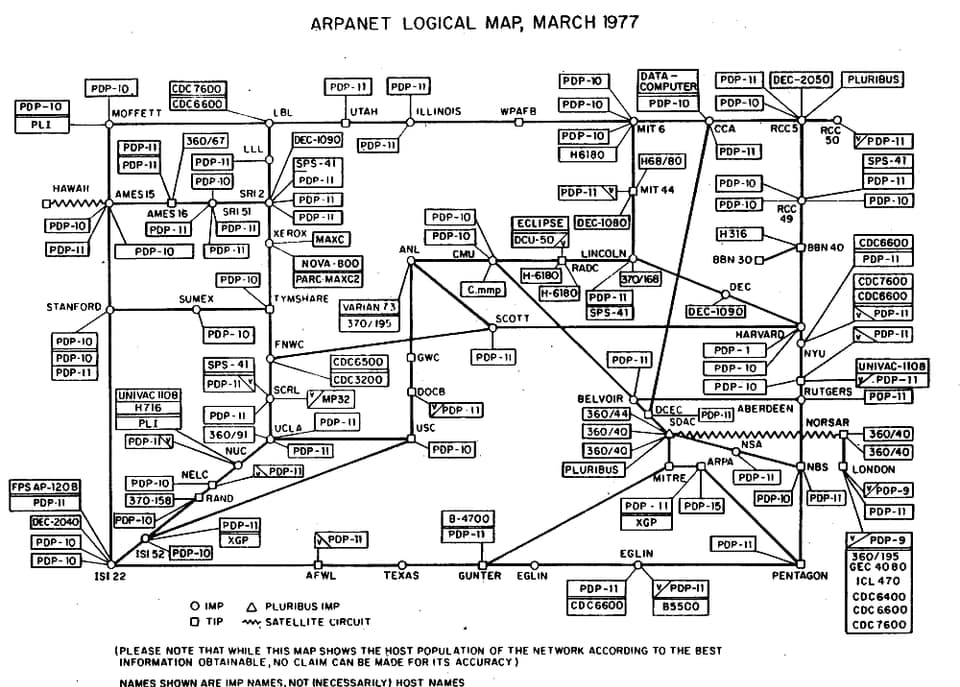
A map of a new network: ARPANET
Los Angeles, California, United States · Americas
1990 to 1993
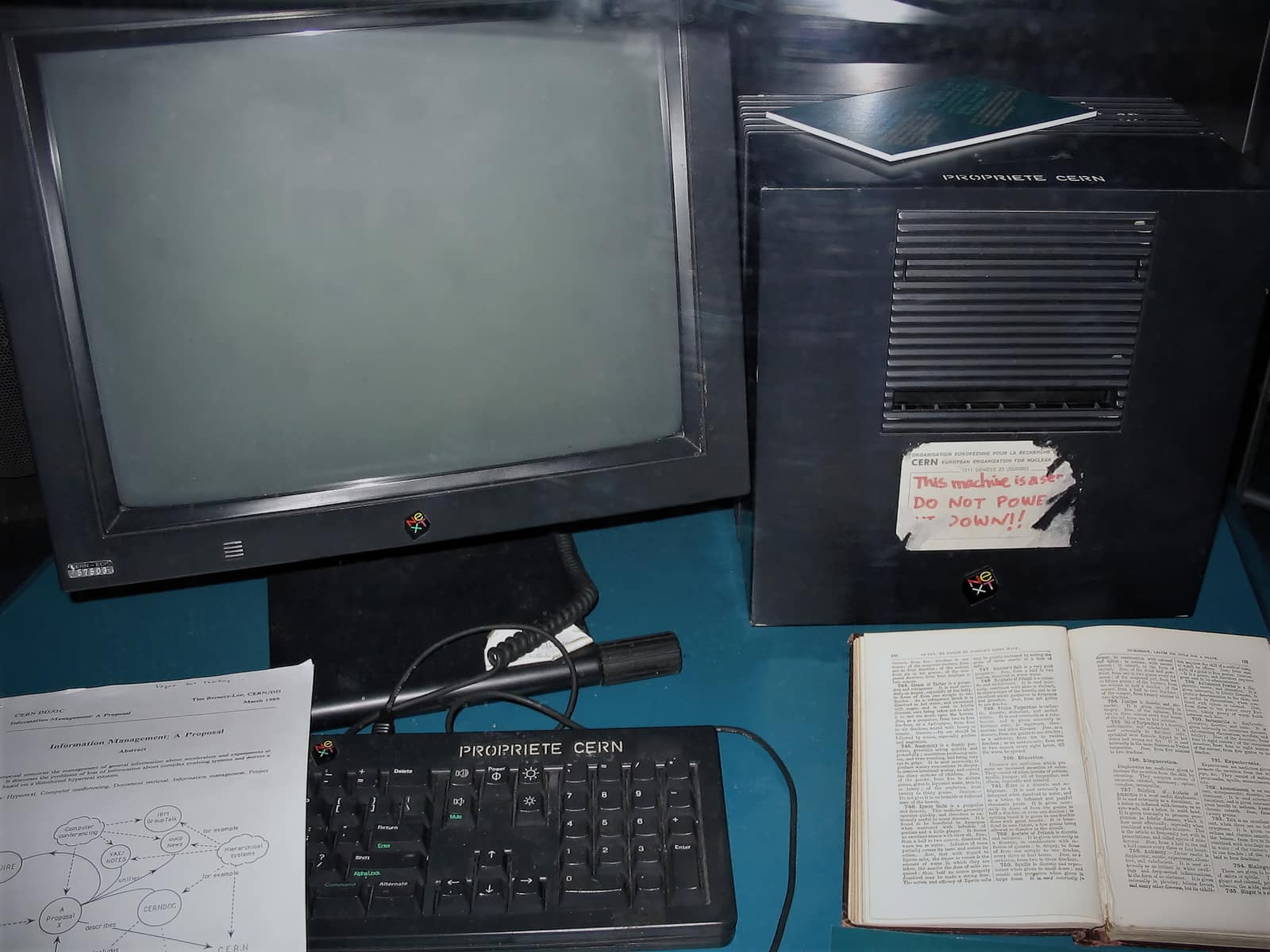
The first web server
Meyrin, Canton of Geneva, Switzerland · Europe
1947
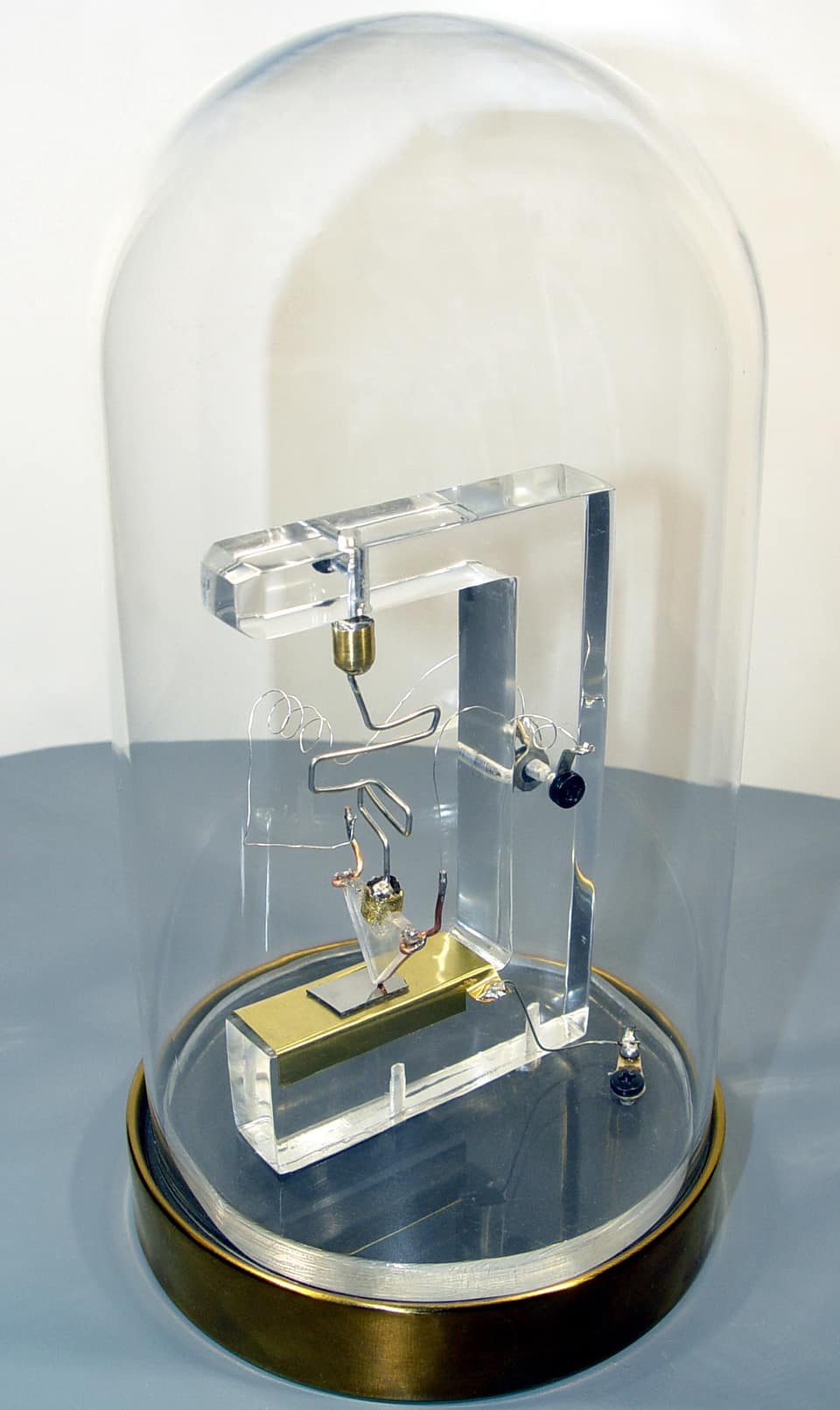
The transistor
New Providence, New Jersey, United States · Americas
1858 to 1866
The cable under the Atlantic
Valentia Island, County Kerry, Ireland; and Heart's Content, Newfoundland and Labrador, Canada · Europe