The cable under the Atlantic
Before 1866, news between Europe and North America crossed the ocean at the speed of a ship, in more than a week; after it, a message crossed in minutes, and the two continents could learn of the same event on the same day.
- Dated
- Place
- Valentia Island, County Kerry, Ireland; and Heart's Content, Newfoundland and Labrador, Canada · The Atlantic Telegraph Company of Cyrus Field, British and American engineers and scientists including William Thomson, and the crews of the cable ships
- Coordinates
- 51° 56′ N · 10° 18′ W (approximate)
- Remains
- Fragmentary
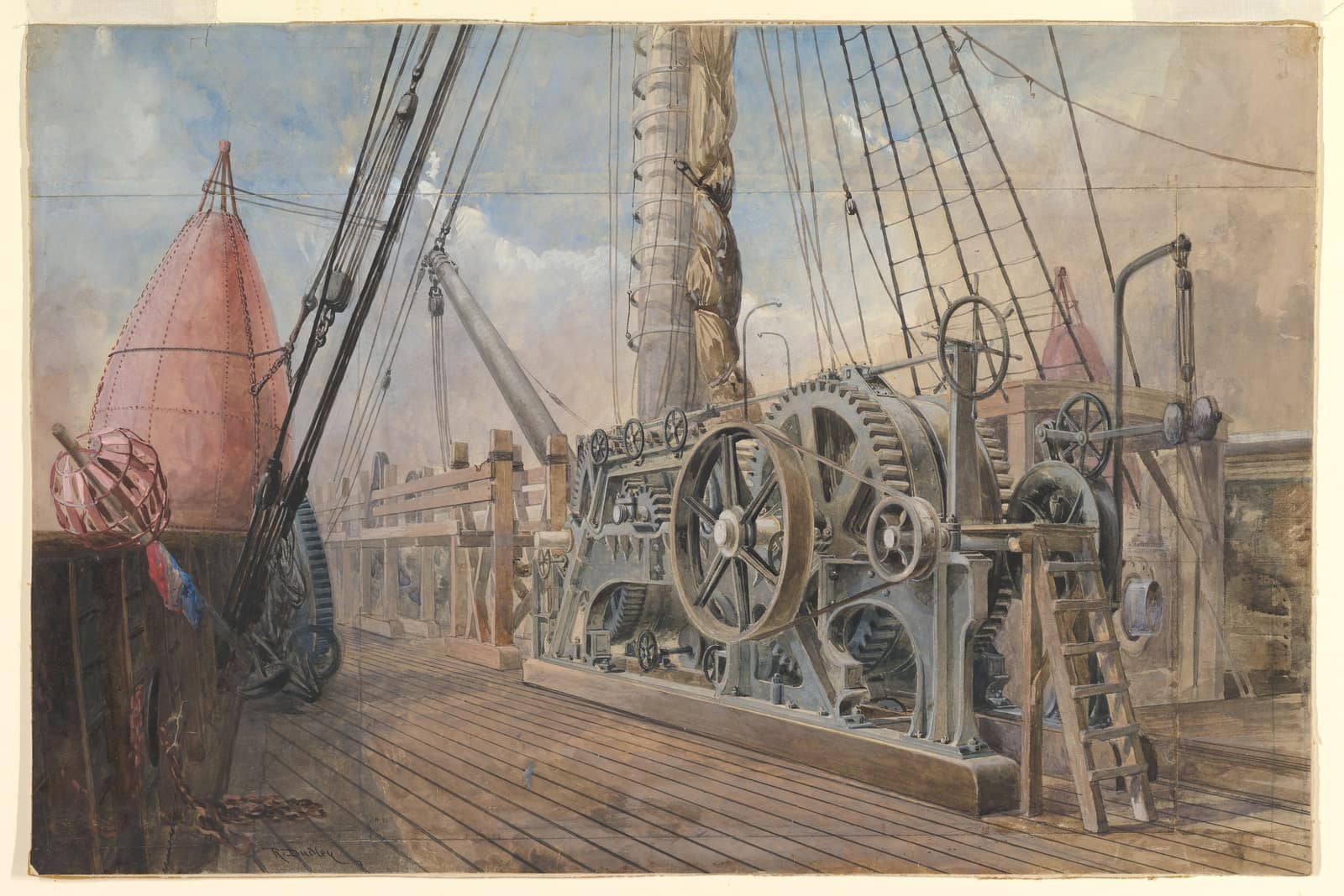

Robert Charles Dudley, The Metropolitan Museum of Art, CC0, via Wikimedia CommonsCC0-1.0Original record
Data saver is on. Images load only when you ask. You can change this in Settings at any time.
From the archivist
In August 1858, a thin rope of copper wrapped in gutta percha and iron lay across the floor of the Atlantic, from an island off the coast of Ireland to a bay in Newfoundland. A greeting from a queen to a president took almost sixteen hours to cross it, letter by letter. Crowds in New York celebrated with fireworks. Within weeks the cable fell silent.
Seven years later the largest ship of its time, the Great Eastern, set out from Ireland with a new cable coiled in her tanks and iron machinery on her deck, like that painted here, to pay it out and haul it back. Some six hundred miles short of Newfoundland, the line snapped and sank.
She tried again. On 27 July 1866 the cable came ashore at Heart's Content, a fishing village in Newfoundland, and it held. That summer the crew went back to sea, grappled the lost line of 1865 from the deep ocean floor, spliced it and brought it to land as well.
Before this, news crossed the ocean at the speed of a ship. After it, a price in London, a death in Washington, a treaty or a war could be known on the other shore the same day. The world began to share a single present.
Established
- A first cable between Valentia Island in Ireland and Newfoundland was completed on 5 August 1858 (IEEE).
- On 16 August 1858 Queen Victoria's message of greeting to President James Buchanan, 98 words long, took almost 16 hours to send (IEEE Spectrum).
- The 1858 cable carried 732 messages before it failed within weeks, in September 1858; the use of very high voltages by its electrician, Wildman Whitehouse, is usually blamed, and manufacturing faults also played a part (IEEE; IEEE Spectrum).
- An attempt of 1865 by the steamship Great Eastern failed when the cable broke in mid ocean (IEEE).
- On 27 July 1866 the Great Eastern landed a new cable at Heart's Content, Newfoundland; by 8 September 1866 the lost cable of 1865 had been recovered and completed, giving two working lines (IEEE).
- William Thomson, later Lord Kelvin, devised the mirror galvanometer that made the faint signals readable (IEEE).
- The Heart's Content station closed in 1965; with the station on Valentia Island it forms the Transatlantic Cable Ensemble on a tentative list for UNESCO World Heritage, submitted in 2022 (UNESCO).
Interpretation
The failure of 1858 was long blamed on Whitehouse alone; later study of surviving samples suggests that the cable was also poorly made and stored. That the link of 1866 began the age of instant global communication is a common reading; it was expensive and slow by later standards, and its first users were governments, newspapers and merchants.
In 10,000 years
In 10,000 years, will the old cables still lie on the ocean floor, long after anyone knows what they once carried?
Sources (4)
- IEEE, Engineering and Technology History Wiki. Milestones: Landing of the Transatlantic Cable, 1866. · ethw.org
- UNESCO World Heritage Centre. Transatlantic Cable Ensemble (Canada), tentative list. · whc.unesco.org
- Marsh, A. The first transatlantic telegraph cable was a bold, beautiful failure. IEEE Spectrum, 31 October 2019. · spectrum.ieee.org
- Glover, B. and others. Atlantic Cable: history of the Atlantic cable and undersea communications. · atlantic-cable.com
Related fragments
1876
The telephone: a patent and a sentence
Boston, Massachusetts, United States · Americas
1901
The letter S across the Atlantic
St. John's, Newfoundland and Labrador, Canada · Americas
1969 to 1990
A map of a new network: ARPANET
Los Angeles, California, United States · Americas
1990 to 1993
The first web server
Meyrin, Canton of Geneva, Switzerland · Europe