The first web server
- Dated
- Place
- Meyrin, Canton of Geneva, Switzerland · Tim Berners-Lee and colleagues at CERN, the European laboratory for particle physics
- Coordinates
- 46° 14′ N · 6° 03′ E (approximate)
- Remains
- Intact
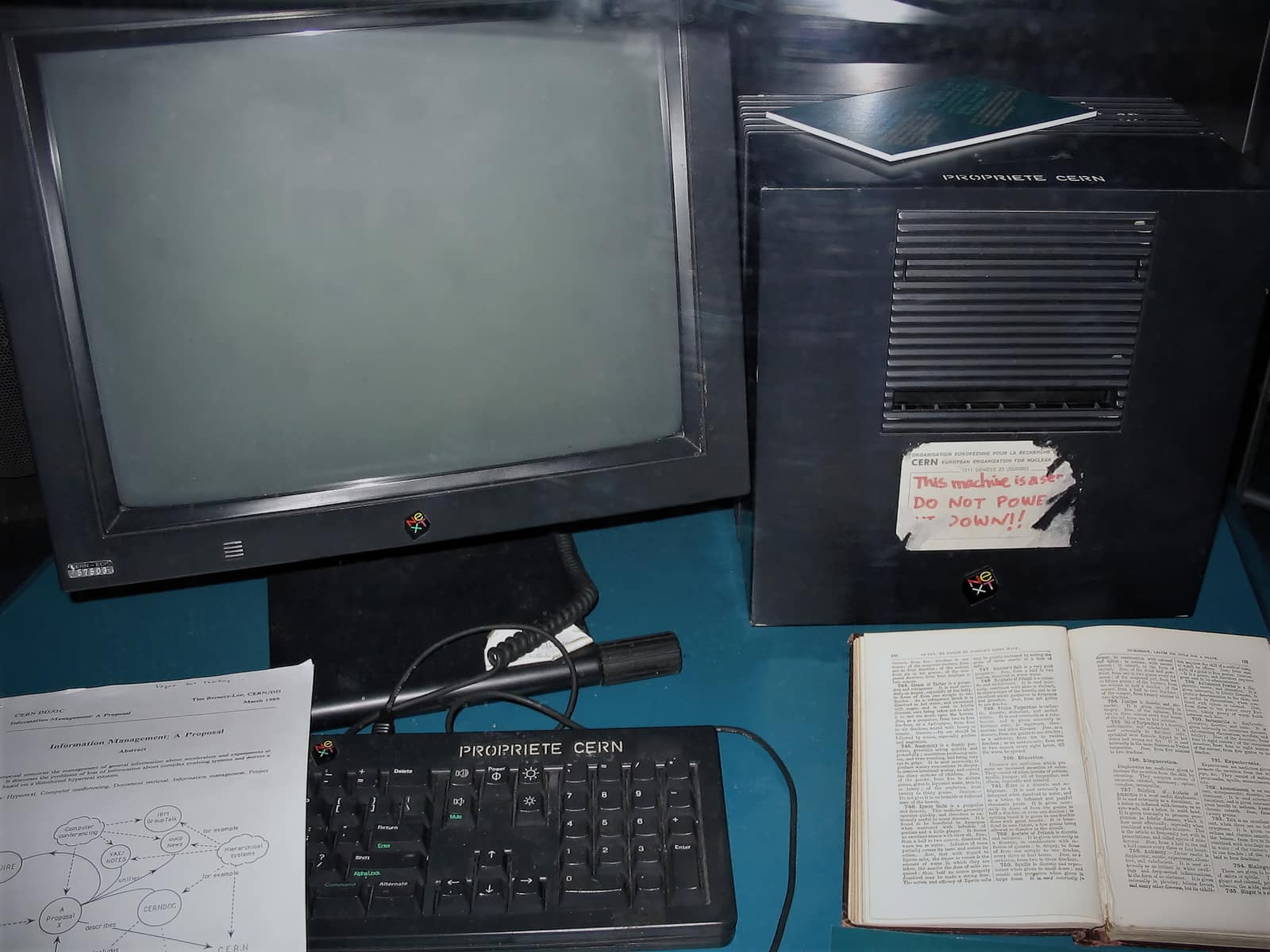

Coolcaesar at the English-language Wikipedia, CC BY-SA 3.0, via Wikimedia CommonsCC-BY-SA-3.0Original record
Data saver is on. Images load only when you ask. You can change this in Settings at any time.
From the archivist
The label is written by hand in red ink, on a strip of white paper stuck to a black cube: This machine is a server. DO NOT POWER IT DOWN!!
Behind it, at CERN near Geneva, a British physicist named Tim Berners-Lee had written a proposal in 1989 for a way to share documents between the laboratory's many incompatible computers. His supervisor wrote across the top of it: vague but exciting. By the end of 1990, on this machine, he had built the pieces: a language for pages, a protocol for asking for them, an address for each one, a program to serve them and another to read them.
The first page described the project itself. Anyone who found it could learn how to make another.
Then, on 30 April 1993, CERN gave the software away, to the public domain, without licence or fee. Within a few years this civilization kept its letters, its libraries, its commerce and its quarrels on the web. The cube stayed switched on, as the label asked, for as long as it was needed.
Established
- In March 1989, Tim Berners-Lee, a British scientist at CERN, wrote a proposal for a distributed information system, Information Management: A Proposal; his supervisor Mike Sendall noted on it: vague but exciting (CERN).
- By the end of 1990 he had defined HTML, HTTP and the URL and written the first web server and the first browser and editor, running on a NeXT computer at CERN (CERN).
- The first website, at info.cern.ch, described the World Wide Web project itself; CERN restored it in 2013 (CERN).
- On 30 April 1993 CERN released the World Wide Web software into the public domain, so that anyone could use it without fees (CERN).
Interpretation
The web was built on the internet, which already existed, and drew on older ideas of hypertext; its originality lay in joining them in a simple, open system. How much its rapid spread owes to the public domain release of 1993, rather than to the graphical browsers that followed, is a matter of emphasis among historians. Its later concentration in a few large platforms is often contrasted with the open design of its beginnings.
In 10,000 years
In 10,000 years, will anything still link one page of human knowledge to another?
Sources (4)
- CERN. Where the web was born. · home.cern
- CERN. Web at 30: web history. · web30.web.cern.ch
- CERN. Software release of WWW into public domain, 30 April 1993, CERN Document Server. · cds.cern.ch
- Berners-Lee, T. Information Management: A Proposal. CERN, March 1989. · www.w3.org
Related fragments
1969 to 1990
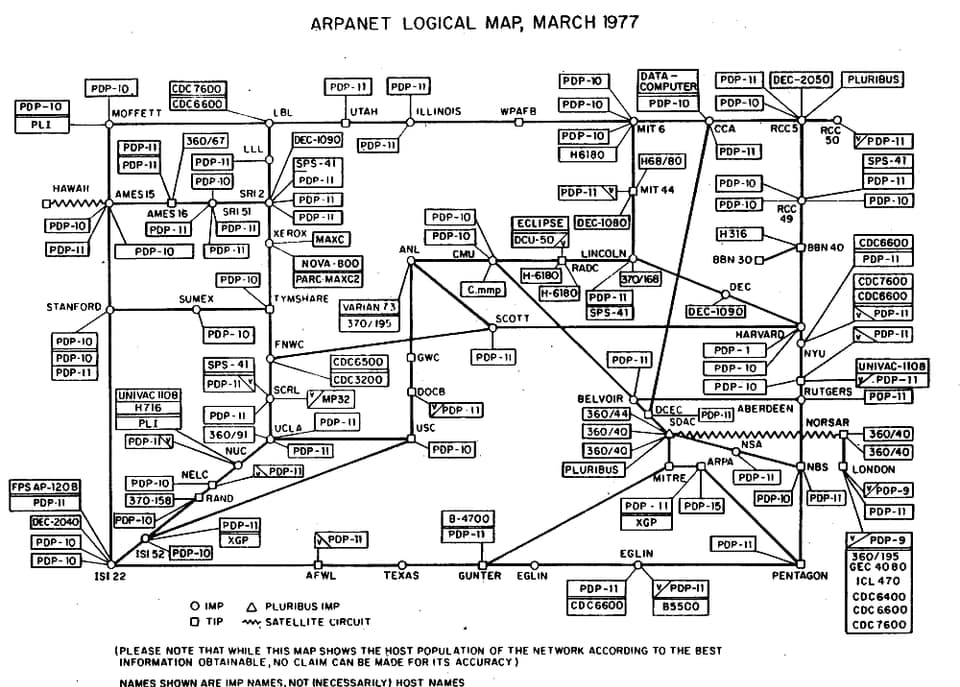
A map of a new network: ARPANET
Los Angeles, California, United States · Americas
1950
"Computing Machinery and Intelligence" (Turing, 1950)
Manchester, United Kingdom · Europe

2020
The Arctic Code Vault
Longyearbyen, Svalbard, Norway · Europe