Three wheels and a petrol engine: the Benz Patent-Motorwagen
Before 1886, travel on land depended on the muscles of people or animals, or on rails; after it, a light vehicle with its own petrol engine could go wherever there was a road, and within a century motor vehicles had reshaped cities, work and the air.
- Dated
- Place
- Mannheim, Baden-Württemberg, Germany · Carl Benz and the workshop of Benz & Cie., Rheinische Gasmotorenfabrik, in Mannheim; Bertha Benz and her sons Eugen and Richard
- Coordinates
- 49° 29′ N · 8° 28′ E (approximate)
- Remains
- Intact
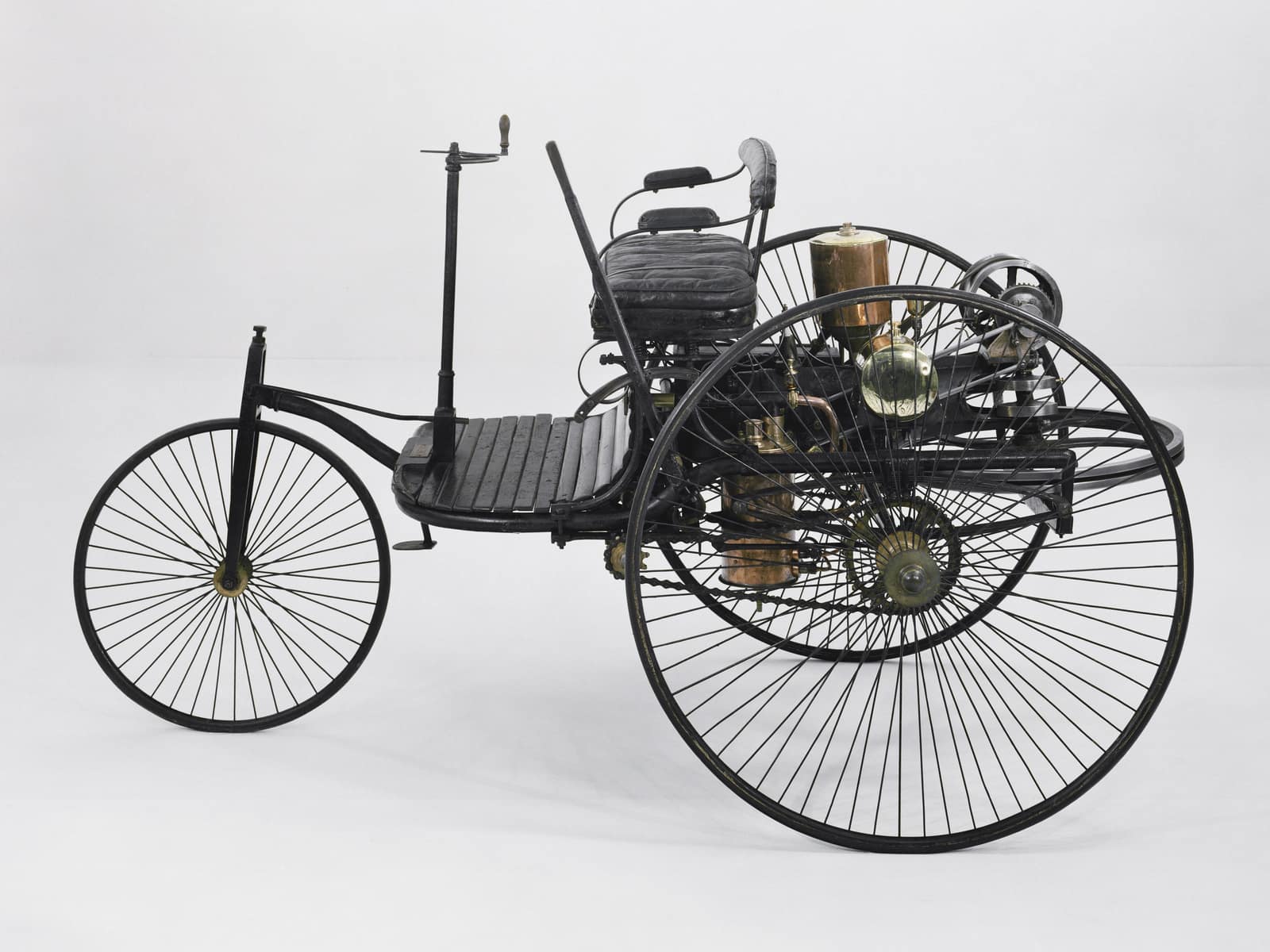

Deutsches Museum, Munich, CC BY-SA 4.0, via Wikimedia CommonsCC-BY-SA-4.0Original record
Data saver is on. Images load only when you ask. You can change this in Settings at any time.
From the archivist
It looks like a large tricycle that has lost its rider. Two tall wheels at the back, a small one in front, a bench, a steering rod with a little handle. Behind the seat, a single cylinder, a flywheel lying flat, a few vessels of brass and copper.
In the winter of 1886 its maker, Carl Benz, registered it at the patent office as a vehicle driven by a gas engine. The engine was his; it burned light petrol bought at a pharmacy and gave less than the strength of one horse.
Two summers later, at dawn, his wife Bertha set out from Mannheim in an improved model with her two sons and drove it to her home town, Pforzheim, about a hundred kilometres away. She did not tell her husband. On the way she bought fuel at a chemist's, had a cobbler put new leather on the brakes, and cleared a blocked line with a hatpin, or so the story is told.
From this carriage came roads laid across the continents, cities built for the car, and air thick with exhaust. The World Health Organization now counts more than a million dead on those roads every year.
Established
- On 29 January 1886 Carl Benz filed a patent with the Imperial Patent Office for a 'vehicle with gas engine operation'; it was granted as DRP 37435 on 2 November 1886, with effect from the filing date (DPMA).
- The vehicle was a light three-wheeler with a water-cooled, single-cylinder petrol engine of almost one litre, weighing about 100 kg, mounted at the rear; it developed less than one horsepower, reached perhaps 12 to 16 km/h, and ran on light petrol bought at pharmacies (Deutsches Museum 2026).
- Benz made a first short public drive with car No. 1 on 3 July 1886 (DPMA).
- On 5 August 1888, without telling her husband, Bertha Benz set out from Mannheim at dawn with her sons Eugen and Richard in an improved Patent-Motorwagen and drove about 100 km to her home town of Pforzheim; on the way she bought ligroin, a cleaning fluid used as fuel, at the town pharmacy in Wiesloch, and had a cobbler fit new leather to the brakes (DPMA).
- In 2011 the patent DRP 37435 was inscribed on UNESCO's Memory of the World Register (UNESCO).
- In a fact sheet of July 2026 the World Health Organization estimated that approximately 1.16 million people die each year in road traffic crashes, the leading cause of death for children and young adults aged 5 to 29 (WHO 2026).
- In 2019 transport accounted for 23% of global energy-related CO2 emissions, and 70% of direct transport emissions came from road vehicles (IPCC 2022).
Interpretation
Calling Benz's car the first automobile depends on definitions: steam carriages had run on roads since the eighteenth century, and in 1886 Gottlieb Daimler and Wilhelm Maybach, working separately near Stuttgart, fitted their own petrol engine to a four-wheeled carriage bought from a coachbuilder (German History in Documents and Images). What set Benz's machine apart was that vehicle and engine were designed together, and that it was patented and then built in series for sale, the No. 3 at 3,000 gold marks (DPMA). Bertha Benz's drive, told and retold, is partly legend in its details, but the German patent office credits it with showing that the car was practical, and with encouraging a doubting inventor. The car in Munich was reassembled around 1895 from the parts of No. 1; which of its parts may have been renewed along the way is not known (Deutsches Museum).
In 10,000 years
In 10,000 years, will the long grey roads that covered the continents be read as the tracks of a single restless century, and will anyone know that the first ones were followed by a woman and two boys?
Sources (7)
- Benz & Co. Fahrzeug mit Gasmotorenbetrieb. Kaiserliches Patentamt, Patentschrift DRP 37435, filed 29 January 1886, granted 2 November 1886. · www.unesco.org
- Deutsches Patent- und Markenamt. With hatpin, garter and 3 hp: Bertha Benz drives into the automotive age. · www.dpma.de
- Deutsches Museum Digital. Benz-Patent-Motorwagen Nr. 1, inventory number 4710. · digital.deutsches-museum.de
- Deutsches Museum. Eine Ikone der Automobilgeschichte wird 140, 2026. · www.deutsches-museum.de
- German History in Documents and Images (German Historical Institute, Washington). The First Four-Wheeled Daimler Motor Car (1886). · germanhistorydocs.org
- World Health Organization. Road traffic injuries, fact sheet, 20 July 2026. · www.who.int
- Jaramillo, P., Kahn Ribeiro, S., Newman, P., et al. Transport. In Climate Change 2022: Mitigation of Climate Change. Contribution of Working Group III to the Sixth Assessment Report of the IPCC, chapter 10, 2022. · www.ipcc.ch
Related fragments
c. 3150 BCE
The wheel and axle of the Ljubljana Marshes
Stare gmajne, near Vrhnika, Ljubljana Marshes (Ljubljansko barje), Slovenia · Europe
1712 to 1769
Fire made to work: from Newcomen's engine to Watt's condenser
Coneygree, Tipton, near Dudley, West Midlands, United Kingdom · Europe
1903
The first powered flight: the Wright Flyer
Wright Brothers National Memorial, Kill Devil Hills, North Carolina, United States · Americas