The first powered flight: the Wright Flyer
Before 17 December 1903, no one had flown in a powered machine heavier than air under their own control; within one human lifetime, aircraft crossed oceans in hours and the same century ended with people walking on the Moon.
- Dated
- Place
- Wright Brothers National Memorial, Kill Devil Hills, North Carolina, United States · Wilbur and Orville Wright, bicycle makers of Dayton, Ohio, helped by the men of the Kill Devil Hills lifesaving station
- Coordinates
- 36° 01′ N · 75° 40′ W (approximate)
- Remains
- Intact
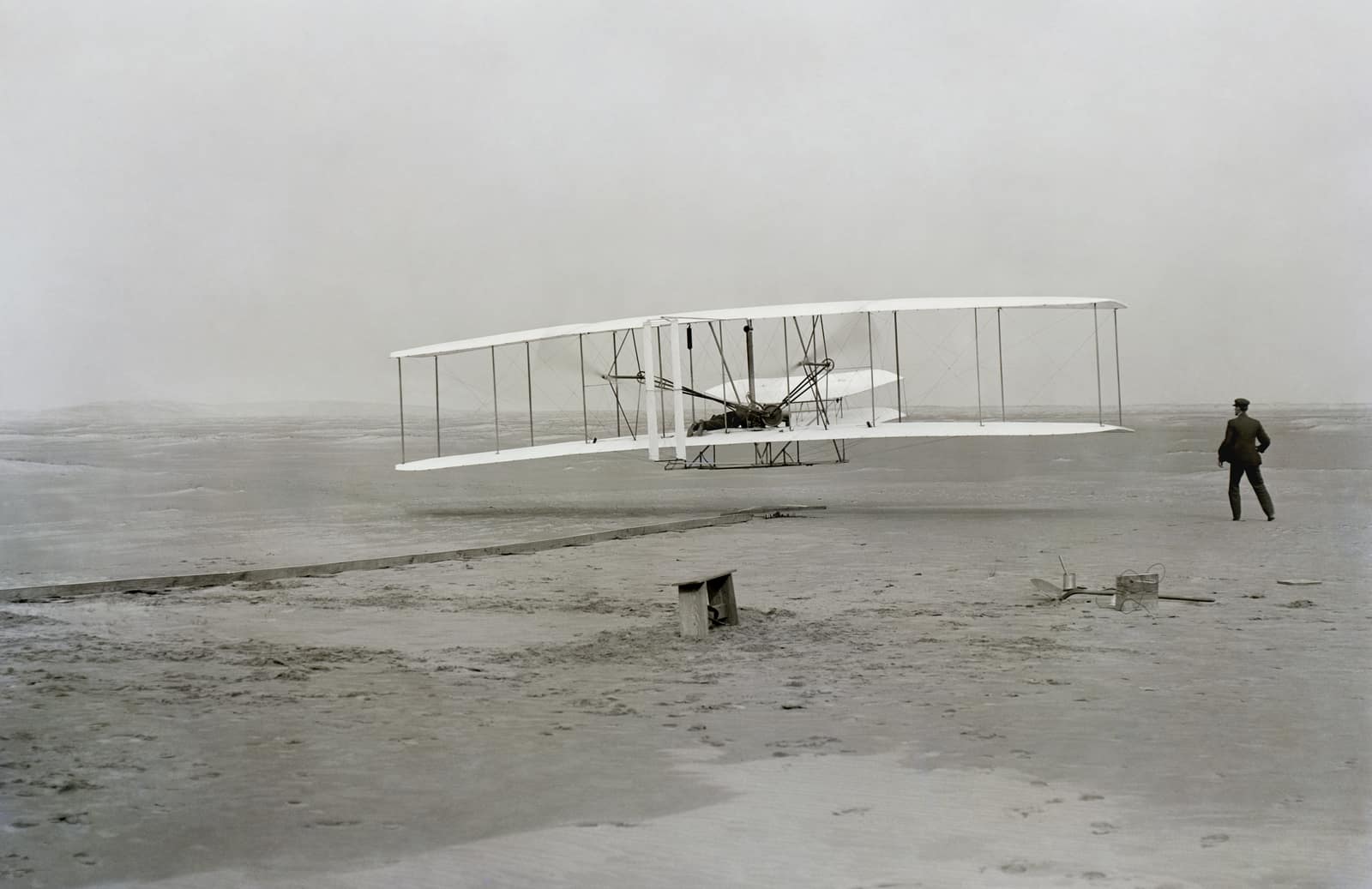
John T. Daniels, 1903, Library of Congress, domaine publicPDMOriginal record
Data saver is on. Images load only when you ask. You can change this in Settings at any time.
From the archivist
Twelve seconds. That is how long the first flight lasted, and it was enough.
On a winter morning at the edge of the Atlantic, on sand scoured by the wind, two brothers who made bicycles in Ohio laid a wooden rail along the ground. On it rested a machine of wood and muslin, driven by an engine made in their own shop. Orville lay flat on the lower wing. Wilbur ran beside him, steadying a wing, and let go.
A man from the nearby lifesaving station, standing where Orville had placed the camera, pressed the bulb at the moment the machine left the rail. It came down some thirty-six metres away. Before the morning was over the brothers had flown four times, the last for nearly a minute. Then the wind turned the machine over, and it never flew again.
Six and a half decades later, men of the same civilization walked on the Moon.
Established
- On 17 December 1903, at 10:35 a.m., at Kill Devil Hills near Kitty Hawk, North Carolina, Orville Wright flew the Flyer for 12 seconds over 120 feet (36 m) (Smithsonian National Air and Space Museum; Library of Congress).
- The brothers made four flights that morning, taking turns; the last, with Wilbur at the controls, covered 852 feet (255.6 m) in 59 seconds. Soon after, a gust of wind overturned the aircraft, which was badly damaged and never flew again (Smithsonian National Air and Space Museum).
- The Flyer has a wooden frame covered with muslin, a wingspan of 12.3 m, a 12 horsepower four cylinder Wright engine, and weighs 274 kg empty (Smithsonian National Air and Space Museum).
- The photograph was taken by John T. Daniels of the Kill Devil Hills lifesaving station, with a camera that Orville had set on a tripod and told him when to trigger; the glass plate negative is in the Library of Congress (Library of Congress).
- Because of a dispute with the Smithsonian, which had long credited its former Secretary Samuel Langley, Orville lent the Flyer to the Science Museum in London in 1928; it came to Washington only on 17 December 1948, after his death (Smithsonian National Air and Space Museum).
Interpretation
Other people claimed earlier powered flights, among them Gustave Whitehead in 1901, and Alberto Santos-Dumont flew publicly in Paris in 1906; most historians accept the Wright flight of 1903 as the first powered, sustained and controlled flight of a heavier than air machine, because it was witnessed, photographed and followed by flights that were steadily improved. What was new was less the engine than the control of the machine in the air, in roll, pitch and yaw, which the brothers had worked out with gliders.
In 10,000 years
In 10,000 years, will anyone remember that we once needed twelve seconds of courage to leave the ground?
Sources (4)
- Smithsonian National Air and Space Museum. 1903 Wright Flyer, inventory number A19610048000. · airandspace.si.edu
- Library of Congress, Prints and Photographs Division. First flight, 120 feet in 12 seconds, 10:35 a.m.; Kitty Hawk, North Carolina (Wright Brothers Negatives), digital ID ppprs.00626. · www.loc.gov
- Library of Congress. First Flight, Wilbur and Orville Wright Papers at the Library of Congress, collection highlights. · www.loc.gov
- Smithsonian National Air and Space Museum. What happened to the original Wright Flyer? · airandspace.si.edu