Pearl Street Station, the first central power network in New York
Before it, electric light came from a generator in or beside the building it lit; after it, current was made in one station and sold through wires under the streets to a whole district, the pattern that electric grids would follow.
- Dated
- Place
- Lower Manhattan, New York, United States · Thomas Edison and the Edison Electric Illuminating Company of New York, with the engineers and labourers who laid its lines
- Coordinates
- 40° 42′ N · 74° 00′ W (approximate)
- Remains
- Lost
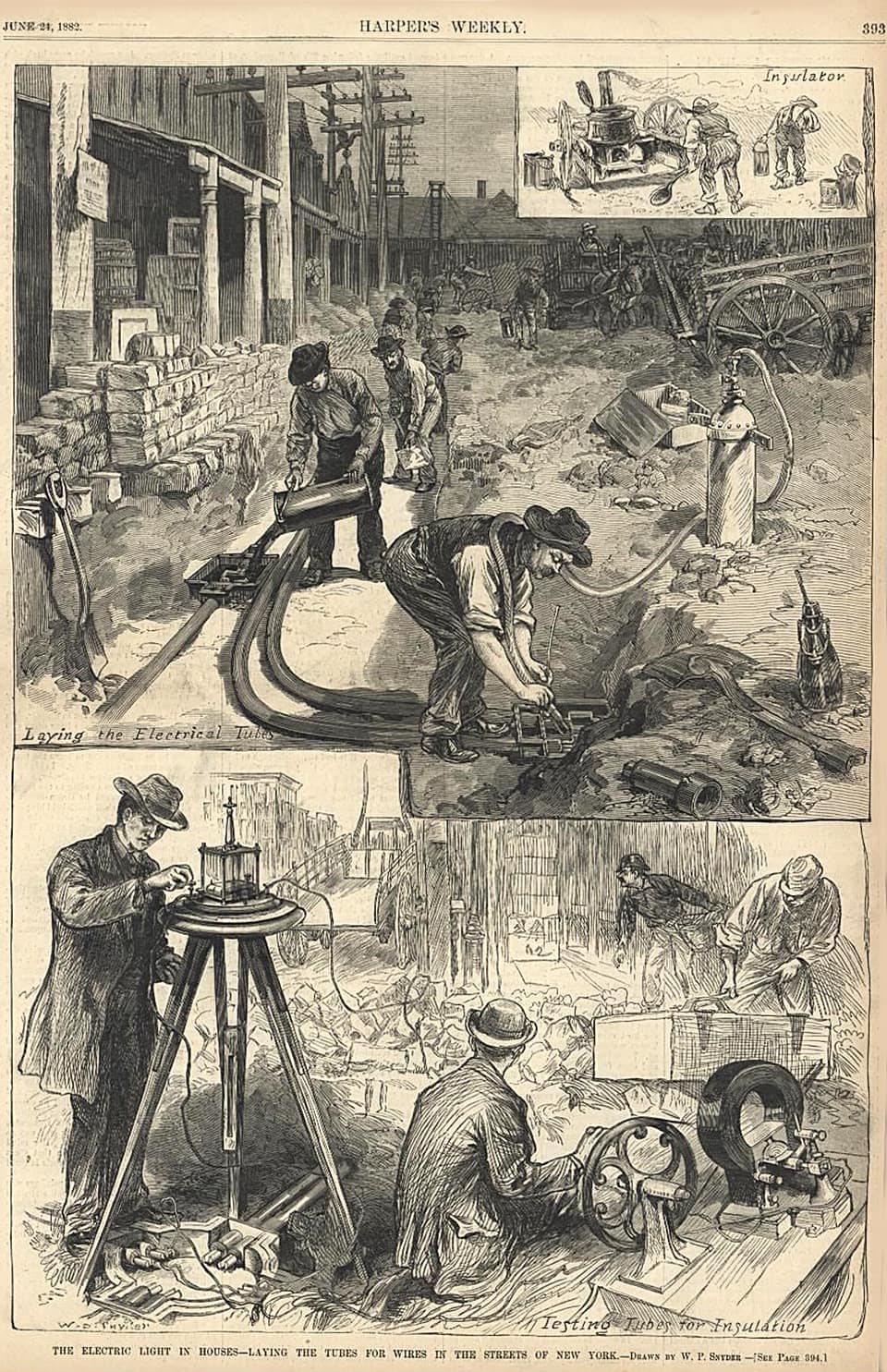

W. P. Snyder, Harper's Weekly, 1882, via Wikimedia CommonsPDMOriginal record
Data saver is on. Images load only when you ask. You can change this in Settings at any time.
From the archivist
In the early summer of 1882, the streets of Lower Manhattan were opened like wounds. Men with shovels cut trenches between the warehouses, laid long iron tubes in them, and poured a hot black compound around the copper inside to keep the current from leaking into the ground. Others followed with instruments on tripods to test each joint.
At 257 Pearl Street, a building near the East River had been filled with coal fired boilers and six great dynamos. On the afternoon of 4 September, an electrician closed the main switch on Edison's order. In offices and shops across a few dozen blocks, glass bulbs began to glow with a light that did not flicker or smell of gas.
What this civilization built here was not the lamp, nor even the machine that fed it, but the arrangement between them: power made in one place, carried under the street and sold to every building on the line. A few months earlier, the same company had tried it along a viaduct in London. Within a lifetime, the pattern covered continents.
Established
- On the afternoon of 4 September 1882 Edison's direct current station at 257 Pearl Street, New York, began supplying customers in the First District, about a quarter of a square mile of Lower Manhattan (IEEE).
- The station was driven by coal fired boilers and steam engines turning six Jumbo dynamos of about 100 kilowatts each, each able to light some 1,200 lamps, at about 110 volts (IEEE).
- Its current reached customers through about 80,000 feet of copper conductors laid underground in tubes, rather than on poles (IEEE).
- Within a year it served 513 customers with about 10,000 lamps (IEEE).
- A fire on 2 January 1890 heavily damaged the station; it was rebuilt, then retired and dismantled by 1895 (IEEE Power and Energy Magazine).
- In January 1882 Edison's company had already begun running a steam driven station at Holborn Viaduct in London, which supplied lamps along the viaduct and nearby buildings (IEEE).
Interpretation
Pearl Street is often called the first central power station, but Edison's own Holborn Viaduct plant in London had supplied public lighting since January 1882, and small public supplies existed elsewhere; Pearl Street is better described as the first complete commercial system of central generation, underground distribution and sale to paying customers. Accounts of the first day differ, giving 59 or about 85 customers and some 400 lamps.
In 10,000 years
In 10,000 years, will anyone remember that light once had to be carried into a house through a tube dug under the street?
Sources (3)
- IEEE, Engineering and Technology History Wiki. Milestones: Pearl Street Station, 1882 (dedicated 10 May 2011). · ethw.org
- IEEE Power and Energy Magazine. History: Pearl Street Station. March and April 2013. · magazine.ieee-pes.org
- Snyder, W. P. The electric light in houses: laying the tubes for wires in the streets of New York. Harper's Weekly, 24 June 1882, page 393.
Related fragments
1800
Volta's pile, the first electric battery
Como, Lombardy, Italy · Europe
1876
The telephone: a patent and a sentence
Boston, Massachusetts, United States · Americas
1947
The transistor
New Providence, New Jersey, United States · Americas