Volta's pile, the first electric battery
Before it, electricity could be gathered and released only as a single spark; after it, a steady current could be drawn at will, and every battery since descends from this stack of discs.
- Dated
- Place
- Como, Lombardy, Italy · Alessandro Volta, professor of natural philosophy at the University of Pavia, writing from Como to the Royal Society of London
- Coordinates
- 45° 49′ N · 9° 04′ E (approximate)
- Remains
- Fragmentary
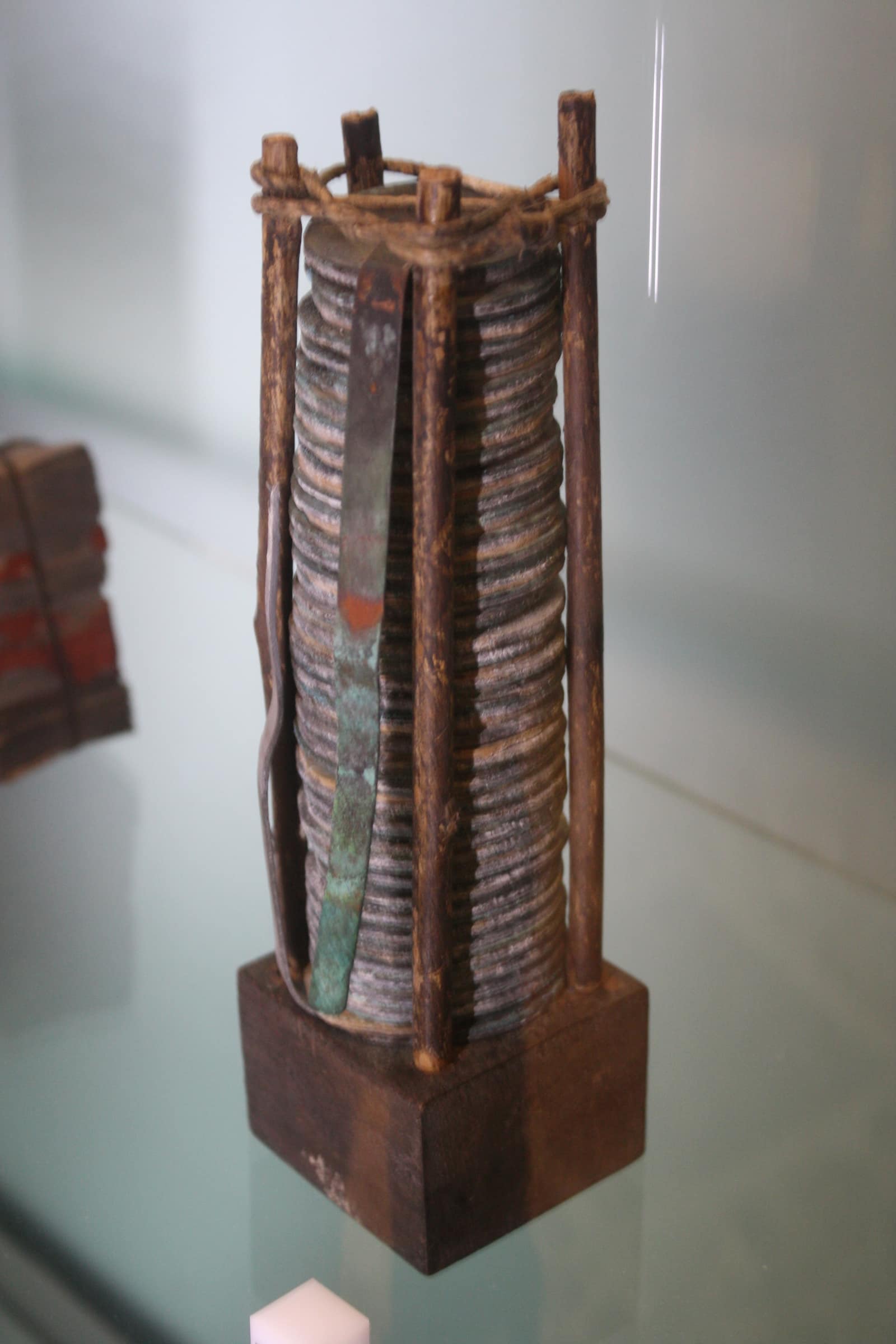

Dario Crespi, CC BY-SA 4.0, via Wikimedia CommonsCC-BY-SA-4.0Original record
Data saver is on. Images load only when you ask. You can change this in Settings at any time.
From the archivist
Until the spring of 1800, this civilization knew electricity only as a spark: a crack from a glass jar, a flash from the sky, gone as soon as it came.
In Como, on the shore of a lake in Lombardy, a professor named Alessandro Volta piled small discs one on another. A disc of silver, a disc of zinc, a round of cardboard wetted with salt water; then silver, zinc, cardboard again, twenty, forty, sixty times. When he touched the two ends of the column with wet fingers he felt a small, repeated shock, and it did not run out.
He described it in French, in a letter dated 20 March and addressed to the President of the Royal Society in London. Before the letter was even read aloud there, men in London had built copies and passed the current through water, which divided into two gases.
From this stack of metal and wet cloth came electrochemistry, the telegraph, and in time every battery the people of this world would carry. The unit that measures its push still bears his name.
Established
- On 20 March 1800 Alessandro Volta, professor at the University of Pavia, dated a letter in French to Sir Joseph Banks, President of the Royal Society of London, describing a new electrical apparatus (Royal Society, L&P/11/137).
- The letter was read to the Royal Society on 26 June 1800 and published that year in the Philosophical Transactions, volume 90, pages 403 to 431 (Royal Society).
- The apparatus was a column of pairs of discs of two different metals, silver or copper with zinc, each pair separated by cardboard or cloth soaked in water or brine; it gave a continuous current rather than a single discharge (Philosophical Transactions, 1800).
- In the same letter Volta described a second form, a row of cups of salt water linked by metal strips, which he called a crown of cups (Philosophical Transactions, 1800).
- Many of Volta's instruments were destroyed by fire at the Como exhibition of 1899; the Tempio Voltiano in Como, opened in 1928, keeps those that survived, with copies of some that were lost.
Interpretation
Volta built the pile to settle a quarrel with Luigi Galvani, who held that the twitching of frog legs revealed an electricity proper to living tissue; Volta argued that the contact of two different metals was enough. Both were partly right, and the chemical source of the current was understood only later. Whether the pile shown in Como is one Volta himself made, or a copy, is not always clear from the displays.
In 10,000 years
In 10,000 years, will anyone still carry a stored current in a pocket, and know that it began with a stack of coins and wet cloth?
Sources (3)
- Volta, A. On the electricity excited by the mere contact of conducting substances of different kinds. In a letter to the Rt. Hon. Sir Joseph Banks. Philosophical Transactions of the Royal Society of London, 90 (1800), 403 to 431. · doi.org
- The Royal Society, Science in the Making. Letter, Account of electricity excited by contact and conducting substances of different kinds, from Alessandro Volta to Joseph Banks, 20 March 1800, L&P/11/137. · makingscience.royalsociety.org
- Smithsonian Libraries and Archives. On the electricity excited by the mere contact of conducting substances of different kinds (digitised copy of the 1800 offprint). · library.si.edu
Related fragments
1882
Pearl Street Station, the first central power network in New York
Lower Manhattan, New York, United States · Americas
1876
The telephone: a patent and a sentence
Boston, Massachusetts, United States · Americas
1858 to 1866
The cable under the Atlantic
Valentia Island, County Kerry, Ireland; and Heart's Content, Newfoundland and Labrador, Canada · Europe
1947
The transistor
New Providence, New Jersey, United States · Americas