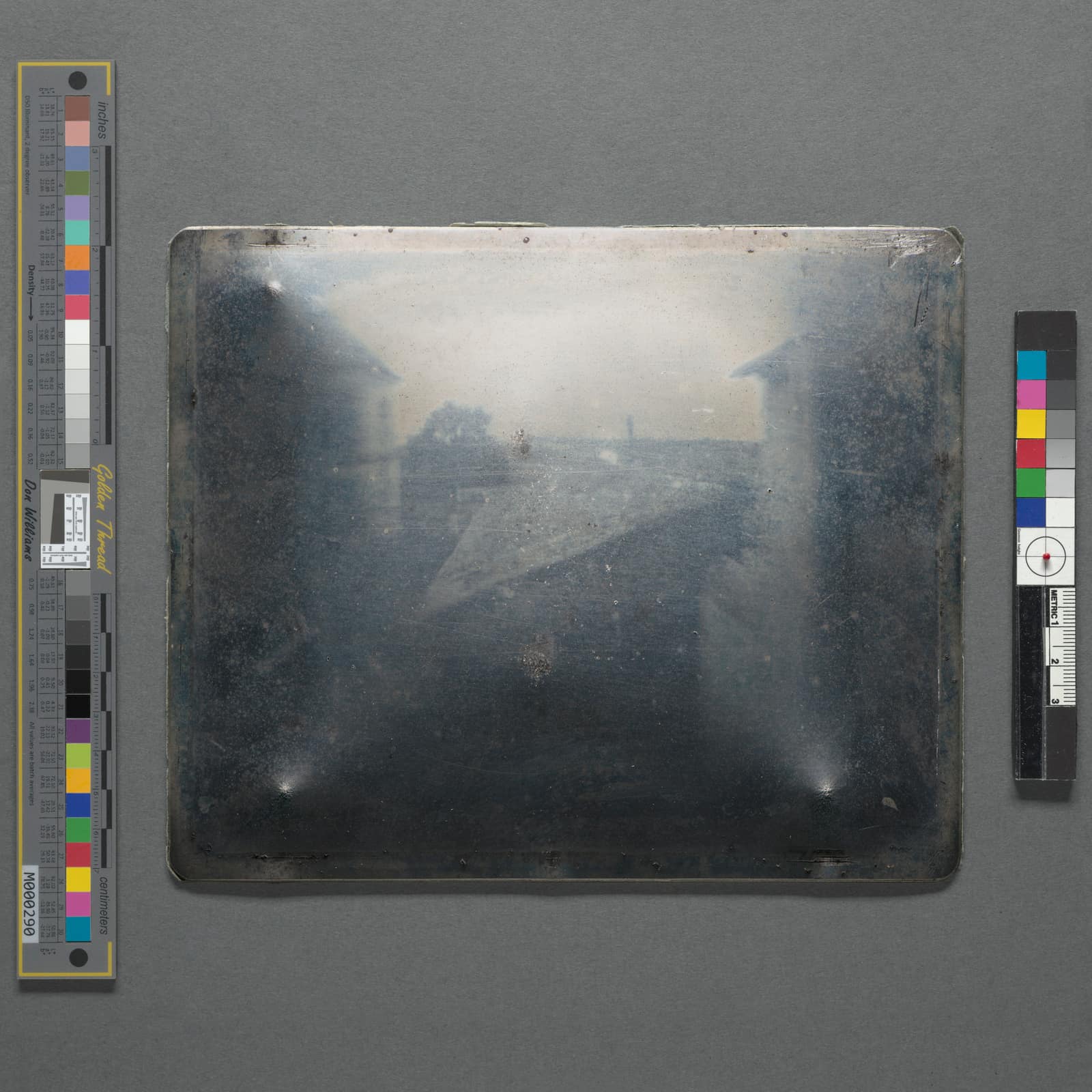
The first photograph from a camera: the view from the window at Le Gras
Before this plate, every image of the world passed through a human hand; after it, light itself could fix a scene, and the way humanity records and remembers began to change.
- Dated
- Place
- Saint-Loup-de-Varennes, Saône-et-Loire, France · Nicéphore Niépce, inventor, at his family estate in Burgundy
- Coordinates
- 46° 43′ N · 4° 52′ E (approximate)
- Remains
- Intact
,_Ni%C3%A9pce_1827_%E2%80%94_HRC_2020.jpg)
Nicéphore Niépce, domaine public ; photographie Harry Ransom Center, via Wikimedia CommonsPDMOriginal record
Data saver is on. Images load only when you ask. You can change this in Settings at any time.
From the archivist
You may need to tilt your head. The image is there, in the dark mirror of the plate, but it only appears when the light strikes it at the right angle: a roof on the left, another on the right, a pale sky between them, a tree.
It is what Nicéphore Niépce saw from an upper window of his house in Burgundy. He had spread a thin coat of bitumen, a kind of natural tar, on a plate of polished pewter and set it at the back of a camera, a box with a lens. Then he waited, perhaps a whole day, perhaps several. Where the light struck, the bitumen hardened. The rest he washed away.
Nothing in this image was drawn. No hand chose where the shadows would fall. For the first time known to this archive, the world had written its own picture, and the picture stayed.
In the two centuries that followed, this civilization learned to do the same thing in a fraction of a second, and then billions of times a day.
Established
- Nicéphore Niépce made the plate in 1826 or 1827 at Le Gras, his family estate at Saint-Loup-de-Varennes in Burgundy, from an upstairs window looking onto the courtyard, outbuildings and trees (Harry Ransom Center).
- He dissolved light-sensitive bitumen in oil of lavender, coated a polished pewter plate with it and exposed it in a camera obscura; the bitumen hardened where light fell, and the rest was washed away with a solvent of lavender oil and white petroleum (Harry Ransom Center; Brown 2002).
- The plate measures 16.7 by 20.3 cm and is the earliest photograph made with a camera that is known to survive (Harry Ransom Center).
- Niépce called his process heliography; in 1827 he took the plate to England, where the botanical artist Francis Bauer recorded the inventor's name on the paper backing of its frame (Brown 2002).
- After London exhibitions around 1900 it lay forgotten for half a century, until Helmut Gernsheim established its history in 1952; the Harry Ransom Center acquired it in 1963 (Harry Ransom Center).
Interpretation
The length of the exposure is uncertain: it has long been given as about eight hours, but the Ransom Center and several researchers now speak of several days, which would explain why sunlight seems to fall on both sides of the courtyard. Whether it is the first photograph at all depends on the definition: Niépce had fixed images earlier by contact with engravings, and his first camera images, on paper around 1816, could not be fixed. The famous reproduction seen in books is a retouched copy made in 1952, not the plate itself.
In 10,000 years
In 10,000 years, when the images we make every second have faded or been lost, will this one still hold its roofs and its tree?
Sources (3)
- Harry Ransom Center, The University of Texas at Austin. The Niépce Heliograph. · www.hrc.utexas.edu
- Brown, B. The first photograph. The Abbey Newsletter 26 (3), 2002. · cool.culturalheritage.org
- Harry Ransom Center. First photograph to travel to Europe for first time in 50 years, press release, 2012. · www.hrc.utexas.edu
Related fragments
c. 1455 CE
The Gutenberg Bible
Mainz, Rhineland-Palatinate, Germany · Europe
1969
The first footprints on the Moon
Tranquility Base, Sea of Tranquility, the Moon · Americas