The Gutenberg Bible
- Dated
- Place
- Mainz, Rhineland-Palatinate, Germany · Printers of Mainz in the Holy Roman Empire: Johannes Gutenberg and his partners
- Coordinates
- 50° 00′ N · 8° 16′ E (approximate)
- Remains
- Fragmentary
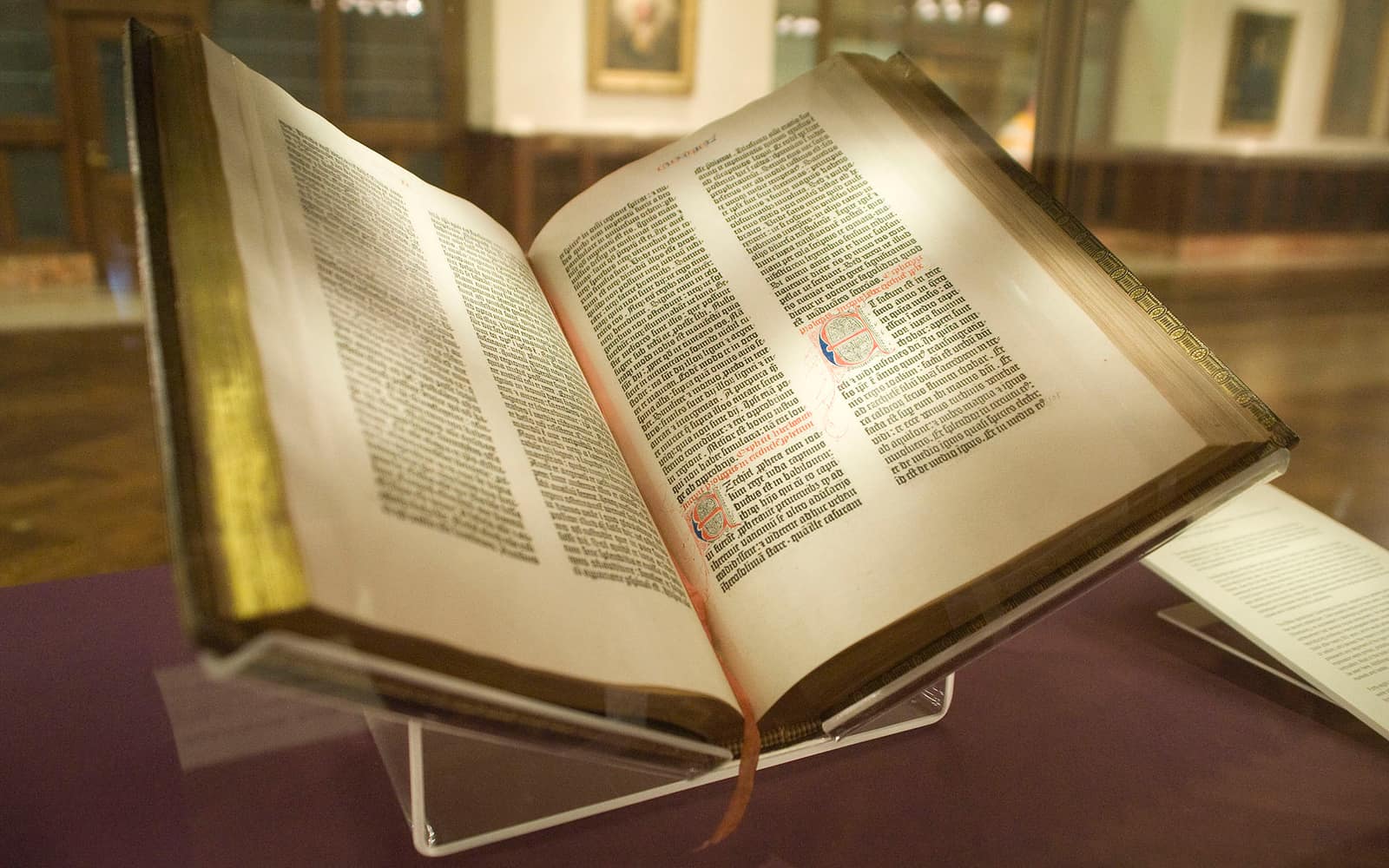

NYC Wanderer (Kevin Eng), CC BY-SA 2.0, via Wikimedia CommonsCC-BY-SA-2.0Original record
Data saver is on. Images load only when you ask. You can change this in Settings at any time.
From the archivist
Before this, every book in Europe was written by a hand. Then, in a workshop in Mainz, a man of the city trained in metalwork found a way to make the hand repeat itself.
Johannes Gutenberg cast letters one by one in metal from a small mould, set them in lines, inked them with a sticky black made with oil, and pressed paper and vellum against them with a screw, like a wine press. The text he chose was the Latin Bible that the churches of Europe read aloud. Two columns to a page, forty two lines to most columns, some 1,280 pages in two volumes.
The pages came off the press bare of colour. Buyers had red headings and painted initials added by hand, so that each copy looks a little different, as if printing had not quite dared to replace the scribe.
A visitor to Frankfurt in 1455 wrote that the letters were so clean one could read them without spectacles. Perhaps 180 copies were made. Within fifty years, printing presses were working in more than two hundred European towns.
Established
- The Bible was printed in Mainz in 1454 and 1455 in the workshop of Johannes Gutenberg, with the backing of Johann Fust; it is also called the 42 line Bible, after the number of lines in most of its columns (Library of Congress).
- In a letter of 12 March 1455, Enea Silvio Piccolomini, the future Pope Pius II, reported having seen sections of it at Frankfurt, clean and legible, and wrote that buyers were said to be ready before the volumes were finished (Library of Congress).
- Perhaps as many as 180 copies were printed, about a quarter of them on vellum and the rest on paper (Library of Congress).
- It was printed with movable metal type cast in a hand mould, an oil based ink and a screw press; red headings, initials and decoration were added by hand after printing (White 2018).
- About 49 copies survive, complete or in part (White 2018).
Interpretation
Gutenberg was not the first to print with movable type: it had been used in China and Korea centuries earlier. What was new in Mainz was the combination of type casting, ink and press that made long runs cheap in an alphabet of few letters. How much the Reformation, modern science and the nation state owe to this machine is still argued; that print changed who could own a book is not.
In 10,000 years
In 10,000 years, will the book still be the form in which we keep what we hold sacred?
Sources (5)
- Library of Congress. The Gutenberg Bible at the Library of Congress: a resource guide. · guides.loc.gov
- The Morgan Library & Museum. Three Gutenberg Bibles. · www.themorgan.org
- Füssel, S. Gutenberg and the Impact of Printing. Aldershot, Ashgate, 2005.
- White, E. Editio princeps: A History of the Gutenberg Bible. London and Turnhout, Harvey Miller, 2017.
- White, E. The Gutenberg Bible, 550 Years after Gutenberg. The Bible and Interpretation, University of Arizona, 2018. · bibleinterp.arizona.edu
Related fragments
1377 CE
The Jikji
Cheongju, North Chungcheong, Republic of Korea; the book is in Paris · Asia
868 CE
The Diamond Sutra of 868
Mogao Caves, Dunhuang, Gansu, China · Asia
895 CE
The Clarke Plato
Istanbul, Türkiye · Europe